

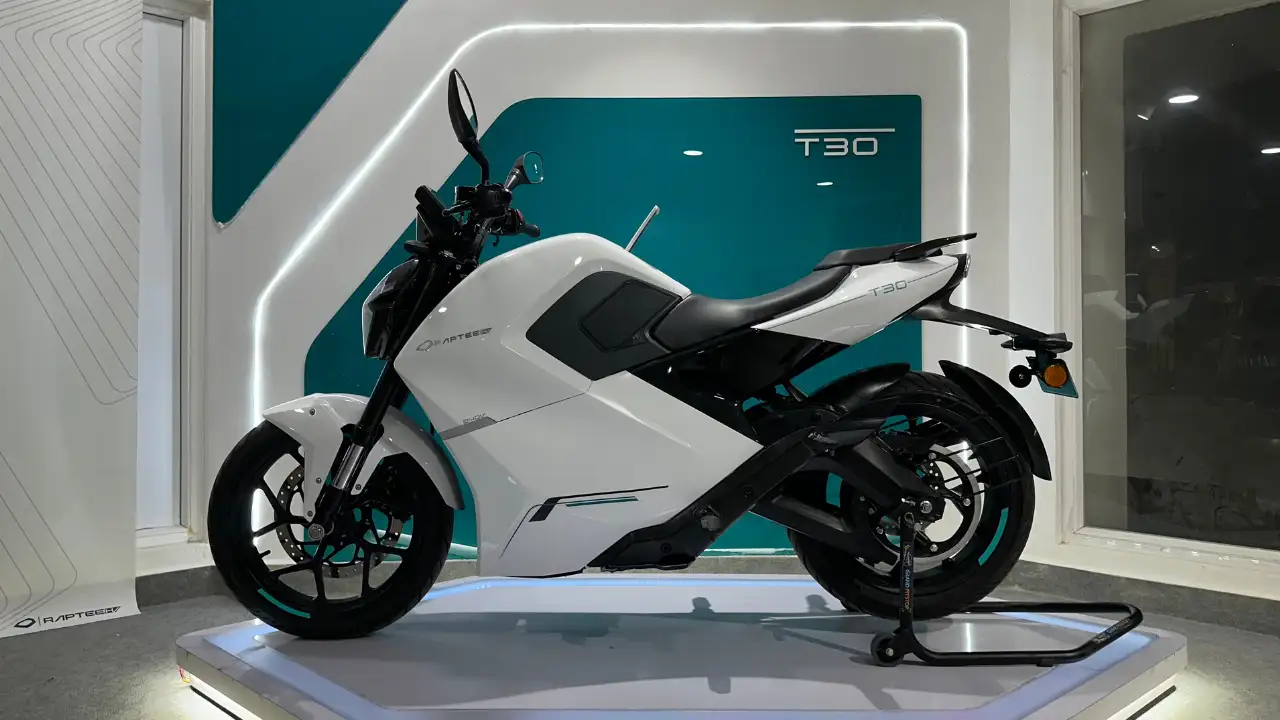

Revolutionizing the EV Motorcycle Market with High-Voltage Innovation
The electric motorcycle industry is witnessing a groundbreaking transformation, as Indian startup Raptee.HV introduces the Raptee T30, the first 240V high-voltage electric motorcycle. With this pioneering technology, Raptee aims to redefine the EV two-wheeler landscape, offering faster charging, superior efficiency, and performance comparable to conventional 300cc internal combustion engine (ICE) motorcycles.
For years, the electric two-wheeler segment in India has been dominated by scooters, leaving motorcycles with limited innovation. While scooters typically operate on low-voltage 48V-72V systems, motorcycles demand higher power output and range. The Raptee T30’s 240V architecture represents a paradigm shift, offering rapid charging, enhanced range, and optimized performance.
How Raptee’s 240V Architecture Differs from Conventional EV Motorcycles
Most electric motorcycles in the market currently operate on a low-voltage system, usually within the 60V range. While this works well for short-range commuting, it comes with significant drawbacks such as slower charging, thermal inefficiencies, and limited power output. The Raptee T30 breaks this mold with its high-voltage 240V system, similar to what is seen in electric cars.
Key Advantages of a 240V High-Voltage System
- Faster Charging – Compatible with CCS2 fast-charging technology, reducing charge times significantly.
- Higher Power Output – The 22kW motor delivers 30 bhp and 70Nm torque, comparable to a 300cc petrol bike.
- Improved Efficiency – Reduced heat generation improves energy efficiency and battery longevity.
- Lighter Components – A high-voltage system minimizes the need for large heat sinks and complex electronics.
- Extended Range – Achieves an ARAI-certified 200 km range, with real-world performance of 150 km per charge.
Dinesh Arjun, CEO and Founder of Raptee.HV, emphasized in a recent interview that the low-voltage approach often requires heavy thermal management solutions, making production costlier and complex. The T30’s high-voltage system eliminates these issues, allowing for greater affordability without compromising on performance.
Performance & Riding Experience: Bridging the Gap with Petrol Motorcycles
One of the biggest criticisms of early electric motorcycles has been their lack of power and engagement compared to traditional ICE bikes. However, the Raptee T30 challenges this perception with impressive performance metrics.
- Motor Output: 22 kW (equivalent to 30 bhp)
- Torque: 70 Nm, ensuring swift acceleration
- Top Speed: Estimated 135 km/h
- Acceleration: 0-60 km/h in under 4 seconds
With this level of performance, the T30 is capable of matching or even exceeding many petrol-powered motorcycles in the 250cc-300cc segment.
CCS2 Fast-Charging: A Game-Changer for Electric Motorcycles
Charging infrastructure has been a major hurdle for EV adoption. Many low-voltage motorcycles require bulky 8-9 kg chargers that owners must carry around, making long-distance travel impractical. The Raptee T30 solves this by adopting CCS2 fast-charging, an industry-standard used by electric cars.
Charging Times:
- Public CCS2 Charger: 0-80% in just 36 minutes.
- Home Charger: 0-80% in 1 hour.
This revolutionizes convenience, allowing riders to charge their bike quickly at public charging stations, much like electric cars.
Enhanced Range & Efficiency: Designed for Long-Distance Travel
A key concern for riders considering electric motorcycles is range anxiety. While most electric scooters manage around 80-120 km per charge, the Raptee T30 delivers:
- ARAI-Certified Range: 200 km
- Real-World Range: 150 km per charge
- Consistent Performance in All Modes – Unlike many EV motorcycles, the Raptee T30 maintains a similar range whether in Eco, Normal, or Sport mode.
This ensures that riders can enjoy high-speed riding without the constant worry of losing battery power.
Thermal Management & Efficiency Gains with High Voltage
One of the biggest challenges with low-voltage EVs is heat dissipation. When motorcycles use 60V batteries, they require large cooling solutions, making them bulkier and less efficient. The T30’s 240V architecture resolves this issue by:
- Reducing heat generation, leading to better efficiency.
- Eliminating large heat sinks, making the bike lighter.
- Increasing battery lifespan by ensuring less thermal stress on individual cells.
This technical advantage makes the Raptee T30 a more sustainable, long-lasting electric motorcycle.
Cutting-Edge Software: AI-Driven Predictive Maintenance
Beyond its hardware innovations, Raptee is also integrating advanced software solutions to enhance the riding experience and after-sales service. The T30 is powered by an automotive-grade quad-core processor with five microcontrollers dedicated to:
- Throttle and braking management
- Battery health monitoring
- On-device analytics to predict component wear
On-Device Data Processing & Edge Analytics
Unlike fleet-based electric two-wheelers, which rely on cloud-based analytics, the Raptee T30 processes real-time data directly on the bike. This:
- Identifies potential failures before they happen.
- Notifies riders about necessary maintenance.
- Enhances customer satisfaction by reducing service disruptions.
This AI-driven approach is designed to reduce post-sale issues, making the T30 more reliable and easier to maintain over the long run.
The Future of High-Voltage Electric Motorcycles
Raptee’s innovation has set a new benchmark in the electric motorcycle industry. Several major manufacturers are now considering high-voltage platforms for their upcoming models, with a timeline of 2028-2029 for mass adoption.
Why is the industry shifting to high-voltage?
- Scalability: High-voltage technology enables better performance at a lower cost.
- Infrastructure Compatibility: Standardization with public CCS2 chargers makes EVs more practical.
- Performance Parity with Petrol Motorcycles: The gap between ICE and EV motorcycles is closing.
A Shift in the EV Two-Wheeler Market
For years, the EV motorcycle market in India has been overshadowed by electric scooters. While brands like Ather, Ola, and Bajaj have led in the scooter segment, very few companies have focused on electric motorcycles. The Raptee T30 marks a turning point, proving that electric motorcycles can be both powerful and practical.
Will Other Companies Follow Raptee’s Lead?
With Raptee pioneering high-voltage technology, it is expected that other leading EV manufacturers will follow suit. Major players like Ultraviolette, Revolt, and Tork Motors may adopt similar architectures, making high-voltage electric motorcycles the industry standard in the coming years.

Deependra Singh Chundawat is a Senior Sub-Editor at Udaipur Kiran, specializing in a wide range of technology topics including mobile phones, applications, gaming, PCs, and wearables. Along with covering the latest tech news, he also creates engaging web stories. Passionate about emerging technologies, he stays up to date with the newest trends and enjoys reading and writing about the latest mobile launches and digital innovations.