

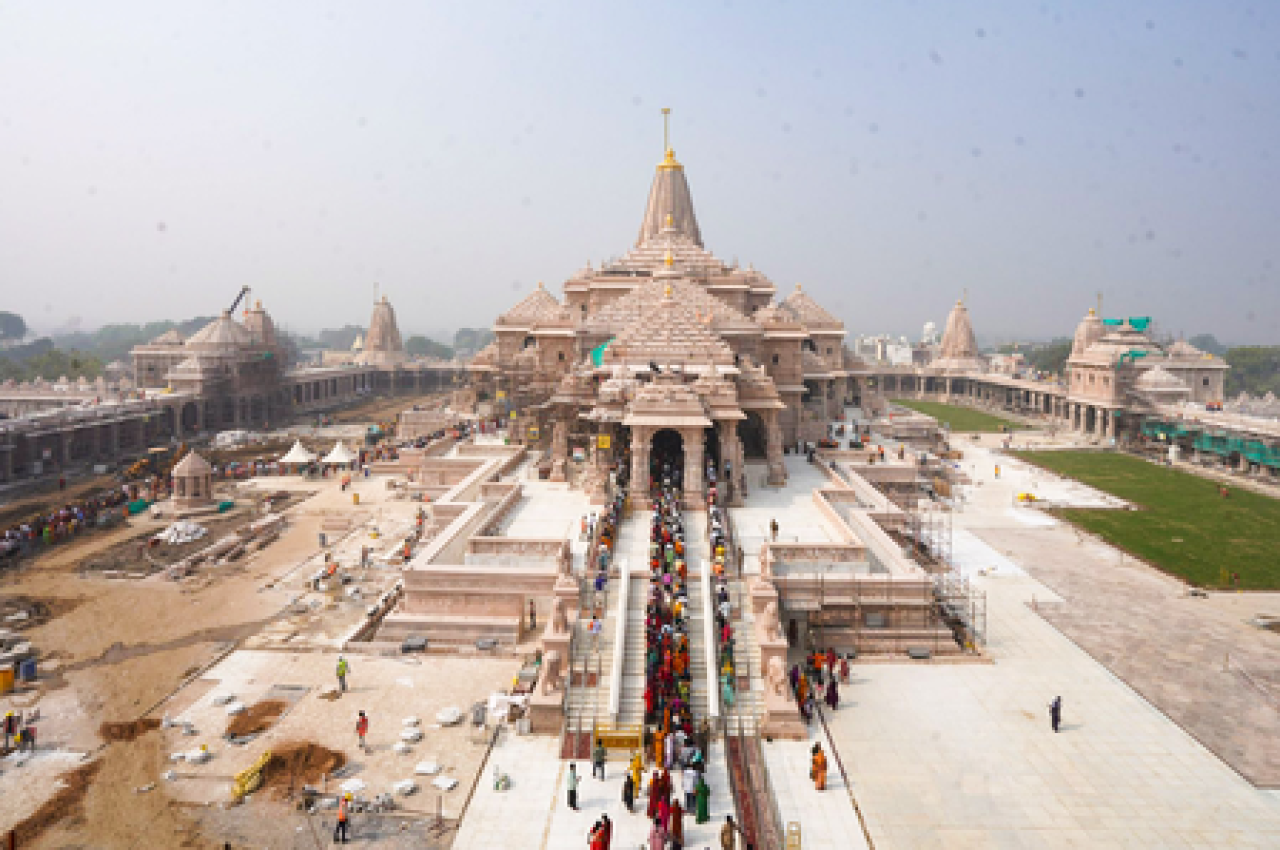

Lucknow, February 17: Under the guidance of Prime Minister Narendra Modi, Chief Minister Yogi Adityanath’s ‘Temple Economy Model’ has received validation from the Indian Institute of Management Lucknow (IIM Lucknow). A recent study report titled ‘Economic Renaissance of Ayodhya’ indicates that the construction of the Ram Temple has led to significant economic activity, investment flow, and job creation in Ayodhya.
The study compares the economic conditions before and after the temple’s construction, demonstrating that religious infrastructure, when linked with thoughtful policy and administrative commitment, can act as a catalyst for regional economic growth. Since taking charge in 2017, CM Yogi has accelerated the Temple Economy, opening pathways to economic prosperity through the temple’s construction and modern infrastructure development in Ayodhya.
Before the temple’s construction, Ayodhya was primarily known as a sacred pilgrimage site, attracting around 170,000 visitors annually. Local markets operated on a small scale, with most shopkeepers earning an average daily income of ₹400-500, limiting economic activity. The presence of national hotel chains was negligible, and the railway station’s facilities were basic, while the lack of an airport affected the region’s connectivity.
Due to limited job opportunities, youth migration to larger cities became common. Revenue from tourism was not significantly contributing to the state’s broader economy, and the real estate market was stagnant. Overall, Ayodhya’s economic structure was confined to traditional pilgrimage-based activities, with clear underdevelopment in expansion and investment potential.
According to the study, after the consecration of Ram Lalla in January 2024, Ayodhya’s economic landscape changed rapidly. The report states that over 110 million devotees were recorded within the first six months, injecting new energy into local markets, transportation, and hospitality sectors. Ayodhya is now projected to attract 50-60 million visitors annually, positioning it among the country’s leading religious tourism centers. Approximately ₹85,000 crore worth of redevelopment projects are underway, impacting not just infrastructure but also the investment and service sectors.
Significant investments are being made in infrastructure, including an international airport, modern railway station, expanded road networks, and urban beautification projects. Initiatives promoting sustainable urban development, such as electric vehicles and solar energy, are also being encouraged, moving Ayodhya towards becoming a “Model Solar City.”
IIM’s report estimates that by 2025, tourism spending in Uttar Pradesh will exceed ₹4 lakh crore, with Ayodhya playing a crucial role. Revenue from tourism-related activities is expected to reach ₹20,000-25,000 crore. Job opportunities in hospitality, construction, transportation, and service sectors have expanded rapidly. Ayodhya has also gained a new identity as a national and international spiritual hub, attracting NRIs, researchers, and global devotees.
The study indicates that according to the Confederation of All India Traders (CAIT), the temple consecration has generated over ₹1 lakh crore in business nationwide, with Ayodhya’s contribution being significant. The daily arrival of over 200,000 devotees has revitalized the hospitality and related industries. More than 150 new hotels and homestays have been established, while renowned hotel chains like Taj Hotels, Marriott International, and Wyndham Hotels and Resorts have announced expansion plans in Ayodhya. Online travel platform bookings for Ayodhya have quadrupled, and there has been a surge in demand for local handicrafts, religious souvenirs, and idols, directly benefiting artisans and local producers.
According to the IIM report, the impact of economic activity is also evident in entrepreneurship and job creation, particularly among the youth. Approximately 6,000 micro, small, and medium enterprises (MSMEs) have either been newly established or have returned to Ayodhya. It is estimated that in the next 4-5 years, tourism growth will create around 120,000 direct and indirect jobs in the tourism, transportation, and hospitality sectors. Daily earnings for small vendors and street vendors have reached up to ₹2,500. The real estate sector has also seen rapid growth, with property values around the temple increasing five to tenfold, attracting investors from across the country.
The report suggests that Ayodhya’s development is no longer limited to religious significance but has emerged as a robust center for regional economic activities. The study highlights that a development model based on religious heritage, when implemented with systematic investment, administrative coordination, and a long-term vision, can bring about extensive and structural changes in the local economy. Ayodhya’s experience illustrates that cultural and religious projects can serve as a foundation for multi-layered economic growth by accelerating tourism, employment, and private investment through planned implementation. Significant changes in infrastructure, tourism facilities, and the investment environment have positioned this pilgrimage town at the forefront of development.

My name is Kuldeep Singh Chundawat. I am an experienced content writer with several years of expertise in the field. Currently, I contribute to Daily Kiran, creating engaging and informative content across a variety of categories including technology, health, travel, education, and automobiles. My goal is to deliver accurate, insightful, and captivating information through my words to help readers stay informed and empowered.