

Greek authorities have initiated emergency measures following an intensifying earthquake swarm near Santorini, a region with a history of seismic and volcanic activity. The tremors, which began last week, have increased in frequency and magnitude, prompting officials to close schools and deploy emergency teams.
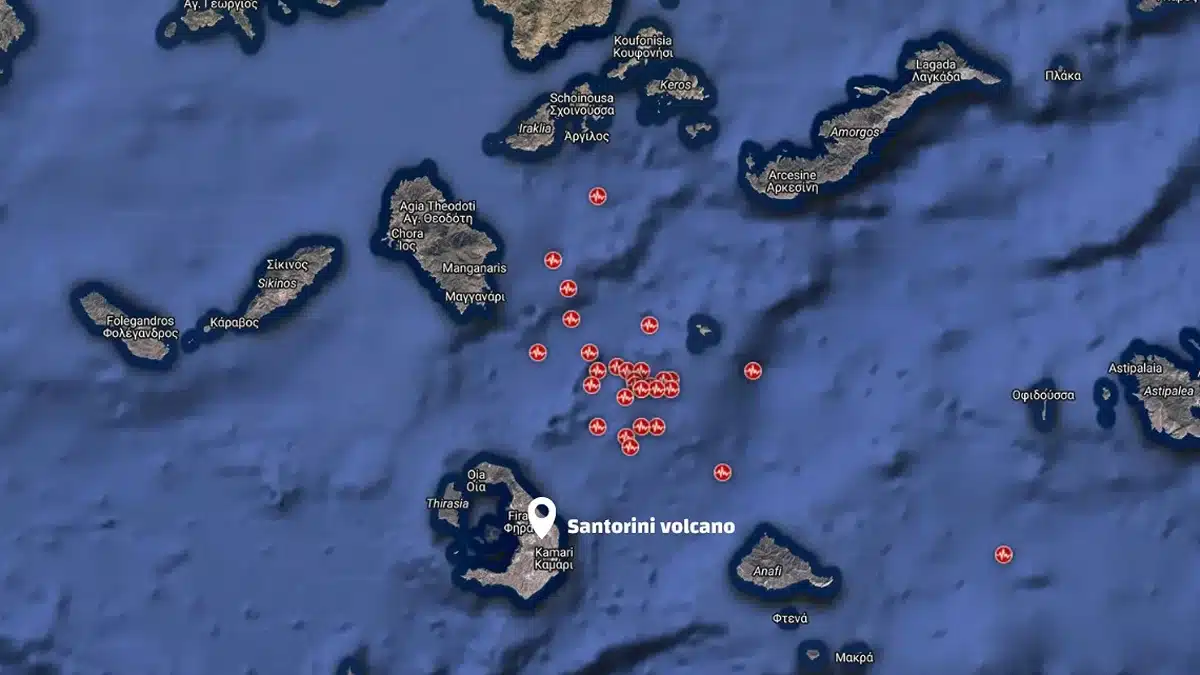
While experts have ruled out immediate volcanic activity, the unusual nature of the swarm raises concerns about potential stronger earthquakes in the region. The largest recorded tremor so far was a magnitude 5 earthquake, which struck 34 kilometers northeast of Santorini at 2:27 p.m. local time, as reported by the University of Athens’ earthquake monitoring system.

Seismic Activity Linked to Fault Movements, Not Volcanic Unrest
Seismologists attribute the ongoing tremors to fault movements rather than volcanic activity. Santorini, located on the Aegean Sea’s tectonic boundary, sits atop the exposed section of the Santorini caldera, a submerged volcanic system.
Expert Analysis
- David Pyle, Professor of Earth Sciences at the University of Oxford, explained that the earthquakes are most likely caused by tectonic shifts along fault lines rather than magma movement.
- He described the swarm as highly unusual, emphasizing the difficulty in predicting future seismic developments, especially due to its underwater location.
Historical Earthquake Swarms and Regional Tectonics
The Aegean region is seismically active, largely due to the African tectonic plate moving beneath the Eurasian plate.
Past Seismic Activity Near Santorini
- 2011-2012 Earthquake Swarm: Previously linked to magma movement beneath Santorini, but not leading to an eruption.
- Kolumbo Volcano’s 1650 Eruption: This underwater volcano triggered a devastating tsunami affecting nearby islands.
Current Swarm’s Unique Characteristics
Unlike the 2011-2012 swarm, the current seismic activity appears more extensive and is centered outside the Santorini caldera, between the underwater Kolumbo volcano and Anydros Island.
Monitoring and Emergency Measures
Greek authorities, along with seismologists and volcanologists, continue to closely monitor the region for any signs of escalating seismic activity or volcanic unrest.
Although no immediate volcanic eruption threat has been detected, experts caution that continued seismic activity could increase the risk of stronger earthquakes, requiring continued vigilance and preparedness.

Bhupendra Singh Chundawat is a seasoned technology journalist with over 22 years of experience in the media industry. He specializes in covering the global technology landscape, with a deep focus on manufacturing trends and the geopolitical impact on tech companies. Currently serving as the Editor at Udaipur Kiran, his insights are shaped by decades of hands-on reporting and editorial leadership in the fast-evolving world of technology.