

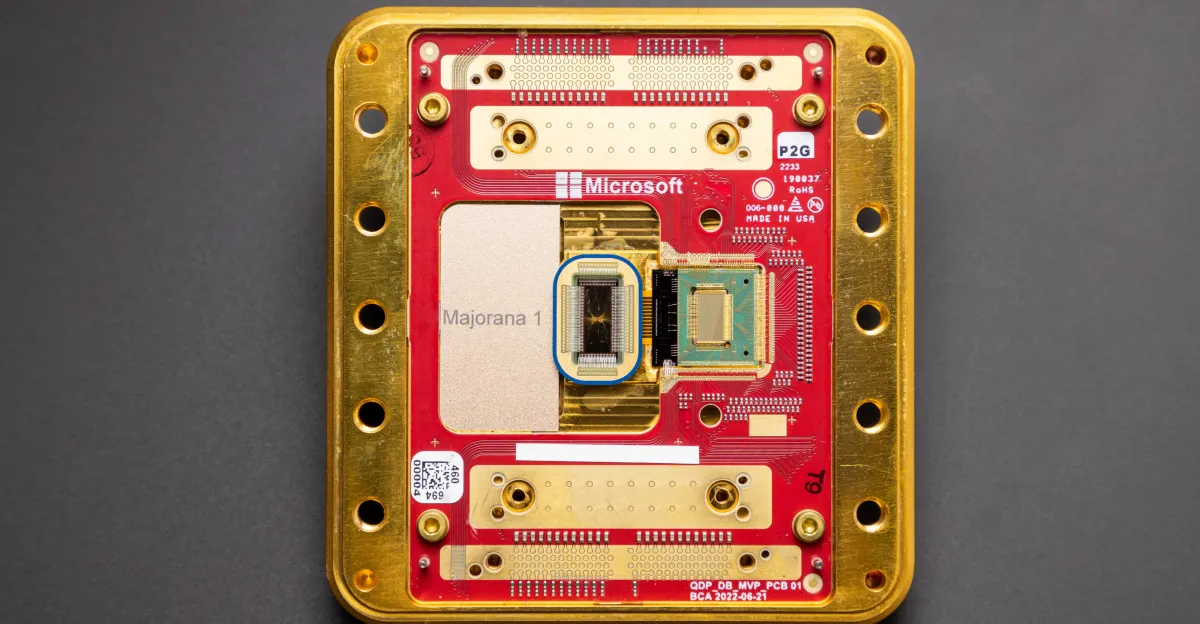
Microsoft has made a groundbreaking announcement that could potentially revolutionize the future of computing. The tech giant unveiled Majorana 1, a new quantum processing unit (QPU) powered by Topological Core technology. According to Chetan Nayak, Technical Fellow and Corporate VP of Quantum Hardware at Microsoft, Majorana 1 represents a transformative step toward practical quantum computing that could solve meaningful, industrial-scale problems within years, not decades.
In his blog post, Nayak emphasized that the new chip is a quantum leap in the field of computing, made possible by a breakthrough class of materials known as topoconductors. This material enables the creation of a topological state of matter, a theoretical concept that has now been realized for the first time. As Satya Nadella, CEO of Microsoft, explained in a post on X (formerly Twitter), the company has created an entirely new state of matter, unlocking a new class of materials that will bring fundamental change to computing.

What Makes Quantum Computing Different from Classical Computing?
Classical computing, which forms the foundation of the digital world, relies on the binary system. Information is processed in bits, which can either be 0 (off) or 1 (on). All operations are carried out by manipulating these bits, which are sequenced into binary code to represent and process information.
In contrast, quantum computing introduces the concept of qubits, which are not limited to just 0 or 1. Qubits can exist in multiple states simultaneously, thanks to the principles of superposition and entanglement. These properties allow quantum computers to perform calculations that classical computers cannot by processing many possible outcomes at once.
What Can Quantum Computers Do?
The potential applications of quantum computing are nothing short of revolutionary. Here’s how quantum computers can change the world:
🔍 Artificial Intelligence (AI): Quantum computing will accelerate AI development by providing exponential computational power, enabling better decision-making and machine learning models.
💊 Drug Discovery: Quantum algorithms will help accelerate drug development, enabling researchers to simulate molecular structures more efficiently, ultimately leading to faster breakthroughs in medicine.
🌍 Weather Forecasting: Quantum computing can handle the complex calculations needed to predict weather patterns more accurately and swiftly.
💡 Materials Research: Quantum computers can assist in creating new materials for use in everything from energy-efficient devices to sustainable construction.
By offering a solution for these complex, time-consuming problems, quantum computers promise to solve world challenges, such as climate change, that are out of reach for classical computing.
Microsoft’s Path to Quantum Computing
Microsoft’s quantum journey has taken a unique approach by focusing on topological quantum computing. The company’s Majorana 1 chip uses a newly developed material called a topoconductor, which enables the creation of a topological state. This state is distinct from traditional phases of matter (solid, liquid, gas) and provides the necessary stability for quantum bits to perform reliably.
At the heart of this quantum advancement are Majorana particles, named after physicist Ettore Majorana, who theorized their existence in 1937. These particles are hypothetical but have now been proven to be crucial for stable qubit formation. This discovery sets Microsoft’s approach apart, as Majorana particles make quantum bits far more stable than previously achieved.
Microsoft’s Role in the Quantum Race
While IBM and Google have made significant strides in quantum computing, Microsoft’s Majorana 1 chip is poised to push the envelope even further. The tech world has long anticipated quantum computing breakthroughs, but Microsoft’s new announcement shows that the shift from theory to reality is much closer than anticipated.
- Google’s quantum chip has already hinted that commercial applications of quantum computing may be just five years away.
- IBM has predicted that large-scale quantum computers will become operational by 2033.
- Microsoft’s Majorana 1 has accelerated the timeline, bringing us much closer to practical quantum computing.
With this breakthrough, Microsoft is positioning itself at the forefront of quantum computing, poised to completely transform the way we approach computing in the coming years.
The Future of Computing
The advent of quantum computing marks a major turning point in the technological landscape. Majorana 1 is not just a chip; it is the gateway to solving some of the world’s most pressing challenges, from medical discoveries to climate solutions. As Microsoft continues its journey toward practical quantum computing, the implications for science, industry, and society are bound to be profound. With quantum technology becoming more feasible, we can look forward to a future where computing truly knows no bounds.

Bhupendra Singh Chundawat is a seasoned technology journalist with over 22 years of experience in the media industry. He specializes in covering the global technology landscape, with a deep focus on manufacturing trends and the geopolitical impact on tech companies. Currently serving as the Editor at Udaipur Kiran, his insights are shaped by decades of hands-on reporting and editorial leadership in the fast-evolving world of technology.