
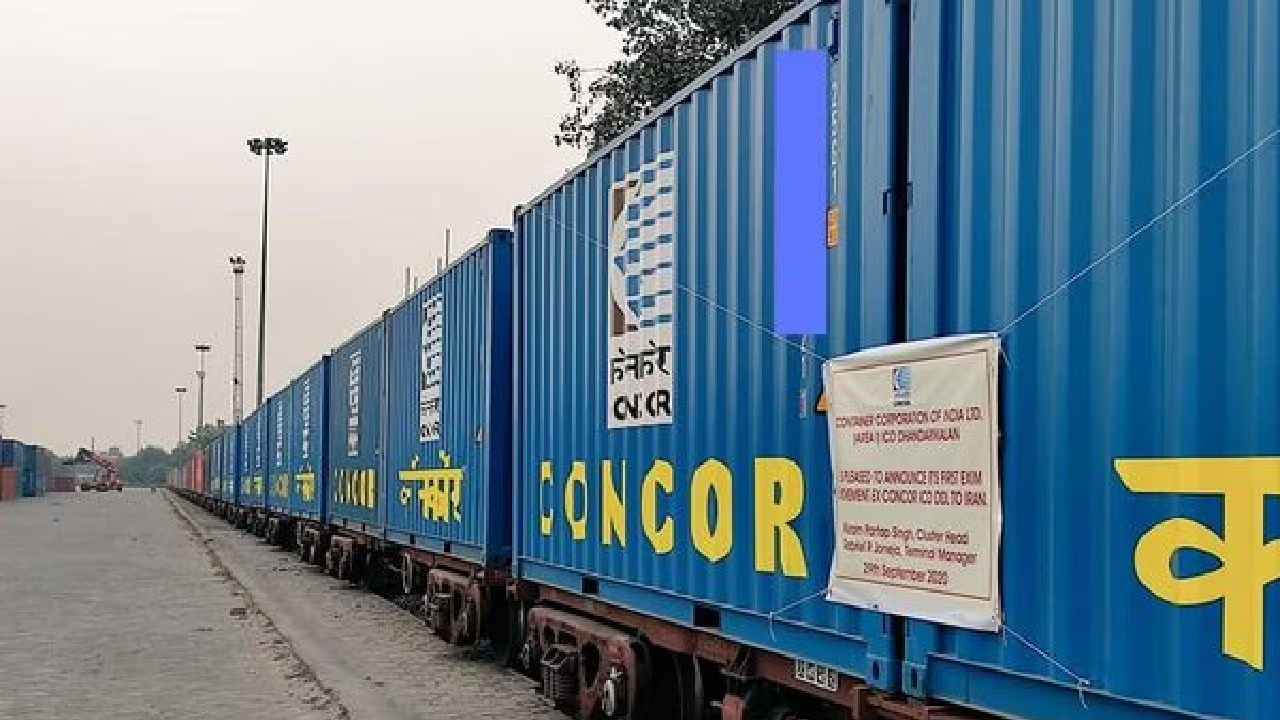
Mumbai, September 5 (Kiran News) — Shares of Container Corporation of India (CONCOR) gained on Thursday after the company announced it has signed a Memorandum of Understanding (MoU) with Bhavnagar Port Infrastructure (BPIPL) to operate and maintain the upcoming container terminal at the north side of Bhavnagar Port in Gujarat.

At 11:00 am, the stock was trading at ₹544.85, up by 0.58% from its previous close of ₹541.70 on the BSE. The scrip opened at ₹544.90 and touched an intraday high of ₹546.20 and a low of ₹543.65. Around 1,957 shares were traded on the counter.
The BSE ‘A’ group stock, with a face value of ₹5, has a 52-week high of ₹777.00 (Sept 5, 2024) and a 52-week low of ₹481.32 (Mar 3, 2025). Its current market capitalisation stands at ₹41,256.84 crore. Promoters hold 54.80% in the company, while institutional investors own 38.93% and non-institutions 6.27%.
BPIPL had earlier signed an agreement with the Gujarat Maritime Board (GMB) in September 2024 for port development. Under this, 235 hectares of land has been allotted on a 30-year lease, with provisions to expand by another 250 hectares. The port is expected to serve Central Gujarat, the Dholera Industrial Belt, and even extend logistics support to customers in the National Capital Region (NCR).
As per the MoU, CONCOR will act as the Container Terminal Operator, responsible for the operation, management, and marketing of the facility. Backed by its nationwide network of terminals and large rolling stock fleet, CONCOR said it is well-placed to deliver efficient and cost-effective logistics solutions.
Incorporated in March 1988, Container Corporation of India’s business spans three key areas — carrier services, terminal operations, and warehousing.

Bhupendra Singh Chundawat is a seasoned technology journalist with over 22 years of experience in the media industry. He specializes in covering the global technology landscape, with a deep focus on manufacturing trends and the geopolitical impact on tech companies. Currently serving as the Editor at Udaipur Kiran, his insights are shaped by decades of hands-on reporting and editorial leadership in the fast-evolving world of technology.