

Astronomers have created the largest-ever three-dimensional map of hydrogen emission from the early universe, offering a new view of cosmic structures formed billions of years ago. The map covers a period roughly 9 to 11 billion years in the past, during the universe’s “cosmic noon,” when star formation activity reached its peak.
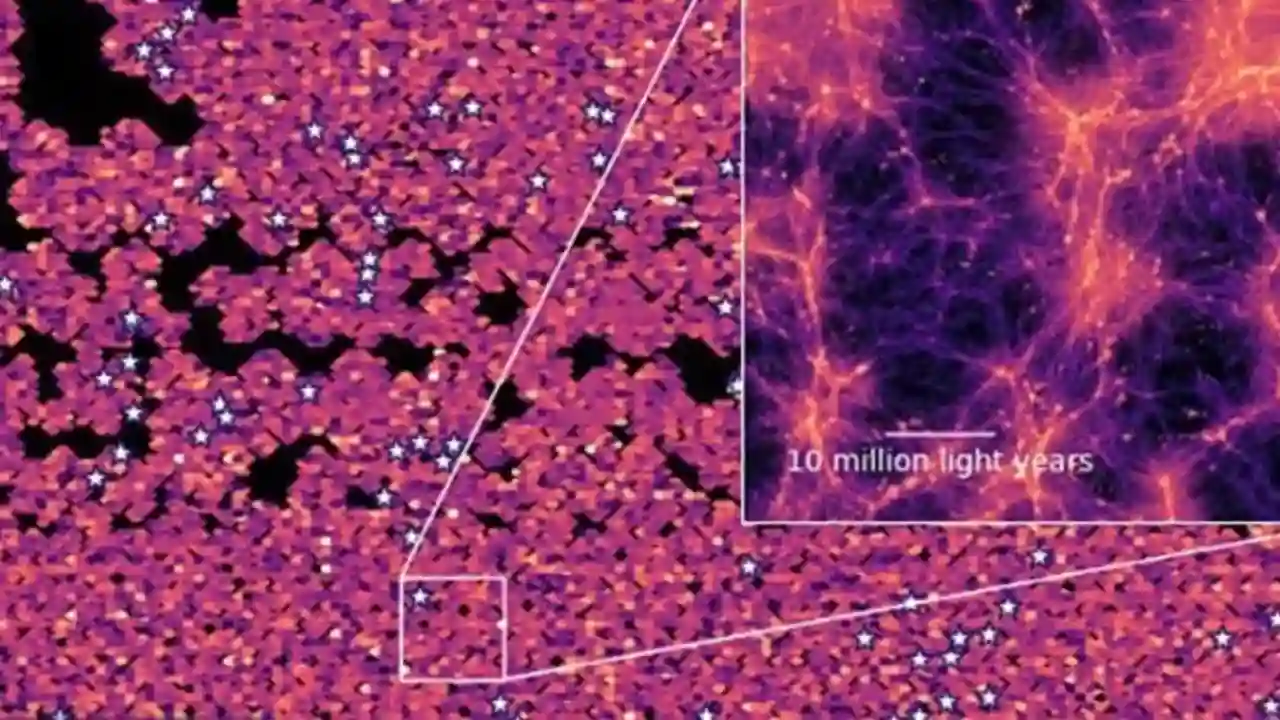

The map was produced using data from the Hobby-Eberly Telescope Dark Energy Experiment (HETDEX), which studies the faint ultraviolet glow of hydrogen known as Lyman-alpha emission found between galaxies. This widespread glow forms a vast “sea of light” across the universe, normally too faint to observe directly until compiled into a large-scale map.
Mapping the Early Universe
According to the research team, the map was created using a method called line intensity mapping. Instead of identifying individual galaxies one by one, scientists combined more than 600 million spectra collected by HETDEX to produce a massive three-dimensional “heat map” showing hydrogen distribution in space.
HETDEX operates at the Hobby-Eberly Telescope in Texas, where specialized spectrographs capture extremely faint signals from distant regions of the universe. By comparing the positions of bright galaxies with the faint hydrogen glow around them, researchers were able to detect vast cosmic structures that earlier surveys—focused mainly on bright objects—could not reveal.
What It Means for Cosmology
Mapping hydrogen from the universe’s peak star-forming era helps astronomers better understand how galaxies formed and evolved. The distribution of hydrogen gas shows how galaxies gathered fuel, formed new stars, and gradually merged into the enormous structures seen in the universe today.
The project also signals the beginning of a new generation of cosmological surveys that rely on intensity mapping, a technique designed to reveal the entire glowing structure of the cosmos rather than just its brightest galaxies.
Co-author Caryl Gronwall described the work as an important milestone, noting that the study is “an exciting first step in using intensity mapping to understand the processes involved in how galaxies form and evolve.”

Bhupendra Singh Chundawat is a seasoned technology journalist with over 22 years of experience in the media industry. He specializes in covering the global technology landscape, with a deep focus on manufacturing trends and the geopolitical impact on tech companies. Currently serving as the Editor at Udaipur Kiran, his insights are shaped by decades of hands-on reporting and editorial leadership in the fast-evolving world of technology.