

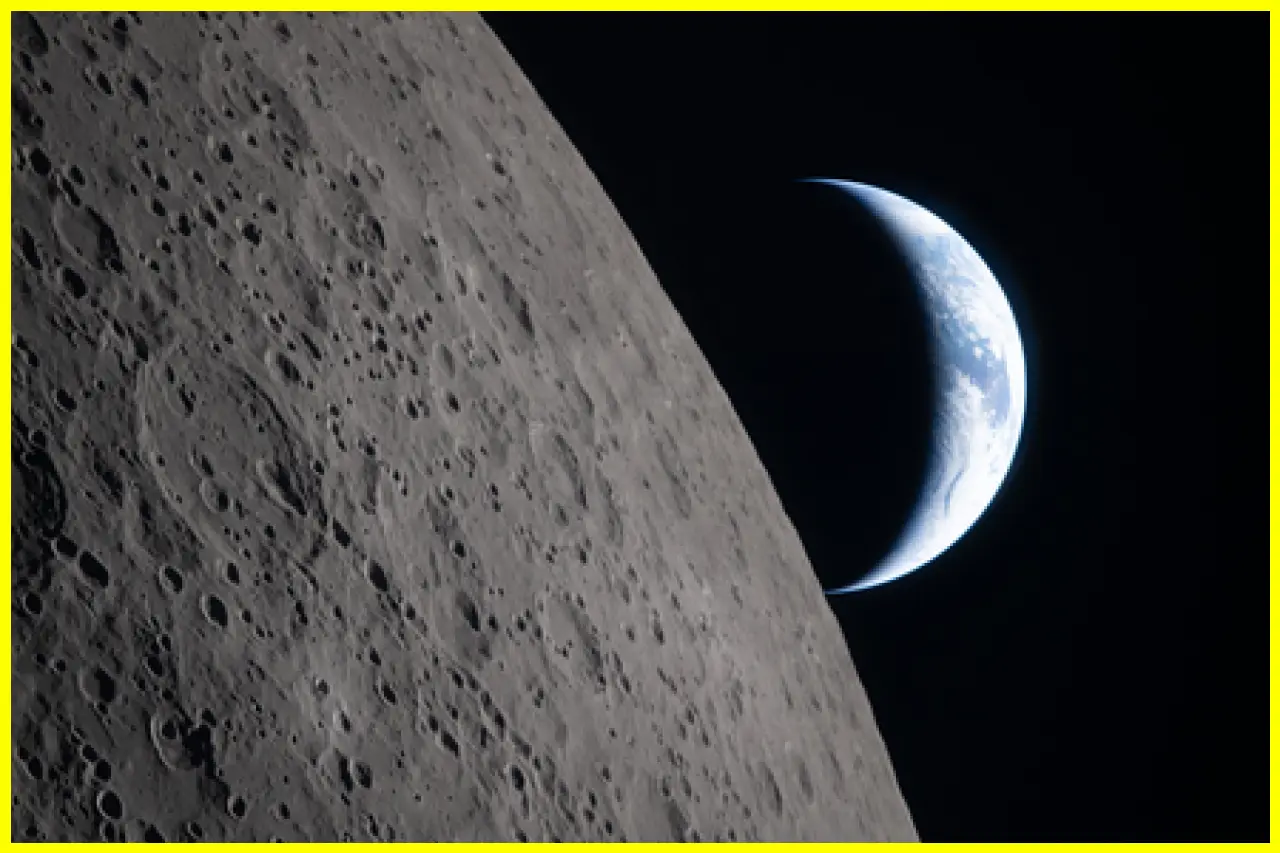

New Delhi, April 8: The American space agency NASA has shared breathtaking images of Earth and the Moon taken during the Artemis II mission on the social media platform X. In their post, NASA wrote, “Hello, Moon. It’s great to be here.” The astronauts aboard Artemis II were able to view parts of the Moon that have never been seen by the human eye, capturing these unique sights in both images and words.
During the Artemis II mission, astronauts Reid Wiseman, Victor Glover, Christina Koch, and Jeremy Hansen photographed numerous memorable views of Earth and the Moon, continuously sharing them with the public. This includes the first-ever space images taken with a smartphone.
The Orion spacecraft is equipped with a total of 32 cameras and photo-video devices. Of these, 15 cameras are installed on the spacecraft itself, recording significant moments such as the launch, solar array deployment, and the journey around the Moon. The remaining 17 handheld devices, including Nikon D5 DSLR, Nikon Z9 mirrorless cameras, GoPro, and smartphones, are with the four astronauts, aiding in engineering, navigation, crew monitoring, and lunar science and outreach activities.
According to NASA, the external cameras on the Orion spacecraft capture the mission from every angle, from the solar array to the interior views of the cabin. A special optical navigation camera assists the spacecraft in determining its position in deep space by taking pictures of Earth and the Moon.
The four-member crew has captured images of Earth showing both the Northern and Southern Auroras simultaneously, with some pictures taken using smartphones, which have been approved for spaceflight for the first time.
Moreover, some early images from Artemis II remind viewers of the famous ‘Earthrise’ photo taken by Bill Anders during the Apollo 8 mission in 1968. At that time, a Hasselblad film camera with a 250mm lens was used. Today, the Artemis II astronauts have access to 80-400mm telephoto lenses and advanced digital cameras, making it easier to take high-quality pictures. However, capturing an identical image remains challenging due to the speed of flight and timing.
–
Agency

Bhupendra Singh Chundawat is a seasoned technology journalist with over 22 years of experience in the media industry. He specializes in covering the global technology landscape, with a deep focus on manufacturing trends and the geopolitical impact on tech companies. Currently serving as the Editor at Udaipur Kiran, his insights are shaped by decades of hands-on reporting and editorial leadership in the fast-evolving world of technology.