

First Direct Observation of Giant Star Consuming Companion in Andromeda
Researchers have directly observed a giant star in the Andromeda Galaxy merging with its companion. This marks a significant breakthrough in astrophysics.

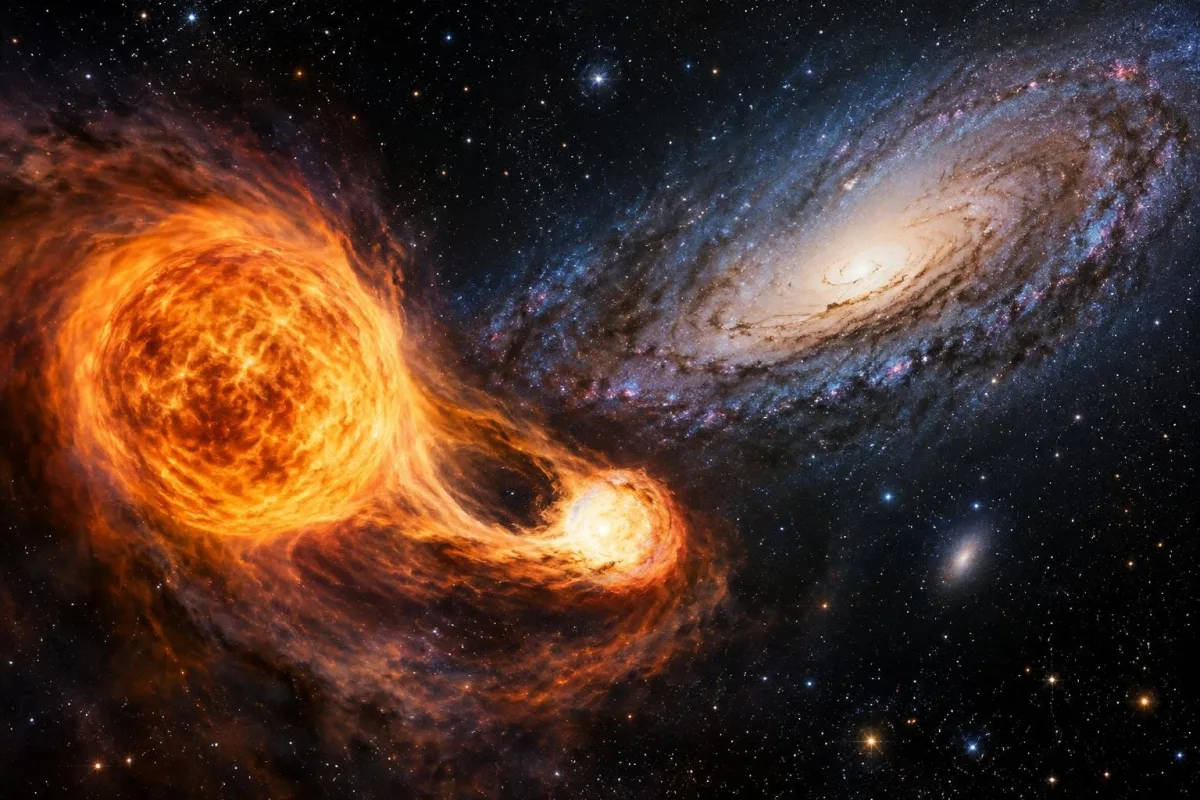
NEW YORK, Nov 20: A team of astronomers has observed a giant star in the Andromeda Galaxy, approximately 2.5 million light-years from Earth, swallowing its companion star over seven years. This marks the first direct observation of common envelope evolution, where a star engulfs a nearby orbiting companion in its final life stages.
The study, led by Dr. Viraj Karambelkar from Columbia University, was published in the journal Nature on November 18. The researchers monitored the star designated AT 2025abao, which began to brighten in 2018, leading to a significant eruption in October 2025. This eruption dramatically increased its brightness, peaking at 1.5 million times that of the Sun.
Throughout the observation period, the star’s brightness fluctuated and intensified, with increases in visible light followed by stronger infrared emissions. The star, approximately seven times more massive than the Sun and 350 times its radius, lost material equivalent to 10-20% of the Sun’s mass. The companion star, about 70% the mass of the Sun, spiraled inward, generating heat and light through friction with the giant’s outer layers.
Dr. Karambelkar noted, “Catching a star engulfing its companion in the act is very difficult,” emphasizing the rarity of such observations. A series of telescopes, including NASA’s James Webb Space Telescope, tracked the events meticulously, providing insights into the process. After the initial brightening phase, the outburst saw material ejected into space at speeds of up to 900 km per second.
This observation offers evidence supporting theoretical models of star evolution and challenges existing understandings of energy dynamics during common envelope evolution. Professor Jason Nordhaus commented on the study, saying it confirms the gradual shrinking of the companion’s orbit.
Researchers believe that further monitoring is essential to fully understand the outcome of this stellar interaction and whether the stars merged completely or continue to exist in a closer orbit. The potential for discovering similar events is promising, with upcoming telescopes like the Nancy Grace Roman Space Telescope expected to reveal more instances in nearby galaxies.