

NASA’s Voyager 1 Reaches One Light-Day Distance from Earth
NASA's Voyager 1 probe has achieved a milestone by reaching one light-day from Earth, nearly 50 years after its launch.

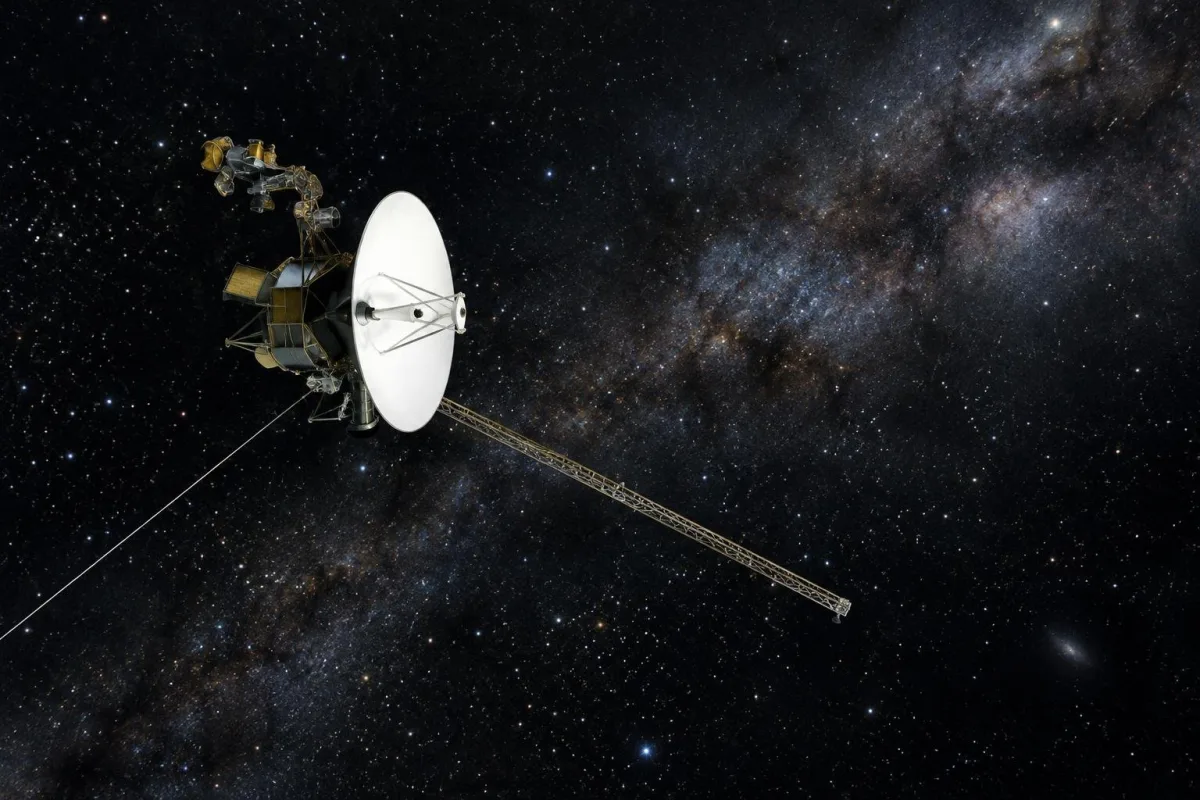
CALIFORNIA, Nov 19: NASA’s Voyager 1 has become the first human-made object to reach a distance of one light-day from Earth, a milestone achieved on November 18. The probe is now approximately 26 billion kilometers away, making communication with Earth complex, as it takes 24 hours for signals to reach the spacecraft and another 24 hours for responses.
Launched in September 1977, Voyager 1 was designed for a mission originally projected to last five years. Over the decades, it has traveled through our solar system and now ventures into interstellar space, having crossed the heliopause in 2012. It travels at about 38,000 miles per hour and is currently heading toward the star Gliese 445, located more than 17 light-years away.
NASA scientist Tiffany Kataria remarked on the significance of the milestone, stating, “It illustrates just how vast space is. It took Voyager 1 nearly 50 years to get to just the edge of our own solar system.”
Voyager 1 continues to gather data despite being nearly 50 years old. However, only two of its scientific instruments are still operational, including a magnetometer to analyze magnetic fields and a plasma wave detector to study charged particles in interstellar space. NASA engineers must make careful adjustments to maintain power levels, as the spacecraft relies on plutonium-powered thermoelectric generators that produce less electricity as they age.
The mission has yielded groundbreaking discoveries in planetary science, such as the first images showing Jupiter’s rings and volcanic activity on its moon Io. Voyager 1 has also sent back iconic images of Earth, including the famous “Pale Blue Dot,” which captures our planet from a vast distance.
NASA’s mission manager for Voyager, Kareem Badaruddin, expressed the uniqueness of this milestone: “It’s never happened before, and it may never happen again — it’s that kind of extraordinary.” Both Voyager 1 and its twin, Voyager 2, which is set to reach one light-day in 2035, carry Golden Records intended to convey the story of human civilization to any potential extraterrestrial life forms encountered in the future.