

Study reveals some black holes form from stars collapsing without supernovae
Astronomers propose that numerous black holes may form from massive stars collapsing without a supernova explosion, based on gravitational wave data.

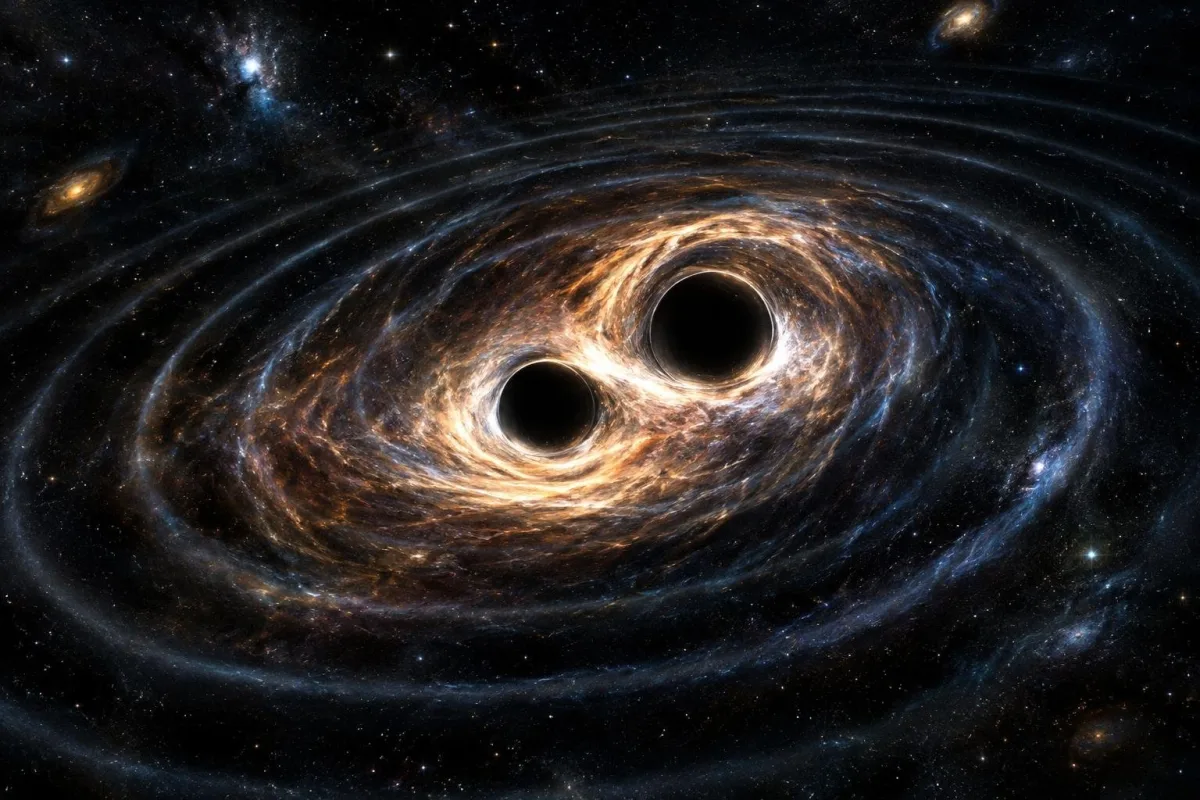
NEW DELHI, Nov 20: A recent study indicates that many black holes may originate from massive stars collapsing directly into themselves without undergoing a supernova explosion. This finding comes from researchers at the California Institute of Technology (Caltech), who analyzed gravitational wave data collected by the LIGO, Virgo, and KAGRA detectors.
Traditionally, scientists believed that black holes formed from the cores of massive stars collapsing after their nuclear fuel was depleted, leading to explosive supernovae. However, this new analysis suggests that some stars might simply implode, creating black holes without the explosive phase.
Katerina Chatziioannou, a physics professor at Caltech, explained that “a vast majority of the merging black holes in the universe are about 10 times the mass of our Sun.” She noted that this group may represent a distinct subpopulation of black holes that “failed to go supernova.”
The research focused on 257 black hole mergers detected over the past decade, demonstrating that approximately 75% of these mergers involved black holes with masses around 10 solar masses. However, the absence of black holes with masses between 12 and 16 times that of the Sun raised questions.
Isaac Legred, a member of the research team, pointed out the rarity of 14-solar-mass black holes, suggesting that a “special cocktail of internal physics” may be responsible for the prevalence of 10-solar-mass black holes. The distribution patterns of the black holes’ masses and their spin rates provide further insight into their formation processes.
The researchers emphasize the need for more investigation. While hypotheses of failed supernovae are well-supported theoretically, direct evidence is still lacking. The gravitational waves detected so far provide compelling data, but understanding the full picture of how these black holes form remains a challenge.
Legred noted the difficulty in studying historical records of stars that did not explode, as they disappear without leaving clear evidence. “We can look up at the sky and try to study historical records of massive stars that failed to explode, but it’s challenging because they just vanish without exploding, leaving a dark patch of sky,” he stated. He remains hopeful about continuing research, considering it an exciting opportunity to deepen our understanding of black holes and their origins.