

BepiColombo Spacecraft Enters Mercury Orbit After Eight-Year Journey
The BepiColombo spacecraft achieved orbit around Mercury on November 21, making it the first robotic visitor to the planet in over ten years.

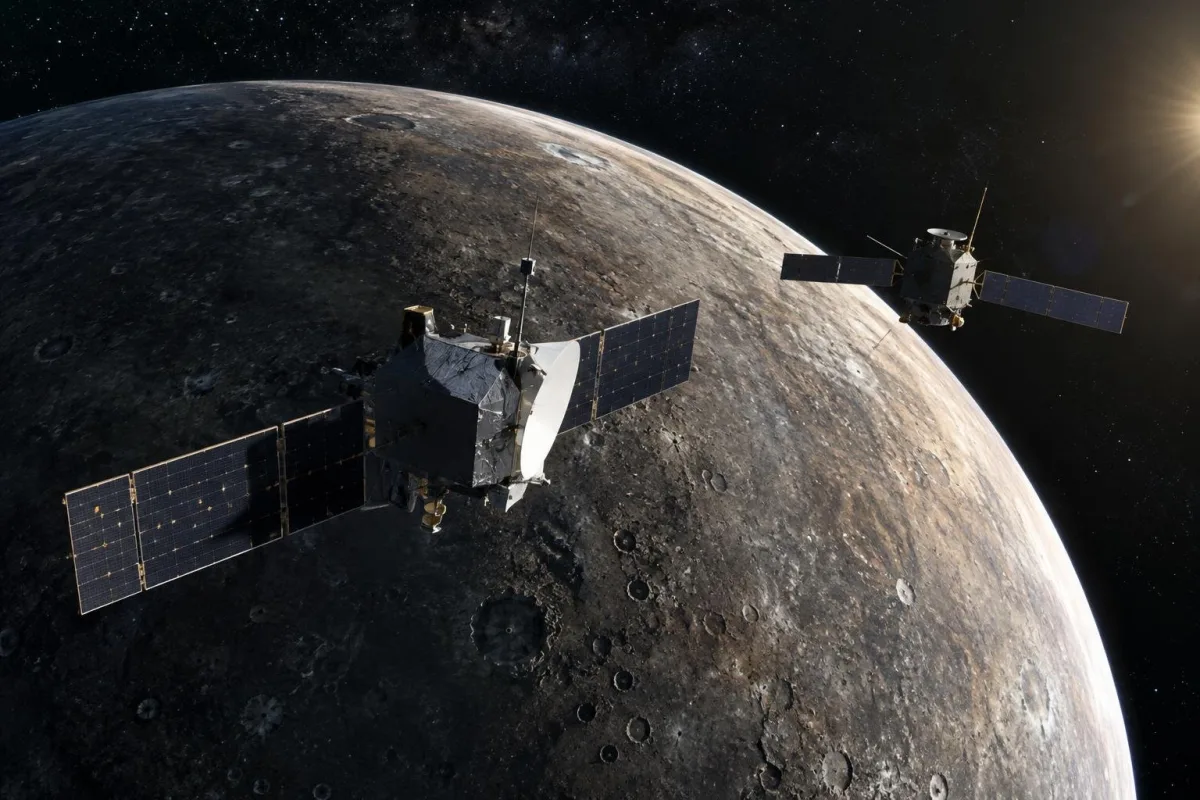
CAPE CANAVERAL, Nov 23: The BepiColombo spacecraft reached orbit around Mercury on November 21, marking the first time a spacecraft has circled the planet in over ten years. This mission, a collaboration between the European Space Agency (ESA) and the Japan Aerospace Exploration Agency (JAXA), follows an eight-year journey through the inner solar system.
This ambitious endeavor involved complex maneuvers to slow the spacecraft for capture by Mercury’s weak gravity. However, the team reported that the maneuver did not go entirely as planned due to a software issue that caused the thruster burn to be shorter than intended. Despite this, the spacecraft is safe, and the team is investigating the anomaly.
Only two spacecraft have previously visited Mercury: NASA’s Mariner 10 in the 1970s and the MESSENGER probe, which orbited from 2011 until its crash in 2015. Now, team members are eager to collect data from BepiColombo, which consists of two orbiters that will separate next month to study the planet from different altitudes.
The $2 billion BepiColombo mission is expected to enhance our understanding of Mercury’s geological and magnetic properties. Lead project scientist Geraint Jones expressed anticipation for the new data, emphasizing the mission’s potential to provide unprecedented measurements from both orbiters.
The spacecraft’s arrival marks the beginning of a six-month period dedicated to orbital adjustments before the two probes begin their scientific investigations. ESA officials stated that the mission aims to explore Mercury’s structure and dynamics, including its magnetosphere and internal composition.
The BepiColombo mission, named after the Italian scientist Giuseppe Colombo, is crucial for unraveling the mysteries surrounding Mercury, particularly given its unique characteristics and proximity to the sun. Researchers are hopeful that the data collected will improve understanding of planetary formation, especially for exoplanets orbiting close to their stars.
Sources
- Space
- ABC News – Breaking News, Latest News and Videos
- National Geographic