

BepiColombo Successfully Reaches Mercury After Eight-Year Journey
The BepiColombo spacecraft successfully entered orbit around Mercury, completing an eight-year journey to explore the planet's mysteries.

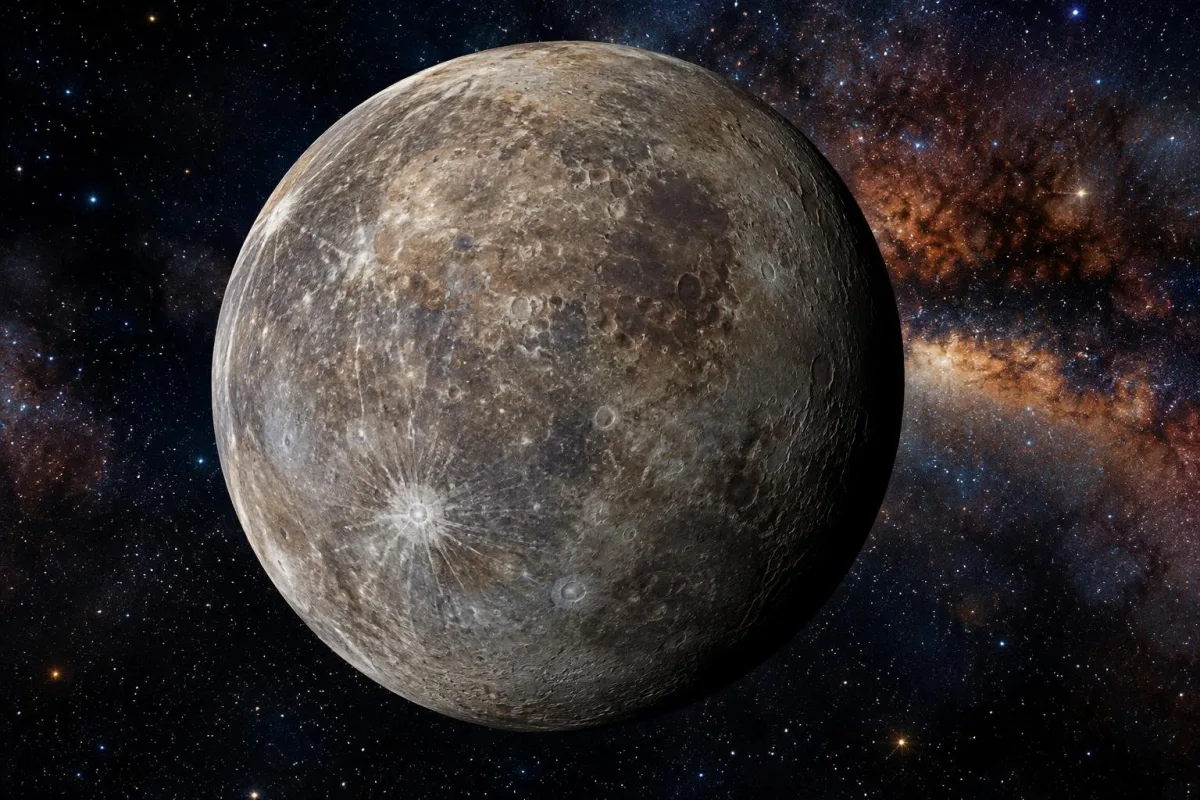
CAPE CANAVERAL, Nov 22: A pair of spacecraft has successfully entered orbit around Mercury after an eight-year journey. The BepiColombo mission, a collaboration between the European Space Agency (ESA) and the Japan Aerospace Exploration Agency (JAXA), marks a milestone in planetary exploration.
Launched in October 2018, BepiColombo made its final approach to Mercury following a complex trajectory involving multiple flybys and gravity-assist maneuvers. The spacecraft, which includes ESA’s Mercury Planetary Orbiter (MPO) and JAXA’s Mercury Magnetospheric Orbiter (MMO), achieved orbit on November 21. Following a thruster firing, flight controllers confirmed successful capture by Mercury’s gravity after several anxious hours.
Geraint Jones, the lead project scientist, expressed anticipation for the data that will be collected, stating, “The mission will provide unprecedented measurements taken by two spacecraft at the planet at the same time.” Once separated next month, each orbiter will study different aspects of Mercury.
Scientific objectives include investigating Mercury’s dense interior, magnetic field, and geological features like craters and volcanic plains. The mission is expected to last at least one Earth year, allowing the collection of crucial data regarding the planet’s formation and evolution.
Mercury’s extreme temperatures, exceeding 800 degrees Fahrenheit (427 degrees Celsius), present engineering challenges for the spacecraft. ESA officials emphasized the need to keep the instruments cool to ensure their functionality throughout the mission.
Previous missions, such as NASA’s MESSENGER and Mariner 10, have provided valuable insights into the planet’s characteristics but left many questions unanswered. Researchers hope BepiColombo’s findings will enhance understanding of both Mercury and the formation of planets close to their stars.
The arrival marks the beginning of a detailed exploration phase that will continue into 2027, when scientific operations are set to commence. The two orbiters will gather complementary data, contributing to a comprehensive understanding of the solar system’s innermost planet.
As scientists eagerly await the first data stream, their focus remains on revealing the mysteries of Mercury, a planet historically overlooked despite its proximity to Earth.
Sources
- ABC News – Breaking News, Latest News and Videos
- Space
- National Geographic