

BepiColombo Successfully Enters Orbit Around Mercury After 8-Year Journey
The BepiColombo spacecraft has entered orbit around Mercury, concluding an eight-year mission aimed at exploring the planet's secrets.

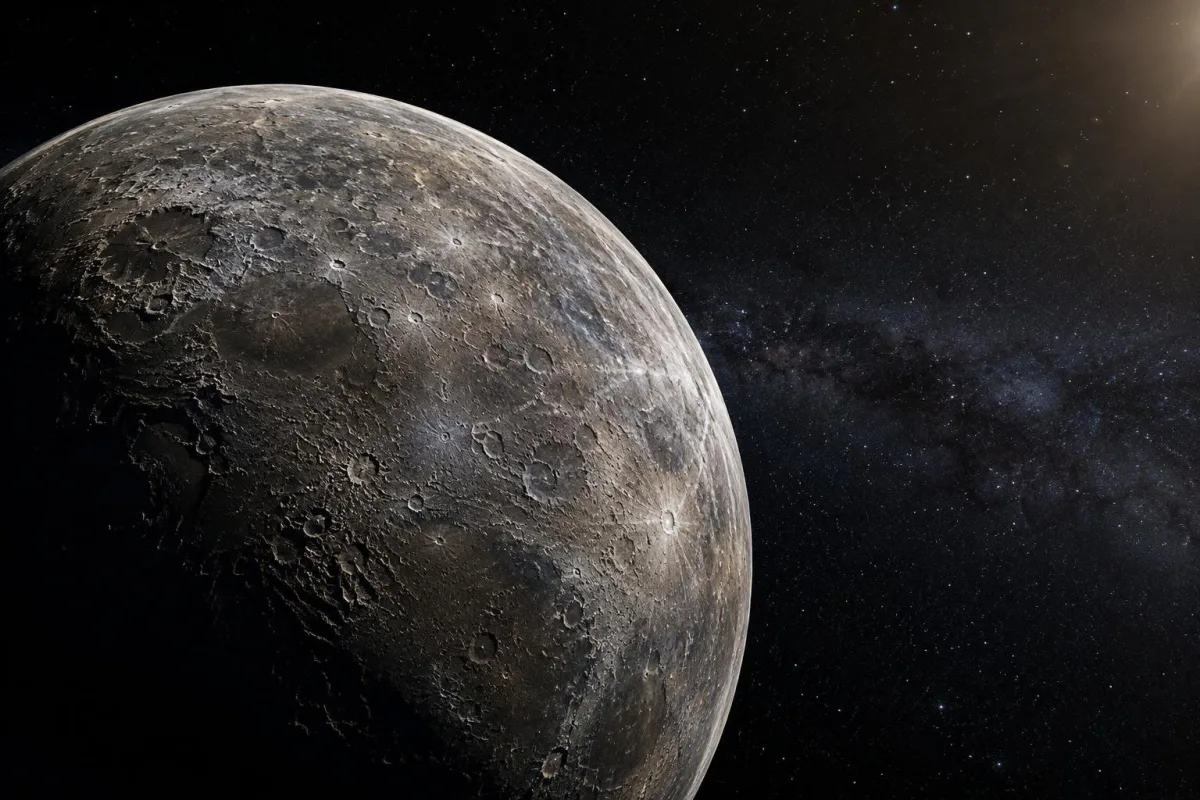
NEW DELHI, Nov 21: The BepiColombo spacecraft has successfully entered orbit around Mercury, completing an eight-year journey that covered nearly 10 billion kilometers.
Today, November 21, marks the official arrival of the mission, a collaboration between the European Space Agency (ESA) and the Japanese Aerospace Exploration Agency (JAXA). The spacecraft’s moment came after a 37-minute orbital insertion burn that began at 1:24 p.m. EST.
According to ESA officials, two main spacecraft make up the BepiColombo mission: the Mercury Planetary Orbiter (MPO) from ESA and the Mercury Magnetospheric Orbiter (MMO), known as Mio, from JAXA. The mission is expected to enhance understanding of Mercury, which historically has been less explored than other planets.
Mercury presents a challenging environment for exploration due to its proximity to the Sun, where extreme temperatures can reach up to 430°C and drop to -180°C. The mission aims to investigate peculiar phenomena such as the existence of ice in polar craters and numerous hollows on the planet’s surface. Professor Emma Bunce, from Leicester University, noted, “There are lots of reasons, scientifically, why we really want to understand Mercury.”
The spacecraft’s journey to Mercury involved a series of gravity-assist flybys, including one around Earth and two around Venus, to slow down sufficiently for orbital capture. The mission’s timeline extended by a year due to an issue with BepiColombo’s propulsion system.
Following this initial orbital insertion, MPO and Mio will remain connected until they separate on December 9. The MPO will eventually settle into a polar orbit by March 2027, while Mio will take a different elliptical path over Mercury’s poles.
Both orbiters are equipped with advanced instruments designed to collect unique data about Mercury, including its composition and magnetic field. The findings from BepiColombo are expected to provide insights into the formation and evolution of Mercury and its interplay with the solar environment.
The mission’s Mercury Imaging X-ray Spectrometer (MIXS) has also achieved a milestone by successfully capturing X-rays from the Crab Nebula, providing early validation of its capabilities. Professor Bunce stated, “It is fantastic to see [MIXS] operating brilliantly in space,” emphasizing the importance of these measurements.
The upcoming months will see BepiColombo transition into a comprehensive scientific operational phase aimed at uncovering the many mysteries that Mercury holds.