

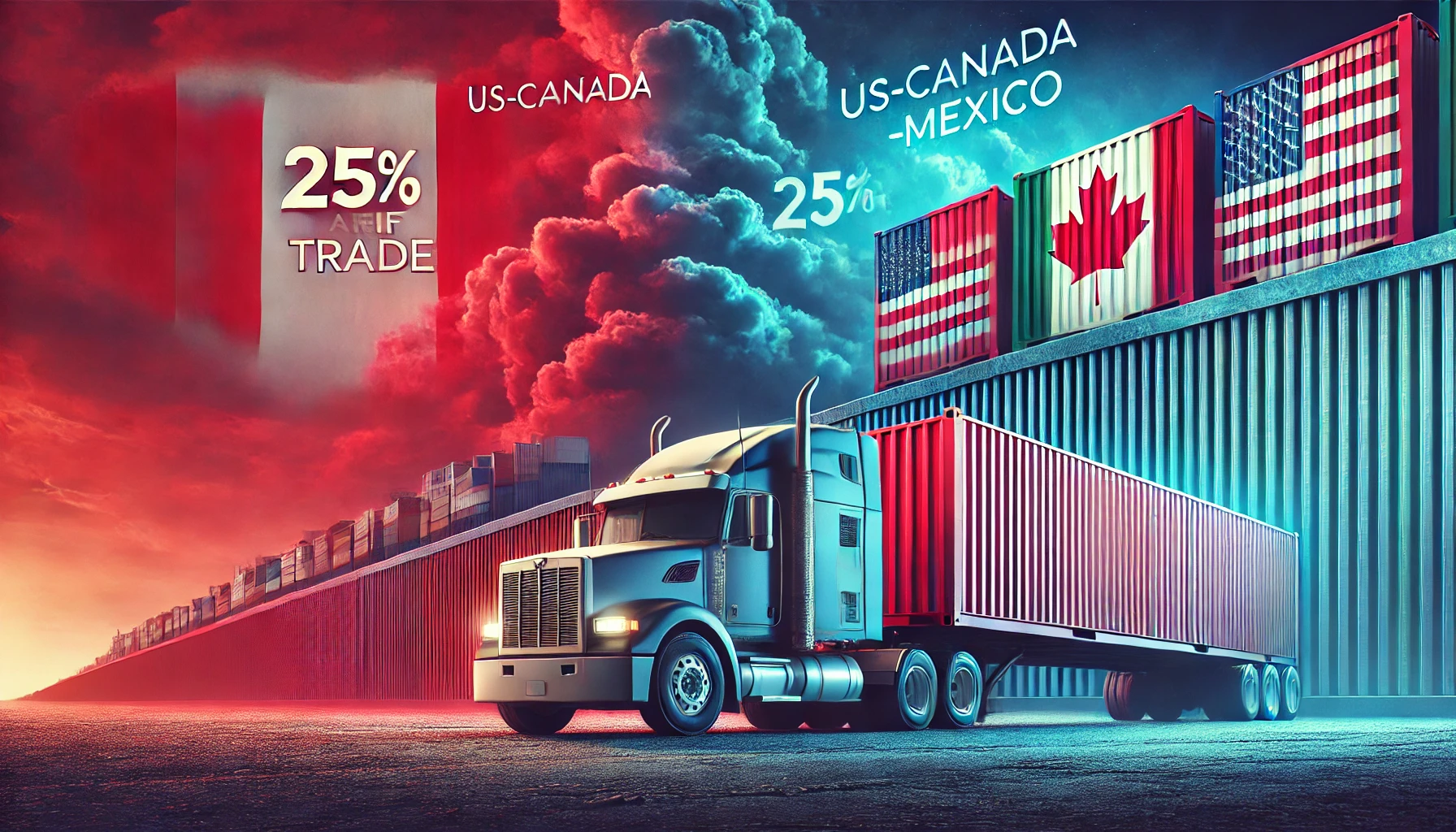
Washington, March 4 – U.S. President Donald Trump has officially imposed a 25% tariff on imports from Mexico and Canada, effective from Tuesday. The announcement, made during a press conference on Monday, also includes an increase in tariffs on Chinese imports, raising the previous 10% tariff to 20%.
In a swift response, Canadian Prime Minister Justin Trudeau declared retaliatory tariffs, stating that Canada will impose a 25% tariff on $155 billion worth of U.S. imports within the next 21 days, beginning with $30 billion worth of goods from Tuesday.


Stock Market Reacts with Sharp Decline
Following the announcement, the U.S. stock market took a hit, with the S&P 500 index plunging by 2% as concerns over a trade war between the neighboring countries intensified.
Partial Exemption for Canadian Oil and Electricity
While Trump has imposed strict tariffs on most Canadian and Mexican imports, he has granted exemptions for oil and electricity, reducing the tariff on these sectors to just 10%.
According to the U.S. Energy Information Administration (EIA), in October last year, the U.S. imported approximately 4.6 million barrels of oil per day from Canada and 5.63 million barrels from Mexico, while domestic oil production averaged 13.5 million barrels per day.
Reciprocal Tariffs and Previous Delays
Trump had previously announced a reciprocal tariff strategy aimed at leveling trade conditions. The new tariffs were initially scheduled for February 4, but after negotiations with Canadian and Mexican leaders, the implementation was delayed by 30 days.
Meanwhile, Mexico has ramped up border security, deploying 10,000 National Guard troops to curb drug trafficking and illegal immigration into the U.S. Similarly, Canada has intensified its efforts to control the fentanyl trade, appointing a Fentanyl Czar to combat smuggling.
Impact on American Households and Businesses
A study by the Peterson Institute for International Economics and Yale University’s Budget Lab warns that the new tariffs will increase costs for American households, with an estimated additional annual expenditure of $1,000 per family.
Major corporations such as Ford and Walmart have already raised concerns about negative business impacts, citing potential price hikes and supply chain disruptions.
According to Cornell University economist Eswar Prasad, inflation will rise in the U.S. due to increased import costs, which could hamper economic growth and trade relations.
U.S.-Canada-Mexico Free Trade Agreement at Risk
The U.S., Canada, and Mexico operate under the United States-Mexico-Canada Agreement (USMCA), a free trade deal that eliminates tariffs on goods exchanged between these nations. Trump previously renegotiated NAFTA (North American Free Trade Agreement) during his last term to establish USMCA.
In 2023, trade between the three countries exceeded $1 trillion in U.S. exports and $1.5 trillion in imports, making this tariff escalation a major economic disruptor.
Key Sectors Affected
The automobile, agriculture, technology, and manufacturing industries are expected to bear the brunt of these tariffs, leading to higher consumer prices and potential supply chain delays.
With economic tensions rising, all eyes are on Washington, Ottawa, and Mexico City, as the three governments navigate this intensifying trade dispute.

Bhupendra Singh Chundawat is a seasoned technology journalist with over 22 years of experience in the media industry. He specializes in covering the global technology landscape, with a deep focus on manufacturing trends and the geopolitical impact on tech companies. Currently serving as the Editor at Udaipur Kiran, his insights are shaped by decades of hands-on reporting and editorial leadership in the fast-evolving world of technology.