

Supreme Court Requires Stricter Food Labelling Standards in India
The Supreme Court has directed the FSSAI to implement stricter food labelling regulations, focusing on public health.

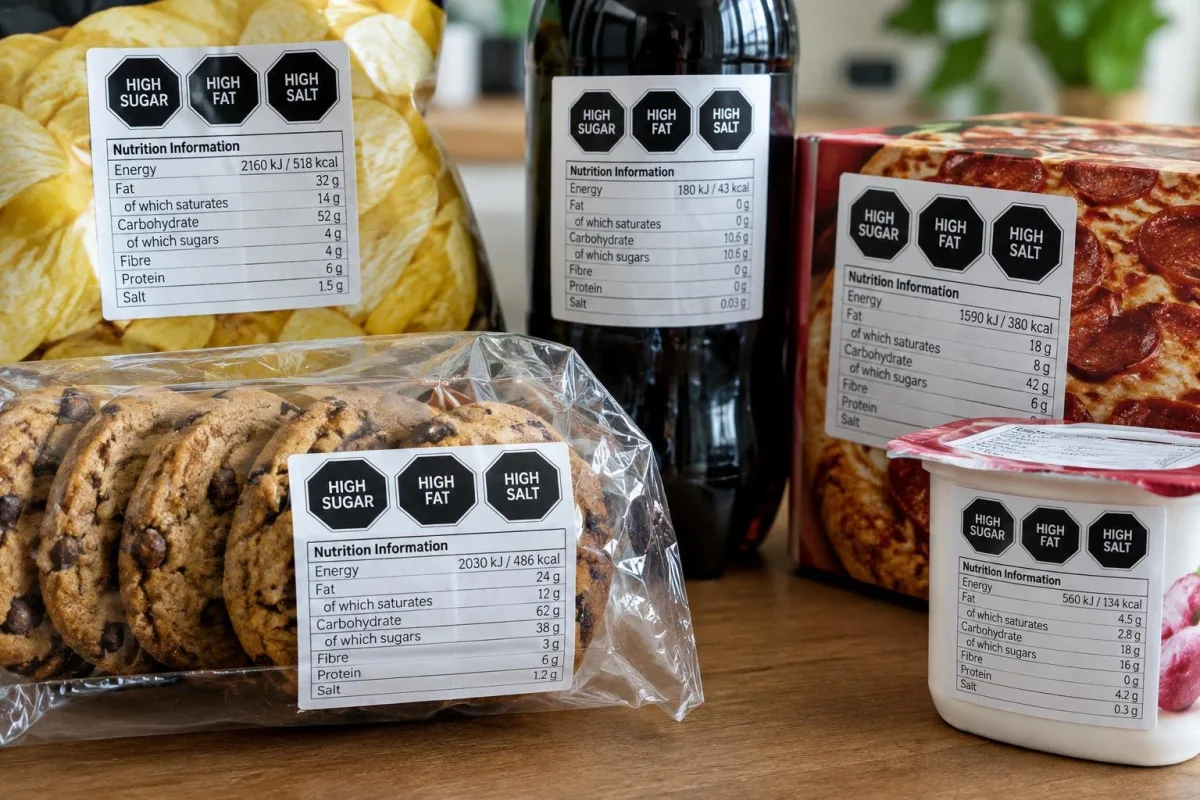
NEW DELHI, Nov 26: The Supreme Court of India has mandated a comprehensive reform of food labelling standards, requiring the Food Safety and Standards Authority of India (FSSAI) to implement clear warning labels on packaged foods containing high levels of sugar, saturated fat, and salt.
In a ruling issued on Thursday, the court established a four-month timeline for the FSSAI to finalize the new front-of-pack nutrition labelling (FoPNL) regulations. The court emphasized that delays in enforcing these labels could severely impact public health, particularly among children.
The ruling, delivered by Justices JB Pardiwala and K Vinod Chandran, specified that each nutrient of concern must be indicated with a distinct red hexagon label stating “High Fat,” “High Sugar,” or “High Salt,” along with a corresponding pictogram. The court rejected a proposal for a single combined hexagon, stating that this would undermine the effectiveness of the labels.
Justice Pardiwala remarked, “A consumer in India is entitled to no less protection, and no less information, than a consumer in the United States or the United Kingdom,” suggesting that existing practices by global corporations are insufficient.
The FSSAI must revisit its criteria for determining nutrient thresholds, focusing on total sugars and saturated fats instead of added sugars and fats, as the court noted that this approach aligns with prior consensus before the 2024 Dietary Guidelines for Indians.
The ruling requires that the graphic representations occupy at least 4-5% of the package’s principal display area and that the text must be easily legible. The court expressed concern that inadequate regulation would lead to consumer “label fatigue,” where too many products carry warnings, ultimately reducing their effectiveness.
The case leading to this ruling originated from a petition by the public charitable trust ‘3S and Our Health Society,’ which advocated for mandatory warning labels rather than the previously proposed star-rating system.
The All India Consumer Products Distributors Federation, representing numerous small manufacturers, expressed concerns about the implementation’s impact on local businesses, stating that the new labelling rules should not disadvantage Indian MSMEs against larger multinational corporations.
The FSSAI must present an affidavit on its progress in implementing the new regulations within ten weeks. The new labels will become mandatory a year after the official notification is published.