

Stanford Researcher Proposes Quantum Gravity Framework Using AI
Venkatesa Chandrasekaran submitted an 83-page paper proposing a new quantum gravity framework, assisted by OpenAI's GPT-6 Astra.

NEW DELHI, Nov 26: Venkatesa Chandrasekaran submitted a paper outlining a quantum gravity framework, developed with OpenAI’s GPT-6 Astra, to arXiv on November 25. The 83-page document is titled ‘An algebraic quantization of gravity from the null cone’ and aims to unify Einstein’s general relativity with quantum mechanics.
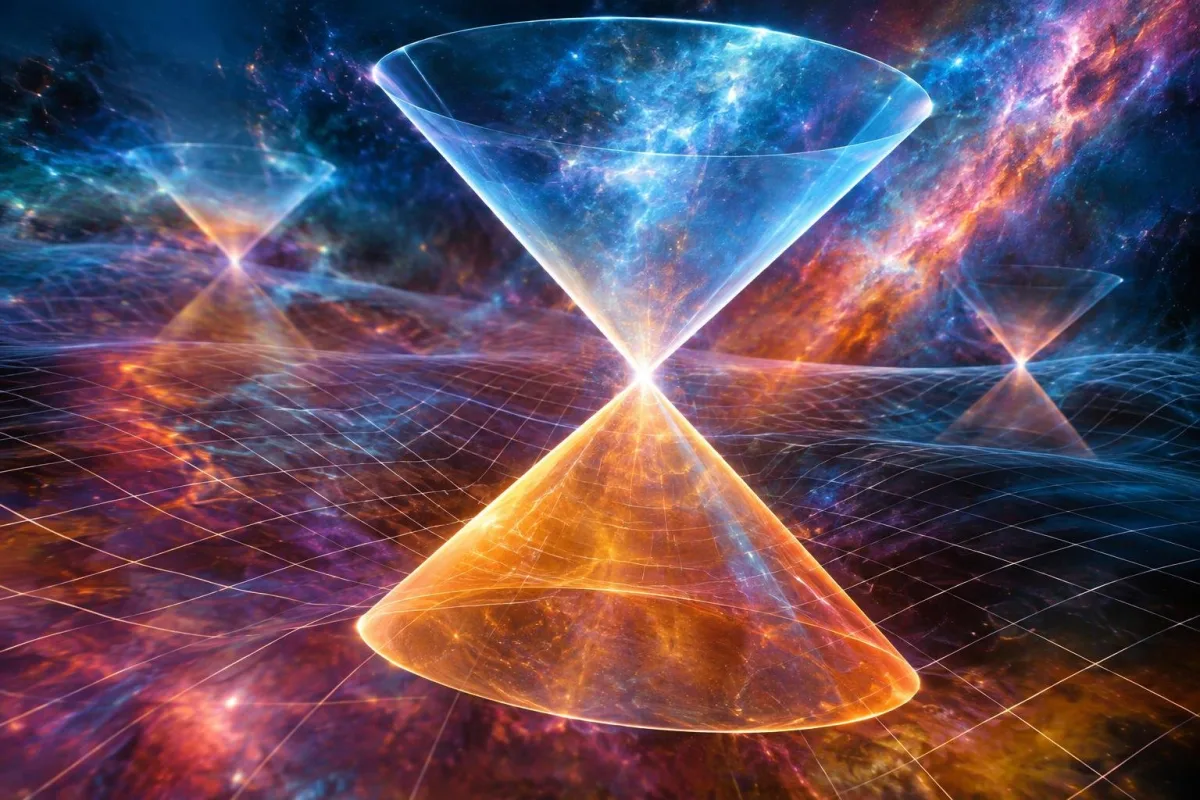
The response to the paper has been significant, with some physicists claiming it could be more impactful than the Riemann hypothesis. Chandrasekaran’s work stands out because it approaches gravitational phenomena via light cones rather than the traditional time-slicing method. This innovative perspective allows for a new way to tackle gravitational constraints and build a Hilbert space representation.
Chandrasekaran calculated results that differ from traditional quantum gravity models. For instance, he found that a graviton pair-creation calculation yields finite answers, unlike other models that produce infinities. The paper also successfully derives Bekenstein-Hawking black hole entropy, including a logarithmic correction that aligns with independent findings from other research.
According to reports, the collaboration with GPT-6 Astra involved around 400 million tokens over several months. While the specifics of how the AI contributed to the calculations remain vague, the integration of AI in this theoretical research marks a shift in physics. As one researcher said, “parts of a paper like this can be checked with formal verification,” but the overall physical correctness needs expert validation.
The proposed theory is strictly about pure vacuum gravity and does not incorporate matter fields or other forces, limiting its scope as a quantum gravity model rather than a comprehensive ‘theory of everything.’ The excitement surrounding it does not imply that practical applications of quantum gravity are imminent, and physicists acknowledge that clear technology implications are still years away.
Chandrasekaran, who earned his Ph.D. from UC Berkeley’s quantum gravity group in 2021, has impressive credentials from the Institute for Advanced Study and collaborations with renowned physicists. The ongoing debate regarding the validity of his findings will unfold over the coming months as the paper undergoes peer review. Whether other experts can replicate his results will play a role in determining the proposal’s acceptance in the scientific community.