

Scientists Create First 3D Map of the Sun’s Magnetic Field
A new study reconstructs the Sun's magnetic field in 3D using existing telescope data, enhancing solar activity insights.

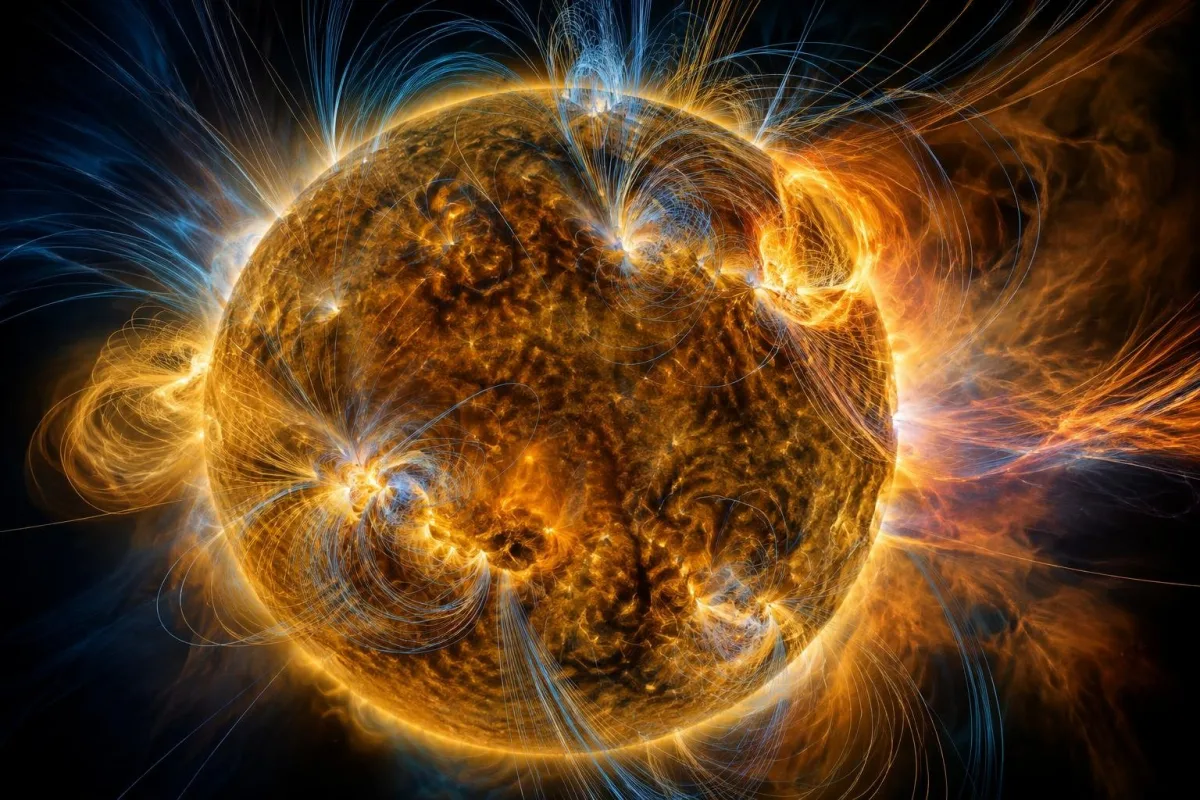
Scientists have constructed the first three-dimensional model of the Sun’s outer magnetic field, a breakthrough that could enhance predictions of solar eruptions and space weather. The study was published in The Astrophysical Journal Letters and details how researchers used existing telescope data to estimate the strength and direction of the magnetic field in the Sun’s corona, the outermost layer of its atmosphere.
Led by Alin Paraschiv from the US National Science Foundation’s National Solar Observatory, the team incorporated data from the Coronal Multi-channel Polarimeter (CoMP) and its upgraded version, UCoMP. They focused on observations made on October 14, 2016, and June 1, 2022, to apply a mathematical technique called IQUD inversion. This method allowed them to analyze waves traveling through the corona, reconstructing the magnetic field’s three-dimensional properties without needing new instruments.
The Sun’s corona, which contains extremely hot plasma, has long posed challenges in measuring its complete magnetic field in three dimensions. This magnetic field is vital in solar activity, influencing events such as coronal mass ejections that can send charged particles toward Earth, potentially disrupting satellite operations and power systems. As noted by the research team, “this method is an important step towards understanding the Sun’s hidden magnetic structure.”
While the current model is promising, it covers only the regions observable with the instruments used. The research team has made their software and datasets publicly accessible for further refinement by other scientists, yet the method is not yet integrated into standard forecasting systems.
A separate study examined the complexity of the Sun’s magnetic environment, particularly in its quiet regions. A research team using the Sunrise-III solar observatory found intricate magnetic structures that contribute to energy transfer in the solar atmosphere. These structures were observed over the chromosphere, revealing that even calm areas of the Sun can contain elaborate magnetic features.
The observations from Sunrise-III challenge previous assumptions about the simplicity of the Sun’s magnetic canopy, indicating that these quiet regions are far more dynamic than they appear. The advanced telescope, launched aboard a high-altitude balloon, allowed for clearer measurements above the Earth’s atmospheric interference, making it possible to detect the thin, elongated magnetic structures across the solar atmosphere.
As researchers continue to unravel the complexities of the Sun’s magnetic field, these studies may lead to improved understanding of solar activity and its effects on space weather, crucial for mitigating impacts on technology here on Earth.
Sources

Bhupendra Singh Chundawat is a seasoned technology journalist with over 22 years of experience in the media industry. He specializes in covering the global technology landscape, with a deep focus on manufacturing trends and the geopolitical impact on tech companies. Currently serving as the Editor at Udaipur Kiran, his insights are shaped by decades of hands-on reporting and editorial leadership in the fast-evolving world of technology.