

Aditya-L1 Marks One Year of Solar Observation Data Collection
India's Aditya-L1 mission has successfully completed its first year of solar observations, offering valuable insights into the Sun's activity and its effects on space weather.

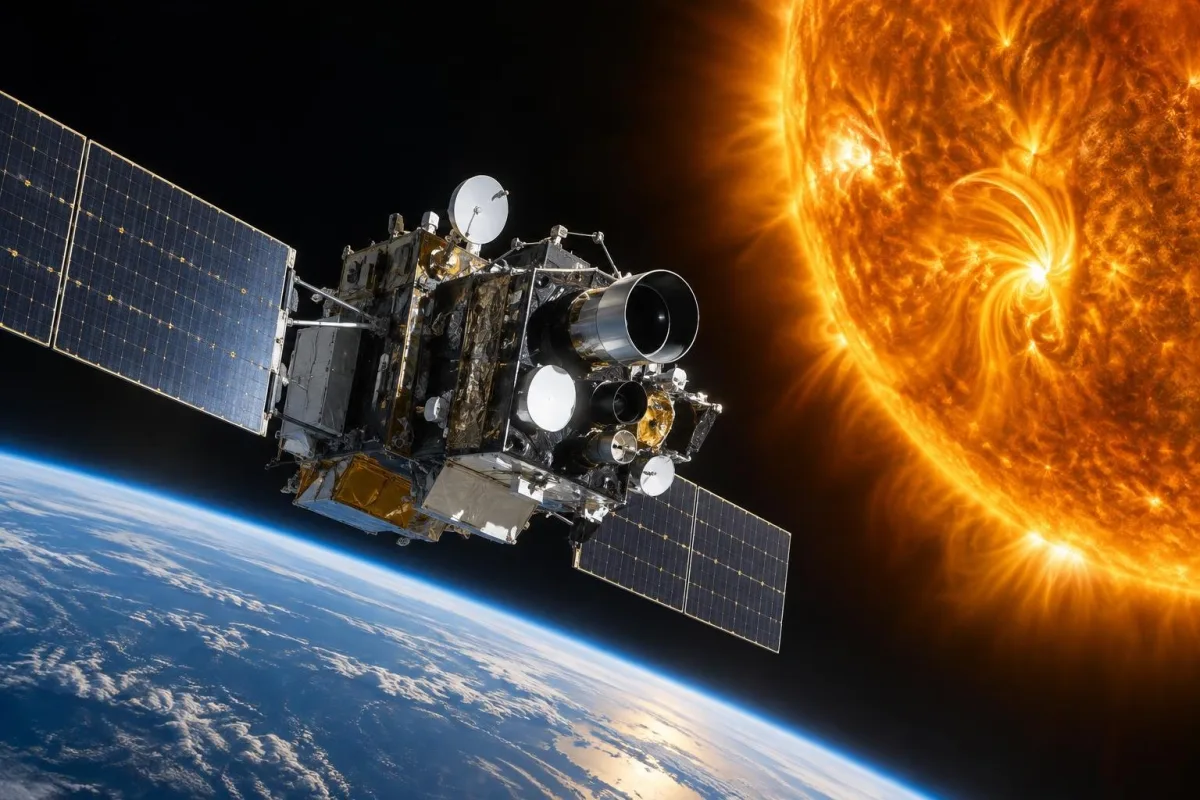
BENGALURU, Nov 7: India’s Aditya-L1 solar mission has successfully marked its first year of observations, enhancing our understanding of the Sun’s behavior. Launched on September 2, 2023, this mission has equipped scientists with new data from its Solar Ultraviolet Imaging Telescope (SUIT) and other instruments.
The spacecraft has been continuously observing solar phenomena from its position at the Sun-Earth Lagrange Point 1, about 1.5 million kilometers from Earth, allowing for uninterrupted data collection. This unique location helps avoid the disruptions typically caused by Earth’s shadow or eclipses.
In a significant achievement, a study published in the Astrophysical Journal Letters revealed findings from the Visible Emission Line Coronagraph (VELC), showing that solar eruptions, specifically coronal mass ejections (CMEs), can expand asymmetrically. This discovery challenges previous assumptions about solar eruptions expanding uniformly.
“We found that it does not expand uniformly in all directions,” said Tanmoy Samanta, a solar astronomer involved in the study. The asymmetrical expansion can influence how CMEs interact with solar wind, affecting their trajectory and speed toward Earth.
The study pointed to a powerful solar flare observed on August 5, 2024, which did not follow the typical symmetrical pattern, potentially helping scientists improve predictions of space weather. “Predicting a CME’s speed and trajectory is important for assessing its potential impact on Earth,” Samanta added.
Aditya-L1’s mission aims to study the heating of the Sun’s outer atmosphere and track how solar activity can disrupt technology on Earth. The spacecraft is expected to continue its observations for five years, contributing valuable insights into the complexities of solar behavior and its implications for space weather.
Sources

My name is Kuldeep Singh Chundawat. I am an experienced content writer with several years of expertise in the field. Currently, I contribute to Daily Kiran, creating engaging and informative content across a variety of categories including technology, health, travel, education, and automobiles. My goal is to deliver accurate, insightful, and captivating information through my words to help readers stay informed and empowered.