

Researchers Unveil Lumina Simulation of 2 Billion Years of Cosmic Evolution
Researchers have developed Lumina, one of the largest simulations of the early universe, modeling cosmic evolution over 2 billion years.

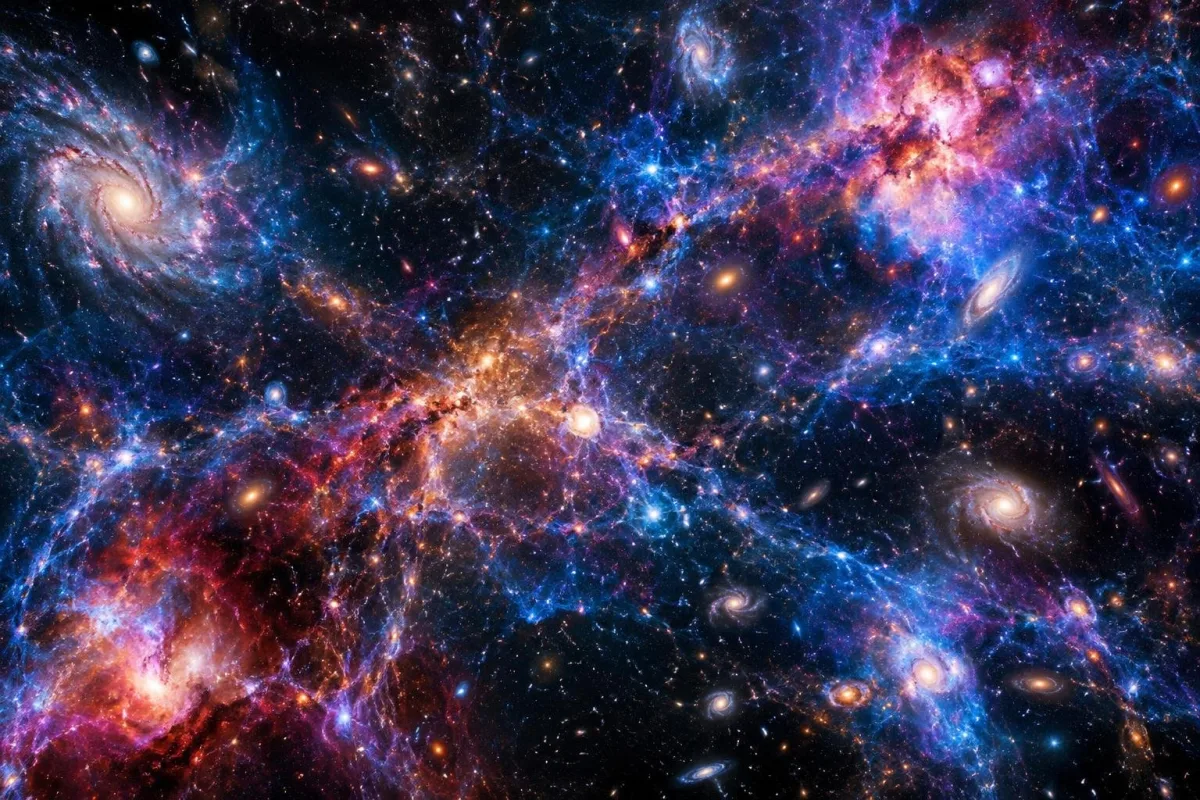
Researchers at the Center for Astrophysics | Harvard & Smithsonian have unveiled Lumina, one of the largest simulations of the early universe, aiming to model cosmic evolution over 2 billion years.
Published in the Monthly Notices of the Royal Astronomical Society, Lumina utilizes advanced computing techniques to explore the interaction of ordinary matter, dark matter, and radiation following the Big Bang. This simulation will help astronomers interpret observations from powerful telescopes, including the James Webb Space Telescope (JWST) and the Nancy Roman Space Telescope.
According to Oliver Zier, the lead author and ITC Fellow at the center, “With JWST, the early universe has become an exciting new frontier in astrophysics.” The simulation recreates a vast volume of space over 100 times larger than previous comparable projects, spanning approximately 1.5 billion light-years on each side.
Lumina particularly focuses on helium reionization, a critical process where radiation strips electrons from helium atoms. This simulation examines this transformation while accounting for its impact on surrounding cosmic structures. Aaron Smith, an assistant professor at the University of Texas at Dallas, remarked on Lumina’s significance, stating, “For the first time, we can follow along as both hydrogen and helium changed into their modern form.”
The development of Lumina required significant computational power, utilizing over 15,000 graphics processing units on one of the world’s fastest supercomputers, Frontier, located at Oak Ridge National Laboratory in Tennessee. This capability enabled researchers to accurately simulate the early universe’s evolution while maintaining intricate details necessary to study individual galaxies and other structures.
As researchers analyze Lumina’s outcomes, they anticipate that unexpected variances between simulations and real observations could offer insights into areas where existing theories may require refinement. The team plans to investigate gas movement between galaxies and the influence of radiation from the Big Bang.

My name is Kuldeep Singh Chundawat. I am an experienced content writer with several years of expertise in the field. Currently, I contribute to Daily Kiran, creating engaging and informative content across a variety of categories including technology, health, travel, education, and automobiles. My goal is to deliver accurate, insightful, and captivating information through my words to help readers stay informed and empowered.