

Smithsonian Scientists Use GPUs to Model Early Universe with Lumina Simulation
Scientists at the Smithsonian have created Lumina, a detailed computer simulation of the universe’s first two billion years post-Big Bang, utilizing over 15,000 GPUs.

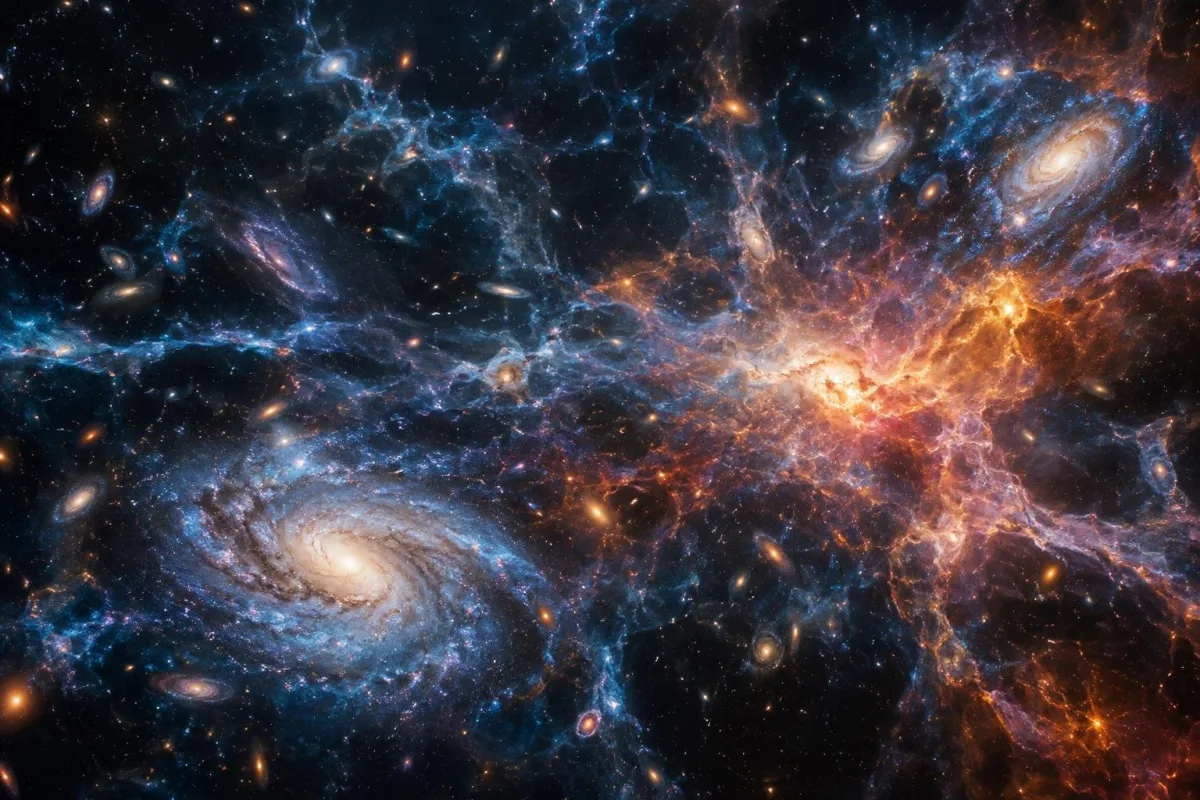
Scientists at the Center for Astrophysics | Harvard & Smithsonian have developed Lumina, a groundbreaking computer simulation that models the universe’s first two billion years after the Big Bang. The simulation utilizes over 15,000 graphics processing units (GPUs) and runs on the Frontier supercomputer at Oak Ridge National Laboratory.
Lumina vividly illustrates the evolution of early stars, galaxies, and supermassive black holes, revealing how these cosmic entities transformed hydrogen and helium in the intergalactic medium. Lead author Oliver Zier said, “To understand what we are seeing with this telescope, we need to translate our theories into detailed predictions.”
The simulation proceeds from approximately 45 million years after the Big Bang, spanning a region about 1.5 billion light-years across. It incorporates the IllustrisTNG galaxy-formation model, allowing researchers to study how cosmic structures influenced the surrounding gas.
Key findings indicate that early stars and galaxies played a significant role in reionization phases, altering the state of cosmic gas. Active galactic nuclei powered by supermassive black holes later contributed to the reionization of helium. Aaron Smith, an assistant professor at the University of Texas at Dallas, expressed excitement over the findings, stating, “For the first time, we can follow how hydrogen and helium changed into their modern form across a vast volume.”
Lumina helps researchers correlate its predictions with observations from significant space telescopes like NASA’s James Webb Space Telescope (JWST) and the Nancy Grace Roman Space Telescope, which are both crucial for studying the universe’s early epochs. While Lumina offers valuable insights, it remains a model and not a definitive recording of cosmic history. Scientists will need to compare Lumina’s outcomes with actual observations to validate its accuracy.
This innovative project highlights the ongoing efforts within the field of astrophysics to utilize high-powered simulations to unravel the complexities of cosmic evolution.

Bhupendra Singh Chundawat is a seasoned technology journalist with over 22 years of experience in the media industry. He specializes in covering the global technology landscape, with a deep focus on manufacturing trends and the geopolitical impact on tech companies. Currently serving as the Editor at Udaipur Kiran, his insights are shaped by decades of hands-on reporting and editorial leadership in the fast-evolving world of technology.