

New Simulation Reveals Details of Early Universe’s Cosmic Dawn
Researchers have unveiled Lumina, a groundbreaking simulation detailing the universe's early days, covering significant transformations in cosmic history.

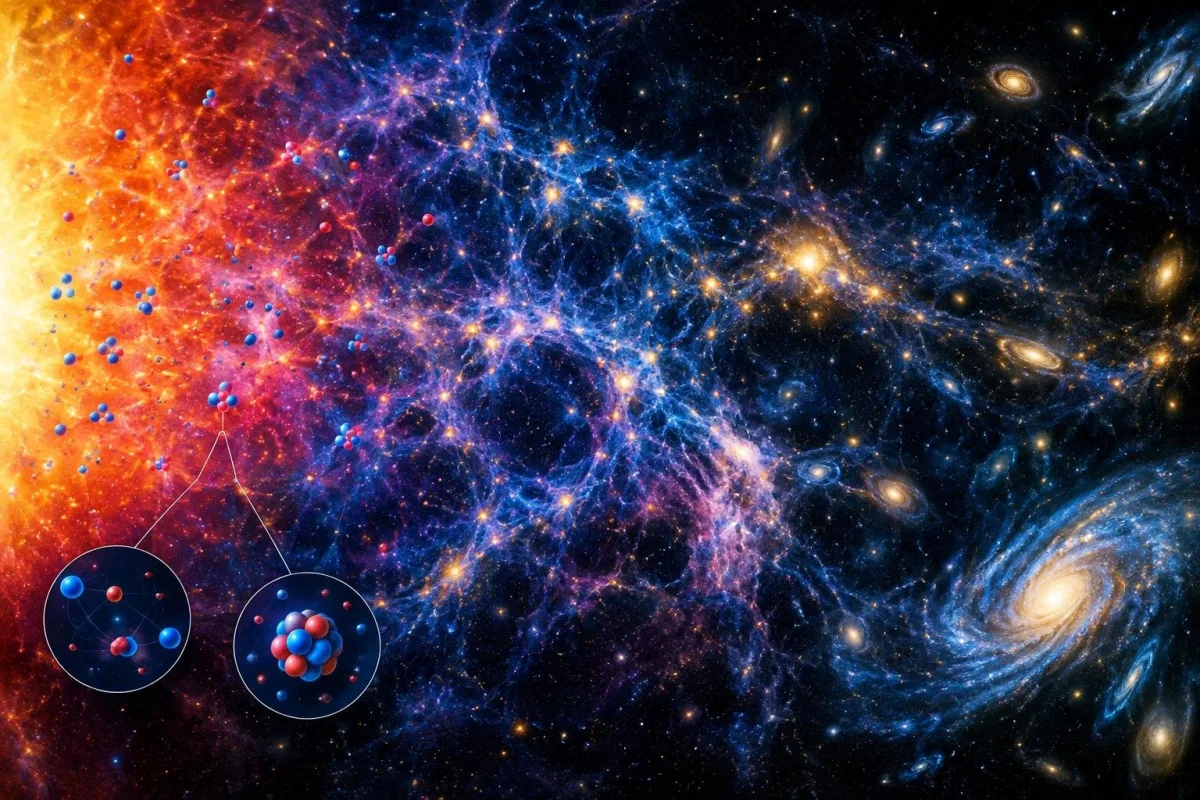
Researchers at the Center for Astrophysics | Harvard & Smithsonian have developed Lumina, a comprehensive simulation of the early universe, which explores the interactions of matter, dark matter, and radiation during the first two billion years after the Big Bang. This simulation is detailed in a study published in the Monthly Notices of the Royal Astronomical Society.
Lumina is reportedly the largest cosmological radiation-hydrodynamics simulation ever created. It simulates a cosmic volume of 500 megaparsecs, approximately 1.6 billion light-years, allowing scientists to observe the emergence of galaxies and the evolution of cosmic structures.
Oliver Zier, the study’s lead author, commented, “With JWST, the early universe has become an exciting new frontier in astrophysics.” Zier emphasized that translating theoretical models into detailed predictions was essential for understanding the observations made by the James Webb Space Telescope (JWST) and the Nancy Grace Roman Space Telescope (NGRST).
While the JWST has been operational for a few years, NGRST, which launched recently, aims to further explore these cosmic processes. The combination of observations from these advanced telescopes with Lumina’s predictions is expected to enhance understanding of how galaxies formed and evolved.
The simulation captures two critical periods in cosmic history: hydrogen reionization and helium reionization. Hydrogen reionization allowed light to travel freely by stripping electrons from neutral hydrogen through ultraviolet radiation from early stars. In contrast, helium reionization was driven by higher-energy radiation from supermassive black holes and active galactic nuclei, a process not extensively studied until now.
Mark Vogelsberger, another study author from MIT, stated, “Lumina does everything from small-scale star and galaxy formation to large-scale re-ionization.” He noted this simulation is 100 times larger in volume than previous best simulations, offering unprecedented detail.
To create Lumina, the team employed over 15,000 graphics processing units on the Frontier supercomputer, one of the world’s fastest. The simulation resolves cosmic scales and individual galaxies, enhancing the precision of astrophysical models.
Lumina is positioned as a valuable tool for researchers to validate their theories against observational data from current and future telescopes, aiming to piece together the complexities of the universe’s early formation.

Bhupendra Singh Chundawat is a seasoned technology journalist with over 22 years of experience in the media industry. He specializes in covering the global technology landscape, with a deep focus on manufacturing trends and the geopolitical impact on tech companies. Currently serving as the Editor at Udaipur Kiran, his insights are shaped by decades of hands-on reporting and editorial leadership in the fast-evolving world of technology.