

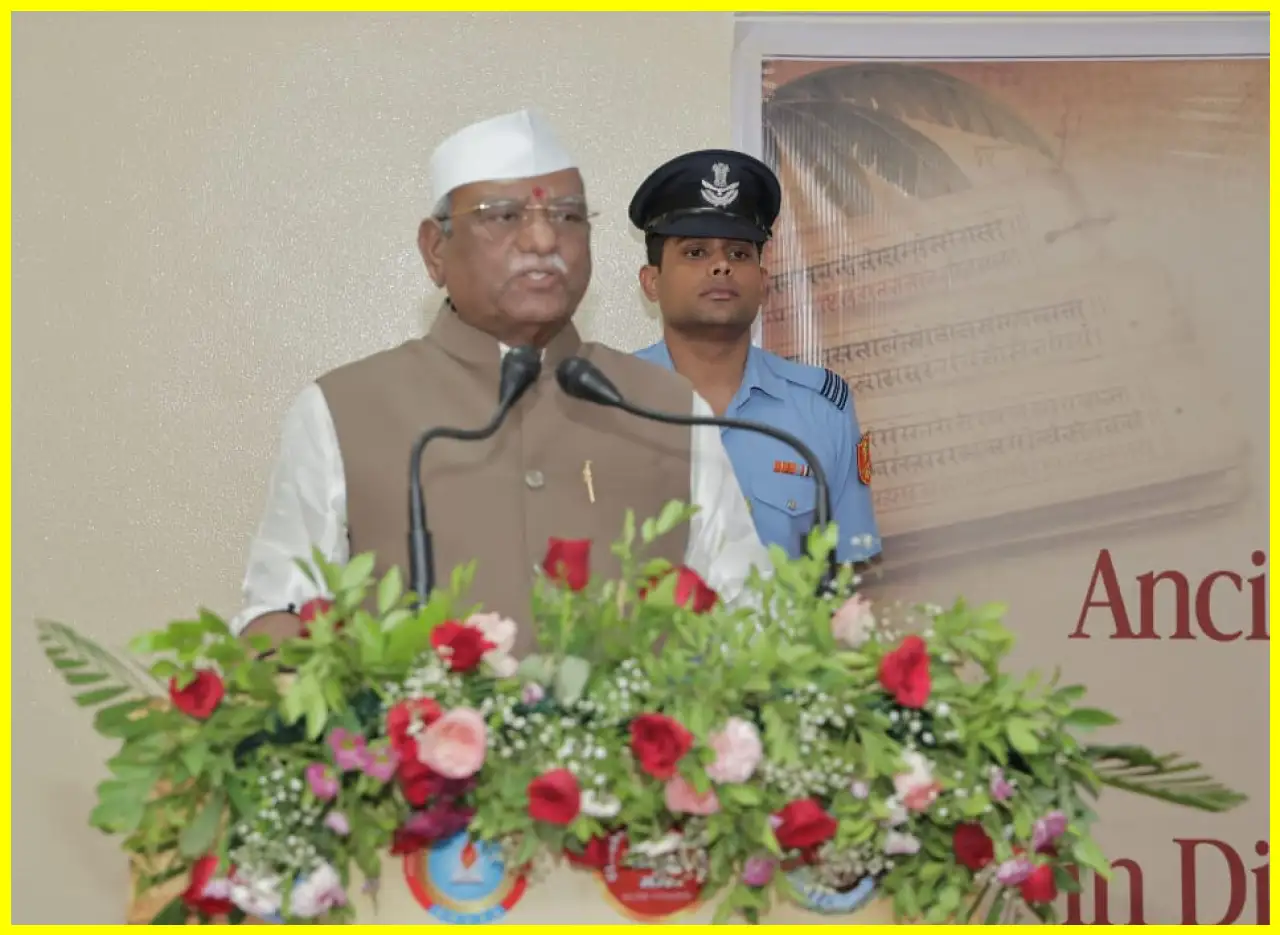

Udaipur: Rajasthan Governor Haribhau Kishanrao Bagde stressed the need for research and study of ancient Indian knowledge traditions across the world, saying India’s knowledge tradition has remained intact through the ages.
He was speaking at the closing ceremony of a two-day international seminar on “Ancient Indian Knowledge Tradition: Modern Dimensions of Knowledge and Science” organised jointly by the Department of History, Faculty of Social Sciences and Humanities, Pacific Academy of Higher Education and Research University, Global Sanskrit Forum and Global History Forum.
Governor Bagde said foreign philosophers, linguists and writers have also recognised various aspects of India’s knowledge tradition, including its intellectual traditions, rich language, philosophy and ideas related to atomism. He said that before the arrival of the British, India had a large network of gurukuls, schools and ashrams supporting education and knowledge.
He also spoke about the role of Bappa Rawal in fighting foreign invaders and presented references related to his contribution. He also linked the name Rawalpindi with Bappa Rawal.
In his welcome address, PAHER University Vice-Chancellor Prof Hemant Kothari highlighted the need for research into India’s traditional knowledge. He said local knowledge and sacred geometry could provide an important base for modern innovation.
Prof Kothari urged the academic and scientific community to look at India’s shared heritage not only as a part of history but also as a source of ideas for scientific development and the growing field of artificial intelligence.
Pacific University Group Chairman Prof B.P. Sharma said ancient Indian knowledge has relevance to many modern fields. He said Sanskrit literature contains knowledge that is being studied by researchers in India and abroad.
He referred to research related to yoga and deep breathing and said such studies are being carried out to understand their possible effects on stress and health.
Rebecca Taylor from Australia, who represented the University of Alberta and Portugal, spoke about the continuing relevance of ancient Indian knowledge systems. She discussed ancient Indian sculpture traditions and said modern artistic expression also carries geometric patterns and spiritual elements similar to those seen in ancient temples.
Mohanlal Sukhadia University Vice-Chancellor Prof Kailash Daga was also present at the programme.
Organising Secretary Prof Ajatshatru Singh Shivratri said 222 research papers were presented during the seminar. Seminar Director Prof T.P. Ameta proposed the vote of thanks.
Prof Dilendra Hiran and Prof Hemant Pandya were appreciated for their contribution to the successful organisation of the seminar.
Prof Pradeep Singh of M.S. University, Baroda, Prof Akhilesh from Indore, historian Dr J.K. Ojha, Dr Rajendra Nath Purohit, Laxman Singh Karanawat, Prof Digvijay Bhatnagar, Dr Manoj Dadich, Dr Ram Singh Rathore, Dr Surendra Chauhan, Dr Ahmed from Sudan, Dr Rakesh Ramawat and Inder Singh were among the academics and scholars present.
The programme was conducted by Prof Mehndi.

Bhupendra Singh Chundawat is a seasoned technology journalist with over 22 years of experience in the media industry. He specializes in covering the global technology landscape, with a deep focus on manufacturing trends and the geopolitical impact on tech companies. Currently serving as the Editor at Udaipur Kiran, his insights are shaped by decades of hands-on reporting and editorial leadership in the fast-evolving world of technology.