

NASA’s Voyager 1 Set to Reach One Light-Day Distance by 2026
NASA's Voyager 1 is set to become the first human-made object to reach one light-day from Earth, traveling over 26 billion kilometers in interstellar space.

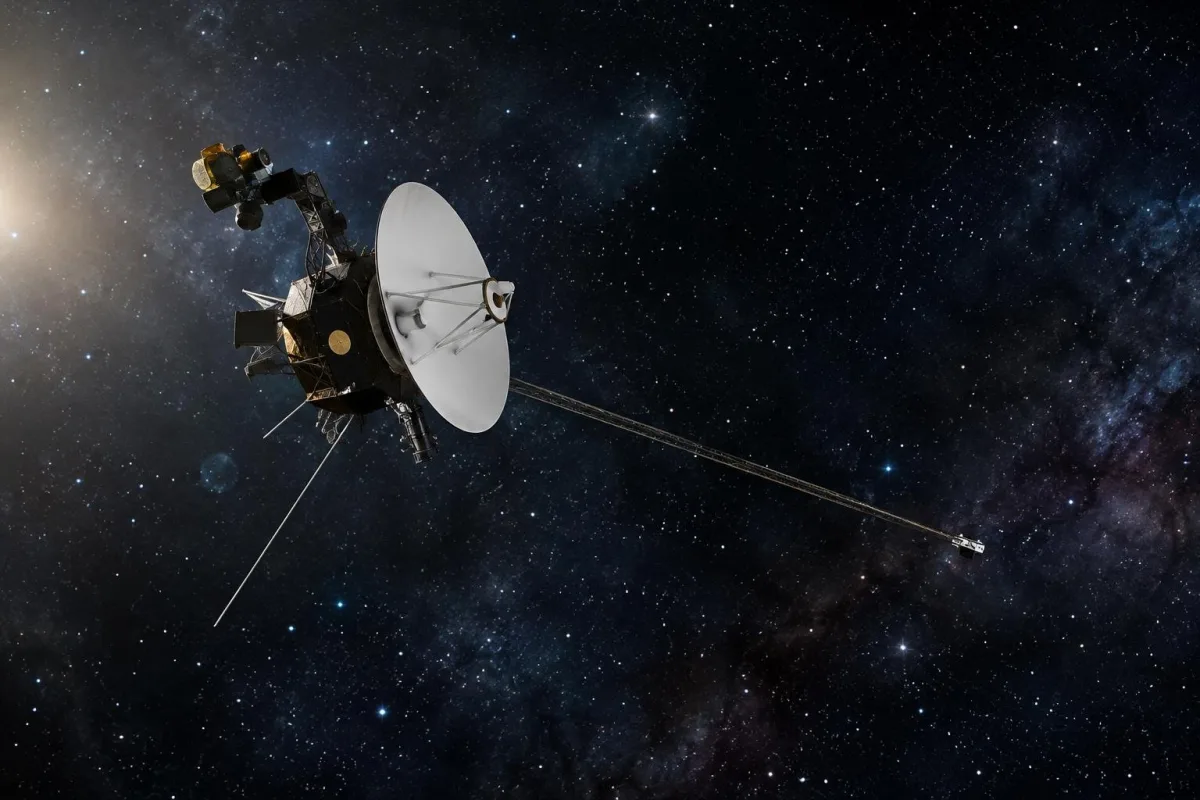
CALIFORNIA, Nov 15: NASA’s Voyager 1 is on the verge of becoming the first human-made object to reach a distance equivalent to one light-day from Earth, over 26 billion kilometers. This milestone is expected on November 18, 2026.
Launched nearly 50 years ago in 1977, Voyager 1 has traveled so far that it now takes 24 hours for light signals to reach it from Earth. The spacecraft has been sending back valuable scientific data since entering interstellar space in 2012, after completing its primary mission of exploring the outer planets.
Project manager Suzanne Dodd described Voyager 1 as “a national treasure,” noting its significance in understanding our cosmic environment. “It’s really extraordinary,” she stated. To mark this achievement, NASA encourages global participation in an event called “Shine Bright for Voyager’s Light-Day,” where people can use their phones to flash the call sign ‘VGR’ in Morse code.
Despite challenges typical of aging technology, Voyager 1 continues to operate and relay scientific information, including data about magnetic fields and cosmic rays. The spacecraft travels at a speed of approximately 61,000 kilometers per hour.
NASA plans to host a discussion on November 19 at the Jet Propulsion Laboratory in California, where officials will discuss the operation of Voyager 1 and 2 and their ongoing contributions to science. Both probes are managed by a small team of engineers who provide commands weekly to maintain their functionalities.
Looking ahead, it will take Voyager 1 about 18,000 years to travel an entire light-year and even longer before it reaches another star. Its twin, Voyager 2, is projected to hit the one light-day mark in 2035.