

NASA’s CHAPEA Mars mission crew completes 378 days of isolation
Four volunteers have emerged from a year-long Mars simulation at NASA's Johnson Space Center, completing the CHAPEA mission.

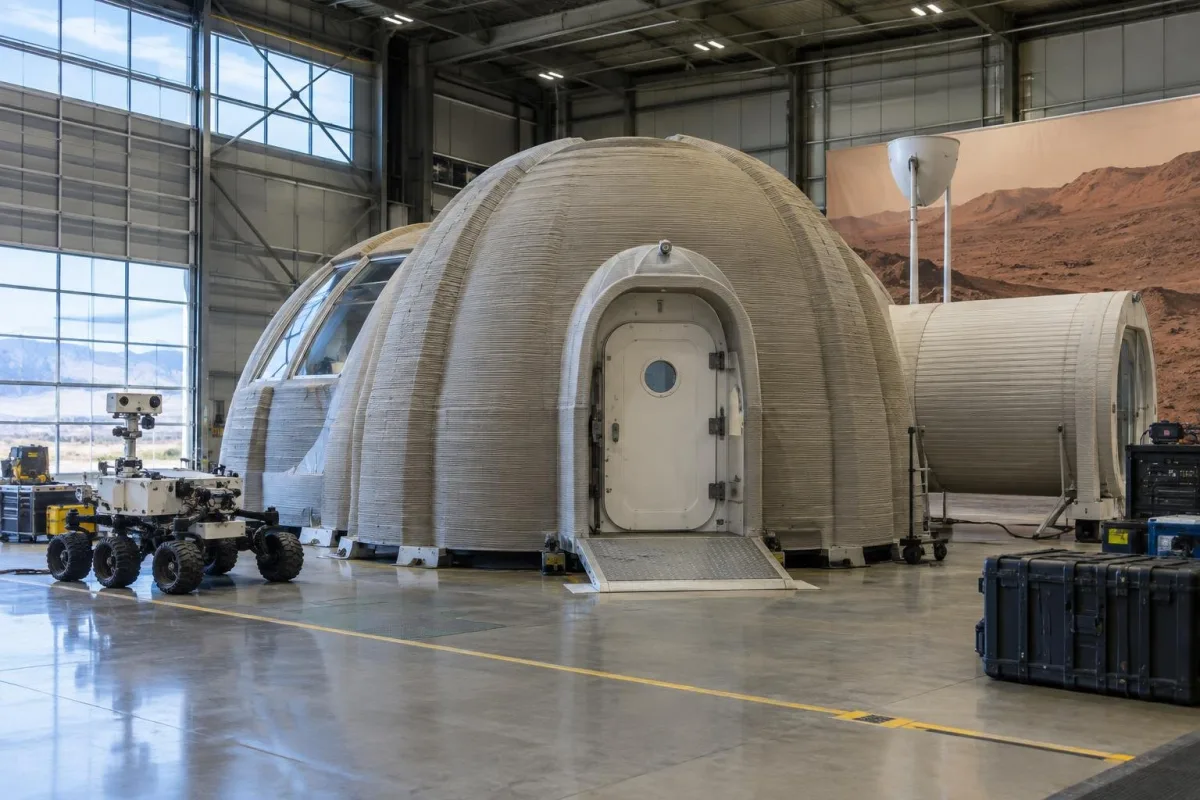
HOUSTON, Nov 2: Four volunteers concluded their year-long Mars simulation mission on Saturday after spending 378 days in a 1,700-square-foot facility at NASA’s Johnson Space Center in Houston. The crew members—commander Ross Elder, medical officer Ellen Ellis, science officer Matthew Montgomery, and flight engineer James Spicer—were greeted by friends and family as they stepped outside for the first time since October 19, 2025.
During their isolation, the crew conducted essential research to inform human exploration of Mars and the Moon. They faced challenges similar to those expected during a real Mars mission, including communication delays of up to 44 minutes and limited resources. NASA’s CHAPEA mission, which stands for Crew Health and Performance Exploration Analog, aimed to replicate living conditions on Mars.
Vanessa Wyche, director of the Johnson Space Center, emphasized the groundbreaking nature of the mission, stating, “For more than a year, they have lived in an isolated environment, conducting critical research.” She noted that the crew maintained their habitat, grew crops, and executed simulated operations that could occur on Mars.
Commander Elder expressed optimism about future Mars missions, stating, “The goal of putting humans on Mars is achievable, but rather inevitable.” The crew’s experience included a two-week communication blackout, simulating potential challenges they might encounter on the Red Planet.
Throughout the mission, the team engaged in various activities, including simulated spacewalks, habitat maintenance, and cultivating plants. They were isolated from the outside world significantly, with Elder joking that their knowledge of current events was delayed. Spicer shared that he received over 4,000 emails during the mission, which they could only read after leaving the simulation.
The CHAPEA mission was designed to provide foundational data that will inform future human exploration missions, including considerations for NASA’s Artemis program and a proposed lunar base. NASA is preparing to transition to a more comprehensive Mars and Moon Exploration Analog (MMEA) program, with simulated operations slated to begin as early as August 2027.
In the next two weeks, the crew will undergo evaluations with NASA scientists to analyze data collected during the mission. This period will be crucial for assessing crew performance and ensuring future readiness for deep space exploration.
“These miraculous achievements lay the foundation for long-duration deep-space exploration,” Elder said.
Sources

My name is Kuldeep Singh Chundawat. I am an experienced content writer with several years of expertise in the field. Currently, I contribute to Daily Kiran, creating engaging and informative content across a variety of categories including technology, health, travel, education, and automobiles. My goal is to deliver accurate, insightful, and captivating information through my words to help readers stay informed and empowered.