

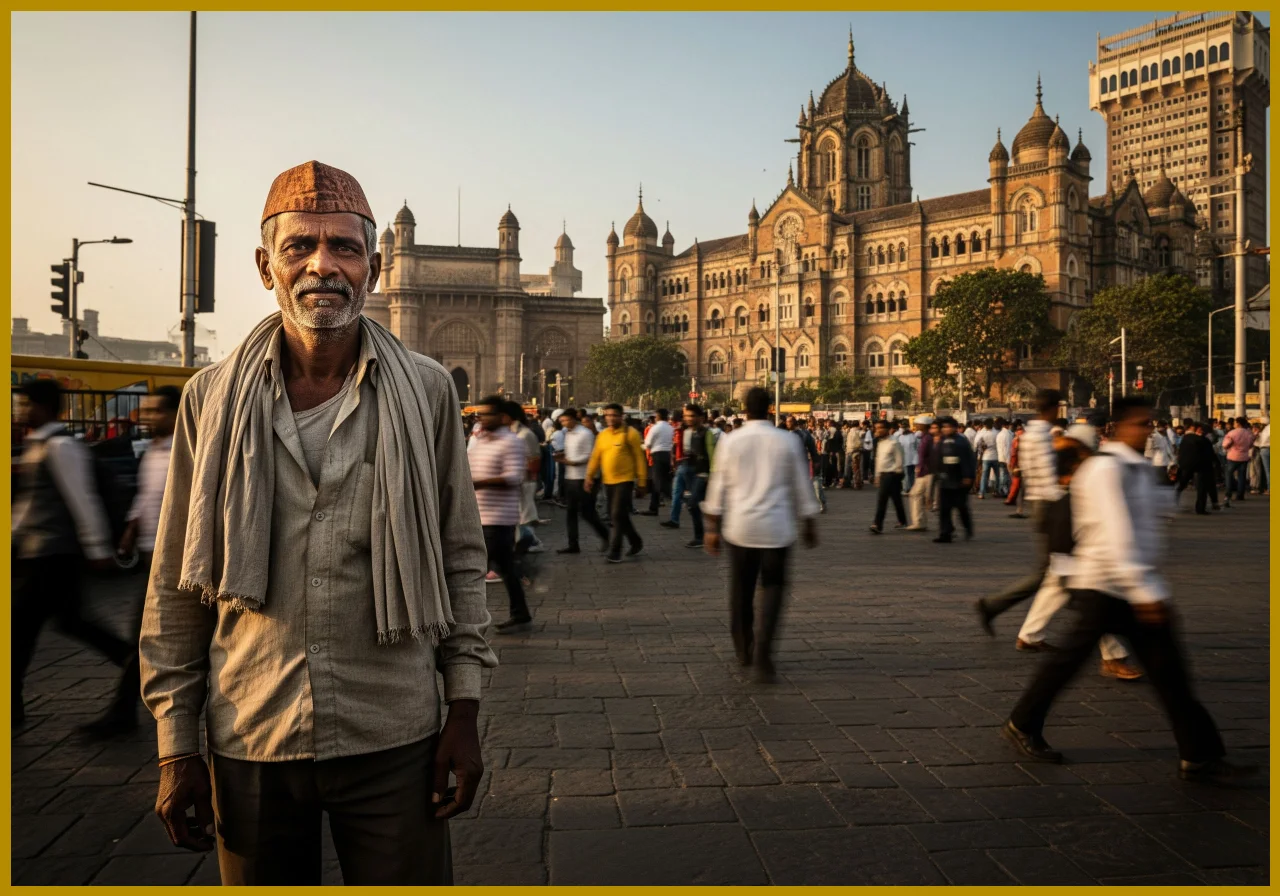

Mumbai, the country’s financial capital, was founded on the struggles of the Marathi-speaking community and the sacrifices of 106 martyrs during the united Maharashtra movement. However, today serious questions are being raised about the existence and identity of the Marathi community in Mumbai, causing increasing concern.
For nearly 25 to 30 years, the Shiv Sena, led by Uddhav Thackeray, ruled the Brihanmumbai Municipal Corporation (BMC). The key question now is how much progress the Marathi community has made during this long tenure, or whether its position has weakened. This issue is openly being discussed among ordinary Marathi citizens.
Once considered the heart of Mumbai, areas like Lalbaug, Parel, Shivadi, Dadar, and Girgaum developed through the hard work of mill workers and the deep roots of Marathi culture. Over the past two and a half decades, rapid cosmopolitan urbanisation has transformed these neighborhoods. The smokestacks of mills have gone silent, replaced by tall glass towers.
The biggest victim of this transformation has been the Marathi community. The previous municipal government had promised that Marathi residents would be provided housing in the new developments. However, the reality was different. Marathi families were displaced from South and Central Mumbai and forced to settle in outer areas like Virar, Karjat, Kasara, and Badlapur. The very people around whom political rhetoric was built are gradually disappearing from Mumbai’s landscape.
Economic empowerment is the foundation of any community’s progress. With an annual BMC budget exceeding ₹50,000 crore, growing into lakhs of crore over 25 years, questions arise about how many Marathi entrepreneurs or contractors have truly emerged during this period.
There are allegations that in tenders for roads, drainage, and bridge construction, priority was not given to local Marathi youth but rather to a limited group of influential players. If the municipal government was truly committed to Marathi interests, then why are Marathi names missing from the list of top contractors in Mumbai?
Experts note that the Marathi community has been largely confined to small businesses like selling vada pav and bhaji, while major economic control remained with a few individuals.
Emotional slogans like ‘Marathi Manush’, ‘Marathi Identity’, and ‘Attack on Mumbai’ have been effective during elections. However, critics argue that these slogans have not translated into concrete opportunities during the time in power.
The decline of Marathi education is a clear example. Marathi-medium schools under the municipal corporation have shut down and student numbers have fallen, while English-medium schools have expanded rapidly. Instead of granting Marathi the status of a classical language, it has been used primarily for electoral gains.
Marathi workers commuting daily from Badlapur and Virar face 4 to 5 hours of local train travel. Despite serving the city, their dream of living in Mumbai has faded. Affordable housing plans have not materialised, redevelopment projects benefited builders while original residents were displaced.
With the upcoming BMC elections and fears of losing power, claims to be protectors of the ‘Marathi Manush’ are resurfacing. But voters are now demanding accountability on children’s futures, employment, and housing rights rather than old assurances.
Political analysts believe that despite 25 years in power, the Marathi community’s overall progress remains unfulfilled. Marathi youth voices are clear: mere emotional speeches cannot sustain livelihoods.
The decreasing Marathi population in Mumbai is more than a statistic; it signals a significant political failure. Despite asserting their rights over Mumbai, the Marathi community has not achieved the expected status, which could be a decisive issue in the upcoming elections.

Bhupendra Singh Chundawat is a seasoned technology journalist with over 22 years of experience in the media industry. He specializes in covering the global technology landscape, with a deep focus on manufacturing trends and the geopolitical impact on tech companies. Currently serving as the Editor at Udaipur Kiran, his insights are shaped by decades of hands-on reporting and editorial leadership in the fast-evolving world of technology.