

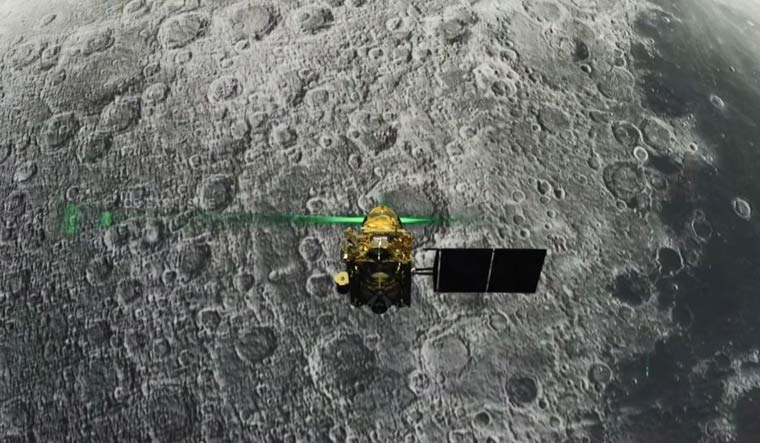
The Indian Space Research Organization (ISRO)-led Chandrayaan-2 mission has made a groundbreaking discovery that could redefine our understanding of the moon.
Recent discoveries from this mission have revealed significant water reserves in the Moon’s polar craters. This discovery is a victory for science and opens the possibility of future lunar exploration and long-term human colonization of the Moon.
Collaboration between ISRO’s Space Applications Center (SAC) and renowned institutes such as IIT Kanpur, University of Southern California, Jet Propulsion Laboratory and IIT (ISM) Dhanbad led to this important discovery.

The Photogrammetry and Remote Sensing Association shows that subsurface ice in the lunar polar craters is estimated to be five to eight times more abundant than surface ice, especially in the first few meters.
The implications of this discovery are far-reaching. Access to these water resources will be a key aspect in supporting exploration missions next month. Harnessing the Moon’s water resources can provide the necessary support for sustainable human existence, from life support to fuel production.
The study also shows regional differences in water ice distribution. The moon’s north pole has twice as much water ice as the south pole. These insights will be invaluable for mission planning and site selection for future lunar exploration.
The origin of groundwater ice dates back to the Imbrian Period, around 3.8 to 3.2 billion years ago. Volcanic activity and formation of impact basins and maria. The primary cause of this water ice is believed to be the release of gas during this period of volcanic activity.
The method used by the research team was comprehensive, using seven instruments on NASA’s Lunar Reconnaissance Orbiter (LRO). These included radar, lasers, optics, neutron spectrometers, ultraviolet spectrometers and thermoradiometers, which together contributed to a deeper understanding of the origin and distribution of water ice on the Moon.
The insights gained from this study are important for ISRO’s in-situ exploration programs on the Moon as well as landing sites for missions to explore and characterize lunar escape zones. As astronaut nations around the world set their sights on the moon, the presence of water ice becomes a strategic advantage. Providing local resources can reduce the cost and complexity of lunar missions and accelerate the pace of space exploration.
This discovery by ISRO scientists is an important moment in our quest to understand the Moon and harness its resources. It is a reminder of the relentless pursuit of knowledge and the spirit of collaboration that drives scientific progress.
As we continue to explore space, discoveries like these will undoubtedly shape the future of humanity’s relationship with the moon and the universe at large. The existence of water at the Moon’s poles is more than a scientific curiosity. It is the ray of hope that leads us into a new age of exploration and discovery.

Bhupendra Singh Chundawat is a seasoned technology journalist with over 22 years of experience in the media industry. He specializes in covering the global technology landscape, with a deep focus on manufacturing trends and the geopolitical impact on tech companies. Currently serving as the Editor at Udaipur Kiran, his insights are shaped by decades of hands-on reporting and editorial leadership in the fast-evolving world of technology.