Ancient Philosophy and Modern Science Should Not Be Seen as Competing Claims: Jahanvi Kumari
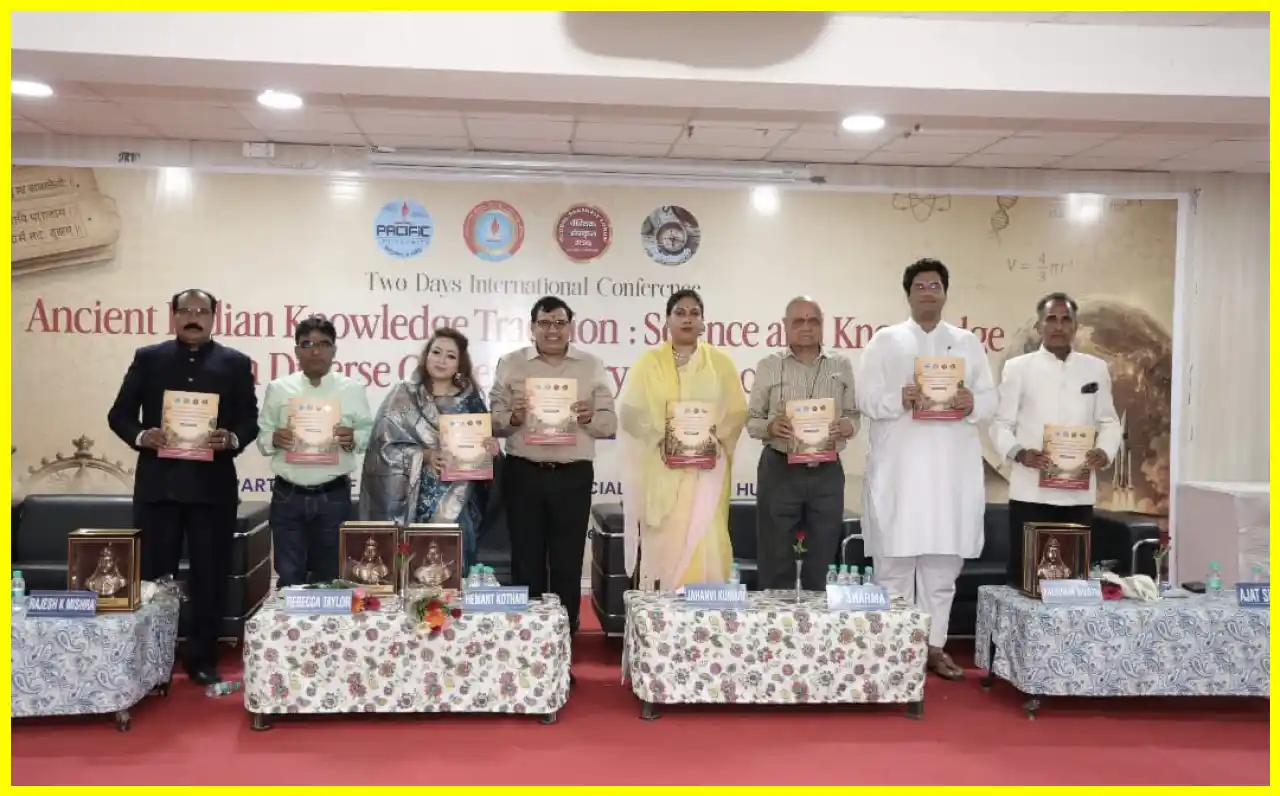

Udaipur: The dialogue between ancient philosophy and modern science should not be viewed as a competition over claims or proof, said Jahanvi Kumari Mewar at an international seminar on the relevance of ancient Indian knowledge traditions.
The two-day international seminar on “Ancient Indian Knowledge Tradition, Knowledge and Modern Dimensions of Science” is being organised jointly by the Department of History, Faculty of Social Sciences and Humanities, PAHER University, Global Sanskrit Forum and Global History Forum.
Speaking at the inaugural session, chief guest Jahanvi Kumari Mewar discussed the connection between India’s traditional heritage and modern curiosity. She presented her views on indigenous knowledge systems and modern scientific thinking and said both should be seen as areas that can learn from each other rather than as competing claims.
The keynote speaker, Australian scholar and Guinness World Record holder Rebecca Taylor, spoke about the deep artistic skill seen in sculpture and described it as a universal language that goes beyond geographical boundaries. She highlighted the long-lasting structure of ancient Indian knowledge systems and said these systems continue to offer ideas for modern academic research while connecting the heritage of earlier generations with present-day global scholarship.
Special guest Prof Anshuman Shastri, Director of Banasthali Vidyapith, stressed the importance of traditional knowledge in building a sustainable future. He said India’s ancient knowledge traditions could also offer useful ideas for making AI systems more human-oriented and for future developments towards Artificial General Intelligence and Artificial Super Intelligence.
PAHER Group Chairman Prof B.P. Sharma said the ancient Indian knowledge tradition had developed as a practical and scientific guide to life. He said centres such as Nalanda and Takshashila had played an important role in spreading knowledge across India and other parts of the world, and that traditional knowledge could offer useful perspectives on present-day mental, environmental and social challenges.
Prof Rajesh Kumar Mishra from the Ministry of Culture was also present as a special guest.
Presiding over the programme, PAHER University Vice-Chancellor Prof Hemant Kothari urged historians and social scientists to adopt AI and make use of modern technology in their work. He said the history of AI along with India’s collective ancient knowledge could play an important role in shaping future scientific progress.
Organising Secretary Dr Ajat Shatru Singh Shivratri said 222 research scholars registered for the seminar, while 148 scholars presented their research papers on the first day.
Senior historians, researchers and academics including Prof Dilbag Singh, Prof Mahesh Dixit, Vice-Chancellor of Kalla Ji Vedic University, Nimbahera, Dr Ahmed from Sudan, Tore Gulbrandsen from Norway, Dr Beima from Africa, Prof Akhilesh from Indore, Dr Mahendra Singh Tanwar, Director of Maharaja Man Singh Pustak Shodh Kendra, Mehrangarh, Prof Neeraj Sharma, Dean, Faculty of Social Sciences and Humanities, and Prof Neelam Kaushik participated in the seminar.
The discussions focused on different historical, scientific, social and modern aspects of India’s ancient knowledge traditions and their relevance in today’s world.

Bhupendra Singh Chundawat is a seasoned technology journalist with over 22 years of experience in the media industry. He specializes in covering the global technology landscape, with a deep focus on manufacturing trends and the geopolitical impact on tech companies. Currently serving as the Editor at Udaipur Kiran, his insights are shaped by decades of hands-on reporting and editorial leadership in the fast-evolving world of technology.