

NASA Concludes 22-Year Swift Space Telescope Mission
NASA's Swift space telescope has officially concluded its mission after nearly 22 years of operations and is expected to re-enter Earth's atmosphere soon.

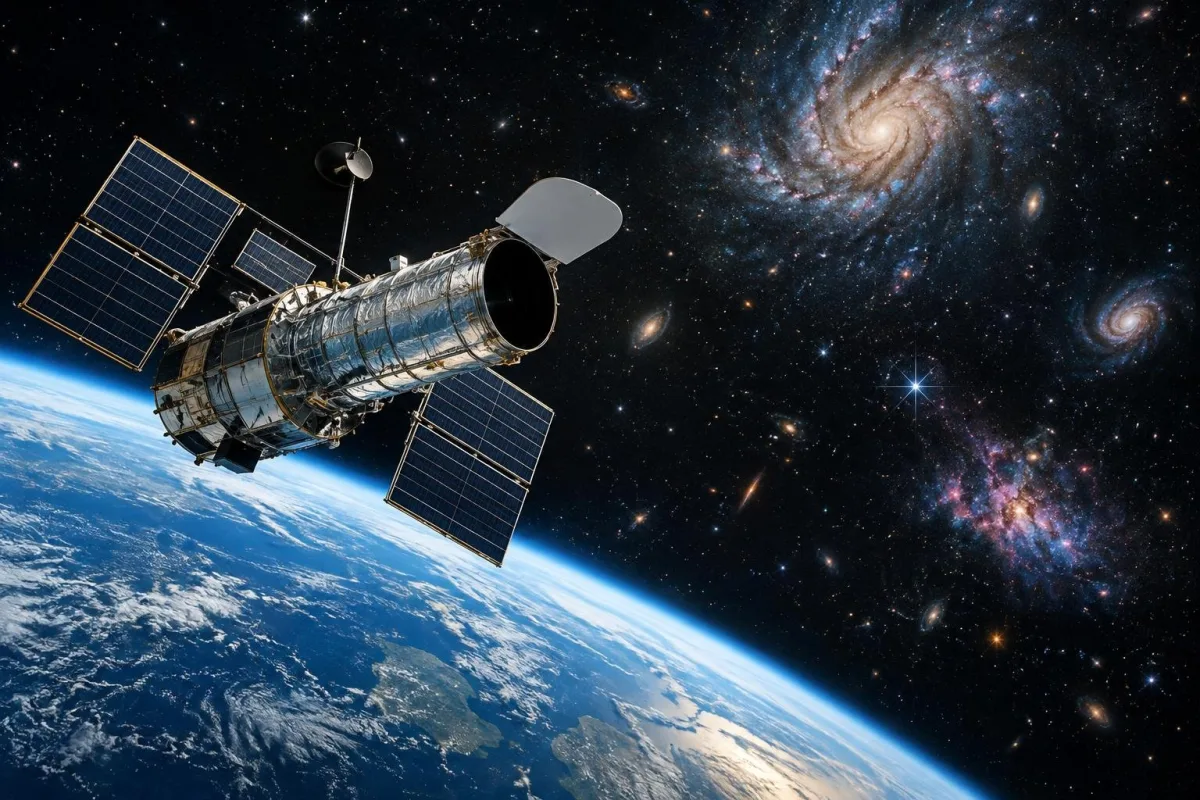
NASA has officially ended the mission of the Swift space telescope, concluding nearly 22 years of operations focused on powerful cosmic events. The decision follows a failed attempt by a private company to boost the telescope’s orbit, with the spacecraft now expected to re-enter Earth’s atmosphere in the coming weeks.
Launched in November 2004, the Neil Gehrels Swift Observatory was initially designed for a two-year mission to study gamma-ray bursts (GRBs), but it continued to operate and gather data well beyond its expected lifespan. According to NASA, Swift has observed over 2,000 GRBs and captured significant astronomical events, including more than 1,400 supernovae and active black holes.
Recent solar activity intensified atmospheric drag on Swift, accelerating its descent from an altitude of 171 miles (275 kilometers). The spacecraft’s operations team at Penn State University sent a command to effectively end the mission on October 20, 2026, shortly after Swift entered safe mode due to its inability to maintain altitude.
A high-risk servicing mission was initiated in July to rescue Swift. Katalyst Space Technologies designed a spacecraft named LINK to capture and boost Swift to a higher orbit. However, LINK encountered propulsion issues during its mission and failed to achieve the rescue, leading to the decision to end Swift’s scientific operations.
Shawn Domagal-Goldman, the director of NASA’s Astrophysics Division, expressed sadness over the mission’s conclusion but emphasized its scientific contributions, stating, “Swift leaves us with an extraordinary archive of multiwavelength observations that will fuel new discoveries for decades more.” The mission’s data has resulted in approximately 7,000 published research papers.
Although the Swift Observatory has ceased operations, its extensive archive continues to hold valuable data for future research. NASA currently has no direct replacement for Swift but is exploring options to utilize its existing fleet of space telescopes to support rapid responses to cosmic events.

My name is Kuldeep Singh Chundawat. I am an experienced content writer with several years of expertise in the field. Currently, I contribute to Daily Kiran, creating engaging and informative content across a variety of categories including technology, health, travel, education, and automobiles. My goal is to deliver accurate, insightful, and captivating information through my words to help readers stay informed and empowered.