

Astronomers Discover Black Hole Behind 15 Years of Supernova Mimicry
NASA's Chandra X-ray Observatory reveals that AT 2016blu, a massive star, is being fed by a hidden black hole, explaining its repeated outbursts.

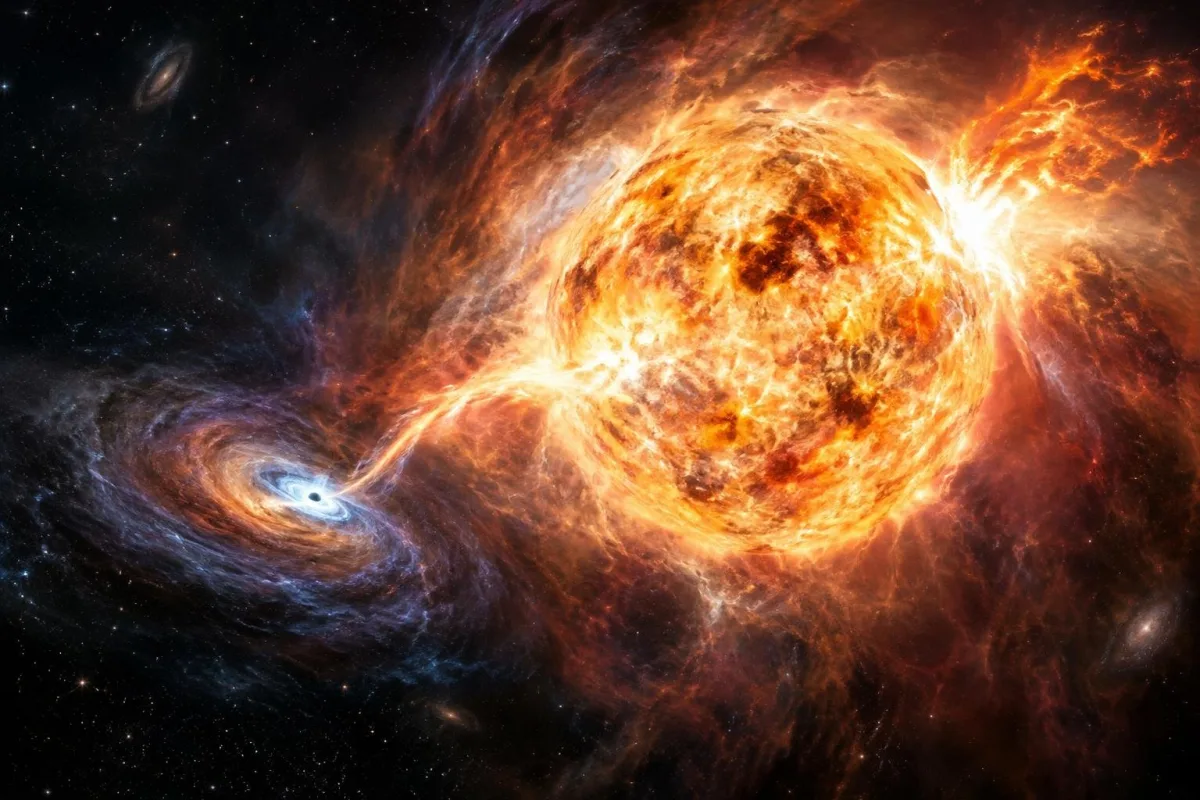
NEW DELHI, Nov 13: Astronomers have identified the cause behind the behavior of a massive star known as AT 2016blu, which has been mimicking supernova explosions. The discovery, confirmed by NASA’s Chandra X-ray Observatory, reveals that a hidden black hole or neutron star is pulling material from this unstable star, resulting in periodic outbursts.
Located in the spiral galaxy NGC 4559, approximately 30 million light-years from Earth, AT 2016blu has exhibited at least 27 bright eruptions since its initial observation in 2012, leading scientists to suspect they were witnessing supernovae. However, the star consistently survived these events, prompting researchers to label it a “supernova imposter.” “For 15 years, astronomers have been watching this star get really bright and then dim again on a regular basis,” said Mojgan Aghakhanloo from the University of Virginia.
The recent study, published in The Astrophysical Journal, utilized Chandra’s X-ray capabilities to uncover the star’s companion. This companion is theorized to be a compact object in an elliptical orbit, exerting strong gravitational influence that causes material from AT 2016blu to be ejected and heated into X-rays.
Núria Torres-Albà, also from the University of Virginia, noted that a new approach was necessary to understand these eruptions, stating, “To understand the cause of these eruptions, we realized we needed X-ray data.” Chandra’s observations confirmed that during the closest approaches between the two celestial bodies, material from the star falls towards the compact object, forming an accretion disk that gets hot enough to emit X-rays, subsequently causing the star to shine brightly in optical wavelengths.
This periodic activity occurs roughly every 113 days, a pattern that distinguishes AT 2016blu from true supernovae, which do not survive their explosive ends. The researchers suggest this could link supernova imposters with ultra-luminous X-ray sources, which remain poorly understood and are typically associated with compact objects.
The findings may also offer insights into other massive stars that display similar brightness variations and their evolutionary paths leading up to actual supernova explosions. The study emphasizes the importance of Chandra’s sharp X-ray vision in resolving cosmic mysteries.
“We suspected that the bright repeating flashes at optical wavelengths might actually be powered by periodic blasts of high-energy X-rays,” said Nathan Smith, co-author and an astronomer from the University of Arizona. This work demonstrates how advanced observatories like Chandra can enhance our understanding of the complex dynamics within distant star systems.