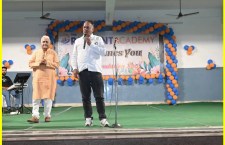




The discussions were part of an online celebration of ‘Himalaya Diwas’ by Wadia Institute of Himalayan Geology (WIHG), an autonomous institute of the Department of Science & Technology, Government of India, last week.
Dr. Vikram Gupta, scientist, WIHG, spoke about some fundamental concepts of ‘Landslide Disaster Risk Reduction (L-DRR) Strategy and emphasised the importance of risk reduction caused by the landslide. He explained how risk reduction measures are a good investment and said that for risk management, it is always better to have a good understanding of landslide processes.
While delivering a lecture on ‘Himalayan Seismicity, Risk Awareness, and Mitigation’, Dr. Ajay Paul, a scientist from the institute, explained how the Himalayan region is prone to earthquake activity. He described how an earthquake could be hazardous to the various lifeline of the people and explained what one should do before an earthquake, during an earthquake, and after an earthquake, which can mitigate the hazardous impacts of an earthquake.
Elucidating the ‘Journey of Black Carbon towards Himalayan Cryosphere,’ Dr. Chhavi P. Pandey, from the institute, said that black carbon aerosol plays a unique and important role in the Himalayan environment. She explained how transportation of Black carbon and other pollutant takes place towards the Himalaya cryosphere.
Dr. Sameer Tiwari, also from the institute, highlighted the ‘Use of Geothermal Resources for heat utilization. He described that geothermal energy is relatively clean and renewable and hence becoming a preferred choice for an alternative energy resource for the future. He said that WIHG has been monitoring around 40 active geothermal springs from the Garhwal and Kumaun Himalayan regions of Uttarakhand. Dr. Rajesh Sharma, senior scientist at WIHG, coordinated this event.

Bhupendra Singh Chundawat is a seasoned technology journalist with over 22 years of experience in the media industry. He specializes in covering the global technology landscape, with a deep focus on manufacturing trends and the geopolitical impact on tech companies. Currently serving as the Editor at Udaipur Kiran, his insights are shaped by decades of hands-on reporting and editorial leadership in the fast-evolving world of technology.