

MIT and Harvard Simulate the Universe’s First 2 Billion Years
Scientists at MIT and Harvard have developed a simulation called Lumina, modeling the universe's first 2 billion years to enhance understanding of cosmic evolution.

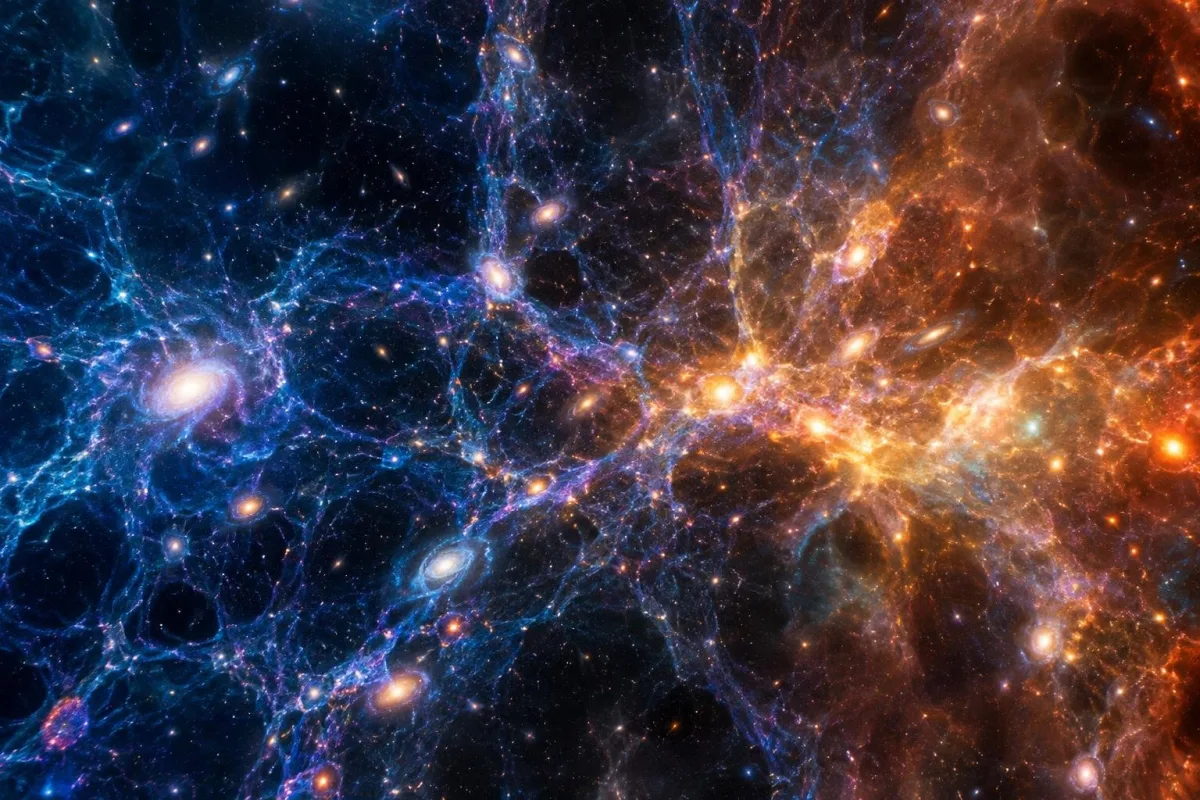
SAN JOSE, Oct 28: Researchers at MIT and Harvard University have developed a powerful computer simulation, Lumina, which reconstructs the universe’s first 2 billion years. This simulation, considered one of the most detailed ever created, allows scientists to visualize cosmic evolution in unprecedented clarity and scale.
Lumina operates on Frontier, one of the fastest supercomputers globally, utilizing over 15,000 graphics processing units to track interactions between gas, dark matter, and light across a significant volume of space. The simulation spans approximately 1.5 billion light-years on each side, making it about 100 times larger than previous models.
Mark Vogelsberger, a physics professor at MIT and a study author, explained, “Lumina does everything from small-scale star and galaxy formation to large-scale re-ionization of hydrogen and helium, in a volume that is 100 times larger than previous best simulations.” The model’s advancements enable astronomers to compare its predictions with real data gathered from modern space telescopes, such as the James Webb Space Telescope.
The research team published their findings in the Monthly Notices of the Royal Astronomical Society, highlighting how Lumina can assist in assessing current theories about cosmic evolution and identify areas that may require further investigation. Lead author Oliver Zier expressed that the collaboration with data from telescopes like JWST is vital for understanding early universe phenomena, stating, “With JWST, the early universe has become an exciting new frontier in astrophysics.”
Lumina’s unique approach also includes a detailed analysis of helium reionization, a process previously less understood compared to hydrogen reionization. The simulation captures how radiation from stars and active galactic nuclei influenced this transformation, providing insights into the relationships among evolving galaxies and the gas surrounding them.
The capabilities of Lumina provide a broader view of cosmic events and facilitate examinations of phenomena such as the movement of gas between galaxies and the influence of residual radiation from the Big Bang. The findings promise to aid scientists in refining their understanding of the universe’s formative years and could reveal new aspects of cosmic history.
As researchers share Lumina with astronomers worldwide, they anticipate that ongoing comparisons with observational data will yield significant revelations about the universe’s early development and the fundamental laws governing it.

Bhupendra Singh Chundawat is a seasoned technology journalist with over 22 years of experience in the media industry. He specializes in covering the global technology landscape, with a deep focus on manufacturing trends and the geopolitical impact on tech companies. Currently serving as the Editor at Udaipur Kiran, his insights are shaped by decades of hands-on reporting and editorial leadership in the fast-evolving world of technology.