

Gujarat Assembly Passes Stricter School Regulations and Special Educator Provisions
The Gujarat Assembly has approved amendments to enhance regulations for schools and establish provisions for special educators.
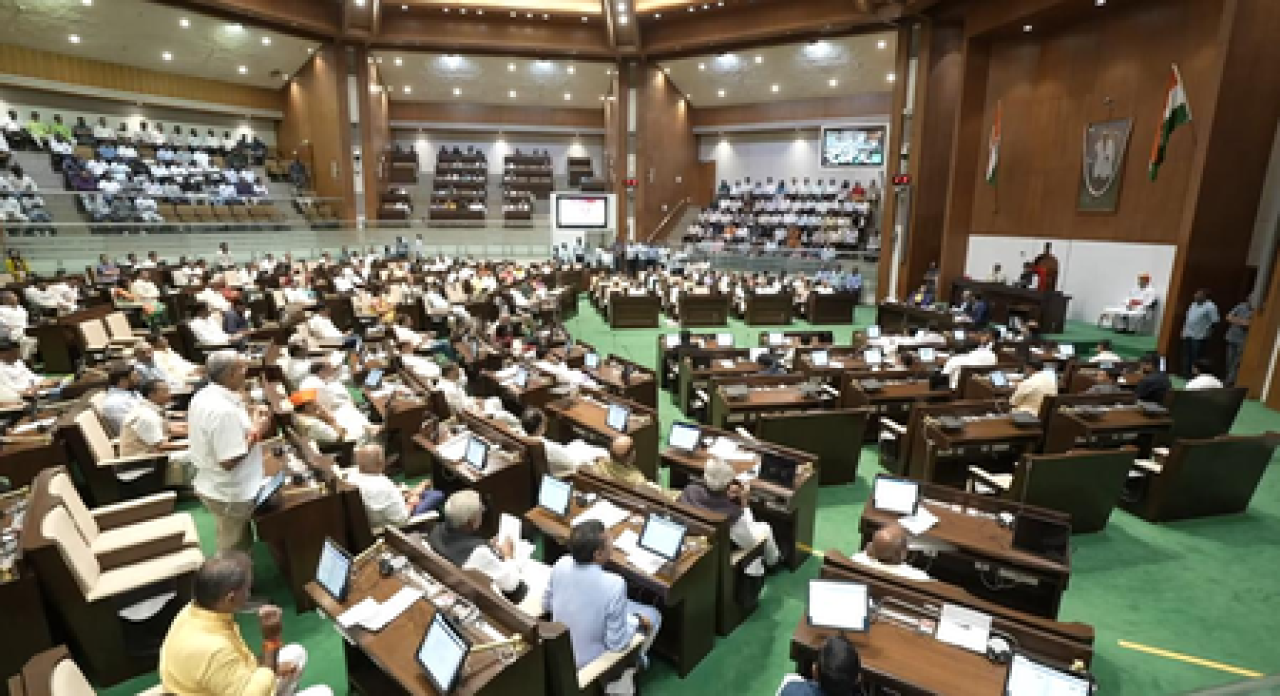

Gandhinagar, September 10 (Udaipur Kiran) : The Gujarat Assembly has recently passed significant amendments to the Gujarat Secondary and Higher Secondary Education Act, 1972, aimed at tightening regulations for schools and enhancing the framework for special educators.
Under the new amendments, penalties for operating schools without proper authorization, making illegal appointments, and arbitrarily closing registered schools have been increased significantly. The government stated that the objective of these rules is to bring greater transparency to the recruitment process.
For secondary and higher secondary schools receiving government aid, illegal appointments of principals or teachers could now result in fines of up to ₹10 lakh, a drastic increase from the previous fine of just ₹1,000.
The amendments also impose stricter laws on unregistered schools, mandating that no educational institution can operate without registration from the Gujarat Secondary and Higher Secondary Education Board. Previously, fines for unregistered schools ranged from ₹1 lakh to ₹2 lakh, but under the revised rules, offenders could face one to two years in jail, fines between ₹10 lakh to ₹15 lakh, or both.
Additionally, the penalties for registered schools that close without proper notice have been raised. Previously, a fine of ₹1,000 was levied for not providing the required six-month notice during an academic session; this has now been increased to ₹20 lakh.
The government emphasized that these measures are designed to ensure that decisions made by school management do not adversely affect students’ education. The six-month notice requirement remains a part of the regulations.
The amendments also lay the groundwork for the appointment of special educators, aiming to strengthen inclusive education for children with special needs. This is intended to provide disabled students with appropriate educational opportunities and guidance from specially trained teachers.
Furthermore, the new law differentiates between grant-in-aid schools and completely private institutions. For registered secondary and higher secondary schools receiving government assistance, the qualifications, working methods, and selection processes for principals, teachers, special educators, and non-teaching staff will be determined by state government regulations.
For registered private schools, the government will set qualifications for these staff categories, and the existing reservation policy will apply to staff recruitment.
Changes have also been made to the composition of Class-B elected members under Section 3(2) of the Act. A member will now be elected from among the teachers of registered secondary schools, excluding post-basic and government schools. Existing rules already govern representatives from government schools, higher basic schools, and higher secondary schools.
Additionally, modifications were made to include non-teaching staff from both government-aided private schools and fully private secondary and higher secondary schools in the fifth category. The scope of the ninth category, related to parent association representation, has also been expanded.
The term ‘private’ has been removed from this provision, allowing all registered secondary and higher secondary schools’ parent association presidents to participate in the election process. Amendments have also clarified the interpretation of this provision to include parent associations from both types of schools explicitly.

Bhupendra Singh Chundawat is a seasoned technology journalist with over 22 years of experience in the media industry. He specializes in covering the global technology landscape, with a deep focus on manufacturing trends and the geopolitical impact on tech companies. Currently serving as the Editor at Udaipur Kiran, his insights are shaped by decades of hands-on reporting and editorial leadership in the fast-evolving world of technology.