

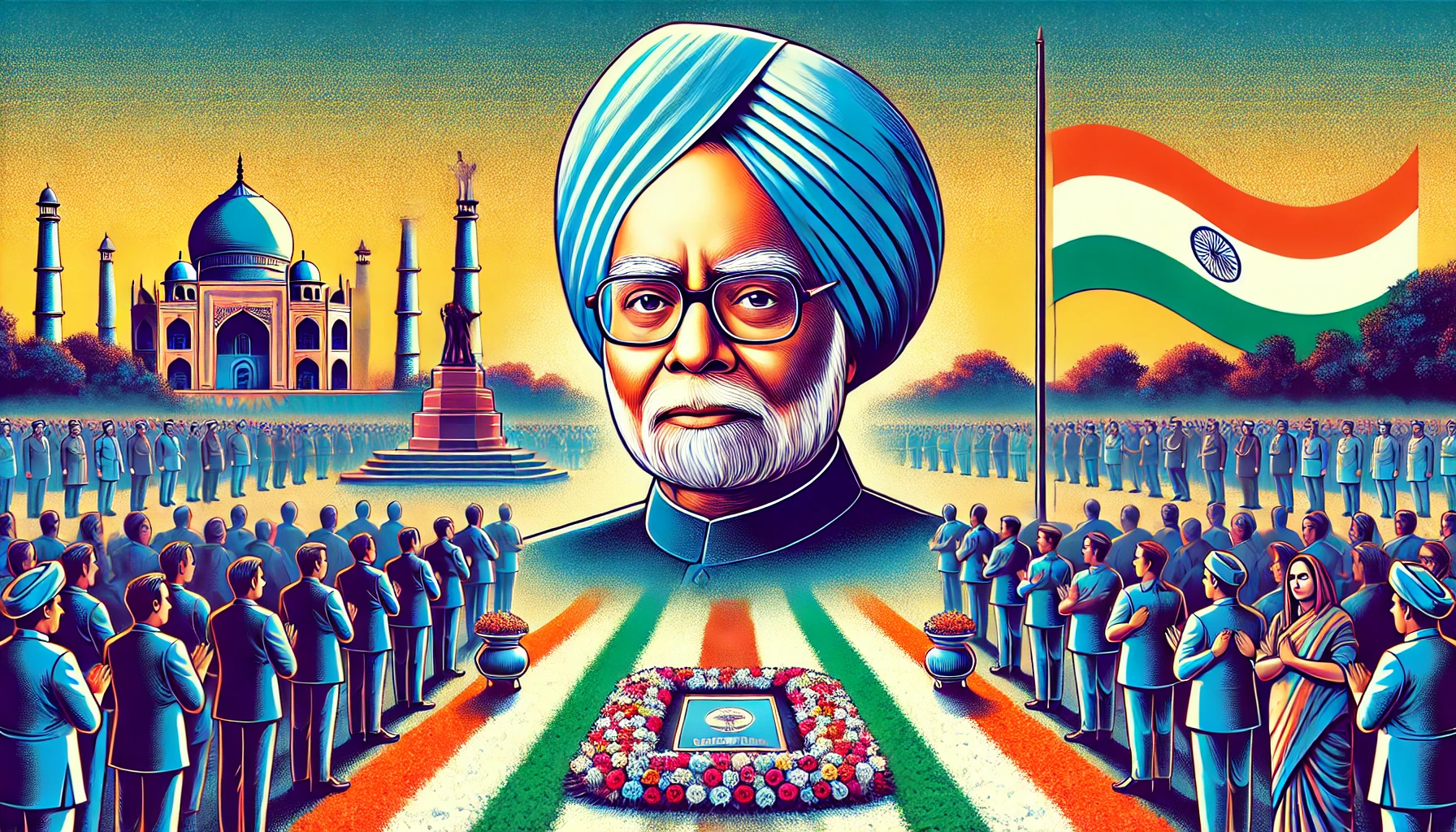
New Delhi, December 27 – Former Prime Minister Dr. Manmohan Singh passed away on Thursday night at the age of 92 at the All India Institute of Medical Sciences (AIIMS), Delhi. He breathed his last at 9:51 PM, following health complications. The central government has announced a seven-day national mourning to honor the late leader.
In this period of grief, a cabinet meeting has been scheduled for 11:00 AM on Friday to pay homage to Dr. Singh. All official events planned for tomorrow have been canceled, and Dr. Singh’s funeral will be conducted with full state honors.


The Final Hours
Dr. Manmohan Singh, who had been unwell for an extended period, experienced difficulty breathing around 8 PM on Thursday and lost consciousness shortly thereafter. He was rushed to AIIMS, where efforts to revive him proved unsuccessful. He was declared dead at 9:51 PM, according to an official statement by AIIMS.
A press release from AIIMS confirmed that Dr. Singh succumbed to age-related illnesses. “He was brought to the medical emergency at 8:06 PM, but despite all efforts, he could not be saved,” the statement read.
A Life of Service and Achievements
Dr. Manmohan Singh was a distinguished economist, politician, teacher, and bureaucrat. He served as the Prime Minister of India from 2004 to 2014, becoming the fourth-longest-serving Prime Minister after Jawaharlal Nehru, Indira Gandhi, and Narendra Modi.
Born on September 26, 1932, in Gah, Punjab (now in Pakistan), Dr. Singh’s family migrated to India during the Partition in 1947. An alumnus of Oxford University, where he earned a doctorate in economics, Dr. Singh began his career with the United Nations (1966–1969) before joining the Indian Administrative Service and holding several key positions in the government.
The Architect of Economic Liberalization
In 1991, amid a severe economic crisis, Dr. Singh was appointed as Finance Minister in the cabinet of Prime Minister P. V. Narasimha Rao. His visionary policies steered India toward economic liberalization, opening the economy to global markets. The structural reforms introduced under his leadership set the foundation for India’s rapid economic growth.
A Statesman Beyond Compare
Dr. Singh served as a member of the Rajya Sabha from 1991 to 2019 (representing Assam) and later from 2019 to 2024 (representing Rajasthan). Known for his humility, intellect, and dedication to the nation, Dr. Singh was a leader respected across political lines.
During his tenure as Prime Minister, Dr. Singh oversaw key reforms and initiatives, including the Right to Education, Mahatma Gandhi National Rural Employment Guarantee Act (MGNREGA), and significant advancements in India’s global relations.
Nation Mourns the Loss
Dr. Manmohan Singh’s demise marks the end of an era in Indian politics. Leaders across the political spectrum have expressed their condolences, recognizing his immeasurable contributions to the nation’s progress.
The government’s announcement of seven days of national mourning underscores the significance of his legacy. His funeral, to be held with full state honors, will provide the nation an opportunity to bid farewell to a leader who shaped modern India with quiet determination and unwavering integrity.

Bhupendra Singh Chundawat is a seasoned technology journalist with over 22 years of experience in the media industry. He specializes in covering the global technology landscape, with a deep focus on manufacturing trends and the geopolitical impact on tech companies. Currently serving as the Editor at Udaipur Kiran, his insights are shaped by decades of hands-on reporting and editorial leadership in the fast-evolving world of technology.