

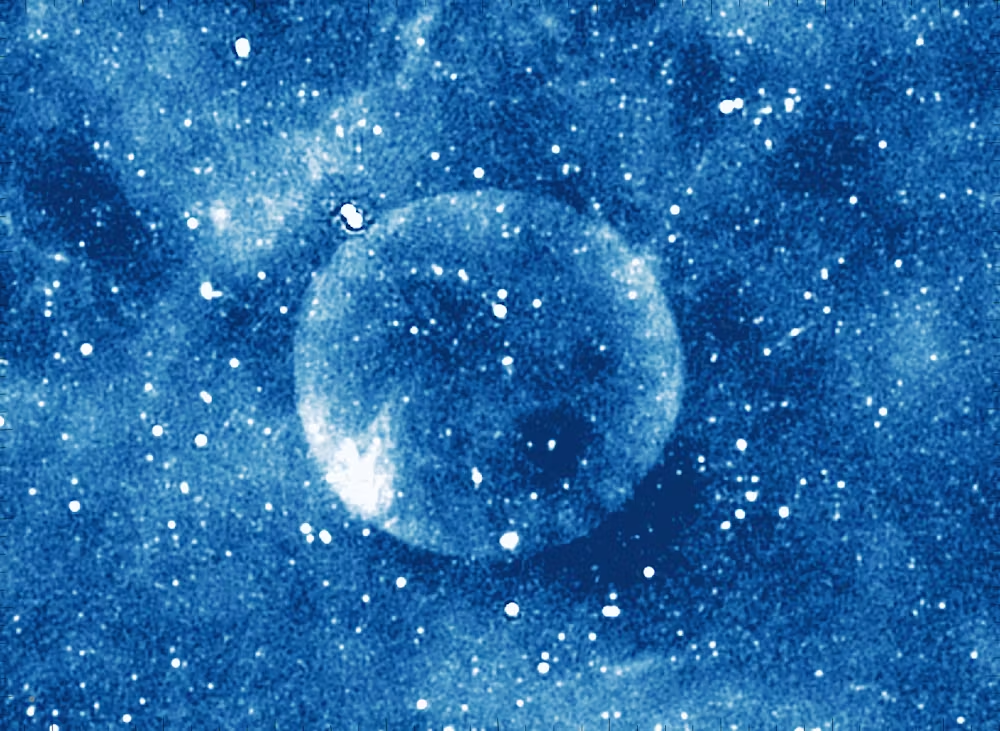
May 18, 2025 — In a remarkable astronomical breakthrough, scientists have identified a new supernova remnant (SNR) exhibiting nearly perfect circular symmetry, an extremely rare phenomenon in cosmic structures. Named “Teleios”—from the Greek word meaning perfect—this celestial formation is officially designated as G305.4–2.2, and was discovered through the Australian Square Kilometre Array Pathfinder (ASKAP) as part of the Evolutionary Map of the Universe (EMU) project.

🌀 A Supernova Remnant Like No Other
Supernova remnants typically appear as chaotic and asymmetrical structures due to the uneven nature of the interstellar medium (ISM) they expand into. However, Teleios defies this trend, standing out for its striking geometric precision.
-
Teleios has been measured at either 45.6 or 156.5 light-years in diameter, depending on its estimated distance from Earth—7,170 or 25,100 light-years, respectively.
-
The structure is defined by a sharp outer shell with extended radio emission inside its southeastern edge, indicating possible interaction with local ISM features.
-
The spectral index of -0.6 points to the remnant being either relatively young or very old, but in either case, exhibiting low surface brightness—a trait that makes its perfect symmetry even more puzzling and noteworthy.
🧬 Scientific Significance and Rare Comparisons
Teleios joins a small group of highly symmetrical SNRs, including lSNR J0624–6948, SN1987A, and MC SNR J0509–6731—each considered exceptional due to their shape and structural clarity.
Astronomers note that Teleios’s formation is likely from a Type Ia supernova, a type of explosion that occurs in binary star systems. These are often associated with relatively clean remnants, but the level of symmetry here remains exceptionally rare.
🔭 What’s Next: Probing Deeper into Teleios
Researchers emphasize the need for further high-resolution, multi-frequency observations to better understand:
-
Teleios’s age and composition
-
Expansion velocity and shockwave behavior
-
Influence of surrounding interstellar medium
Such studies could clarify whether this symmetry results from ideal environmental conditions, an unusual explosion mechanism, or perhaps both. Unlocking these mysteries may offer broader insights into the lifecycle of supernovae and the structure of our galaxy.
🌌 A Celestial Showcase of Cosmic Order
While many SNRs symbolize the explosive chaos of dying stars, Teleios offers a glimpse of cosmic elegance—a perfectly sculpted relic in the aftermath of stellar destruction. It not only deepens the intrigue around supernova remnants but also reinforces the capabilities of next-gen radio astronomy missions like ASKAP and the upcoming Square Kilometre Array (SKA).

Bhupendra Singh Chundawat is a seasoned technology journalist with over 22 years of experience in the media industry. He specializes in covering the global technology landscape, with a deep focus on manufacturing trends and the geopolitical impact on tech companies. Currently serving as the Editor at Udaipur Kiran, his insights are shaped by decades of hands-on reporting and editorial leadership in the fast-evolving world of technology.