


New Delhi, February 16: The first solar eclipse of 2026 is set to occur on February 17. This will be an annular solar eclipse, commonly referred to as the ‘Ring of Fire.’ According to NASA, a solar eclipse happens when the moon, sun, and Earth align in a straight line, causing the moon to temporarily block sunlight from reaching certain parts of the Earth. This event occurs during the eclipse season, which happens twice a year, due to the moon’s orbit being slightly tilted relative to the sun-Earth orbit.
During this eclipse, the moon will not completely cover the sun as it is relatively far from Earth. As a result, the center of the sun will be obscured, leaving a bright ring around it that resembles a fiery circle.
On Tuesday, this ‘Ring of Fire’ phenomenon will primarily be visible in the remote and icy regions of Antarctica, with the maximum duration of the annular phase lasting approximately 2 minutes and 20 seconds. Unfortunately, it will not be visible in India.
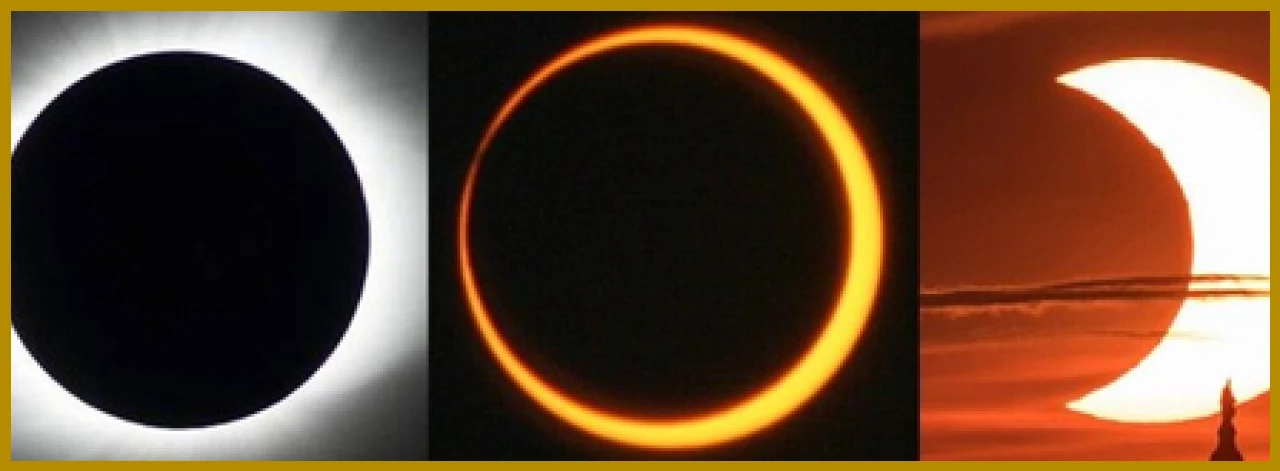
There are four types of solar eclipses: total solar eclipse, annular solar eclipse, partial solar eclipse, and hybrid solar eclipse.
In a total solar eclipse, the moon completely covers the sun, temporarily blocking sunlight from reaching Earth, resulting in darkness during the day and revealing the sun’s corona (outer atmosphere). This is the rarest and most beautiful sight.
An annular solar eclipse occurs when the moon appears smaller than the sun, creating a ring effect. This happens when the moon passes between the sun and Earth but does not completely cover the sun, resulting in a bright ring (Ring of Fire) around the sun.
A partial solar eclipse occurs when only a portion of the sun is obscured, giving the appearance of a piece being cut out. During a partial solar eclipse, the moon passes between the sun and Earth, but they are not perfectly aligned, leaving part of the sun still shining.
A hybrid solar eclipse occurs due to the curvature of the Earth, where some locations experience a total eclipse while others see an annular eclipse. This happens when the moon completely covers the sun in some areas (total eclipse) and only creates a ring in others (annular eclipse), influenced by the Earth’s curvature and the length of the moon’s shadow.
–

Deependra Singh Chundawat is a Senior Sub-Editor at Udaipur Kiran, specializing in a wide range of technology topics including mobile phones, applications, gaming, PCs, and wearables. Along with covering the latest tech news, he also creates engaging web stories. Passionate about emerging technologies, he stays up to date with the newest trends and enjoys reading and writing about the latest mobile launches and digital innovations.