


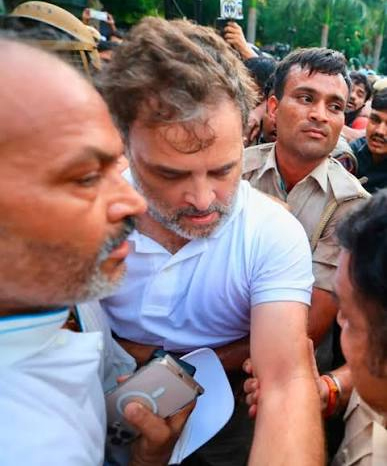

New Delhi, October 6 (Udaipur Kiran): Congress leaders Rahul Gandhi and Priyanka Gandhi Vadra were detained by Delhi Police on Tuesday after sitting in protest for more than eight hours at the Akashvani Bhavan complex. Around 250 people detained along with them were being taken to the Kingsway Camp Police Station.
The protest was held against the Special Intensive Revision (SIR) and to demand the resignation of Chief Election Commissioner Gyanesh Kumar.
Opposition March Stopped Near Akashvani
The opposition parties had organised a ‘Save Democracy March’ from Parliament’s Makar Dwar at around 10 am. Police stopped the march near Akashvani at around 12:30 pm.
Rahul Gandhi and Priyanka Gandhi were subsequently taken onto a bus, but both got off and sat in protest at the complex.
Rahul Gandhi had said that they would not leave without meeting Gyanesh Kumar. When police arrived to remove the protesters, party workers surrounded the two leaders.
More Than 300 Opposition MPs Took Part
Rahul Gandhi claimed that more than 300 MPs from 20 opposition parties were present during the protest. The leaders included Samajwadi Party chief Akhilesh Yadav, Congress president Mallikarjun Kharge and Trinamool Congress leader Abhishek Banerjee.
The protest was reportedly the seventh demonstration by opposition parties against Chief Election Commissioner Gyanesh Kumar in five days in Delhi and Mumbai.
Election Commission Says No Formal Meeting Request
The Election Commission said that no political party had formally requested a meeting with the Commission through its representatives until 4 pm.
According to the Commission’s press note, Delhi Police had informed it that Rahul Gandhi wanted to meet the Election Commissioner along with MPs.
The protest and detention came amid the opposition’s continuing demand for action against the SIR exercise and the resignation of the Chief Election Commissioner.
Bhupendra Singh Chundawat is a seasoned technology journalist with over 22 years of experience in the media industry. He specializes in covering the global technology landscape, with a deep focus on manufacturing trends and the geopolitical impact on tech companies. Currently serving as the Editor at Udaipur Kiran, his insights are shaped by decades of hands-on reporting and editorial leadership in the fast-evolving world of technology.