

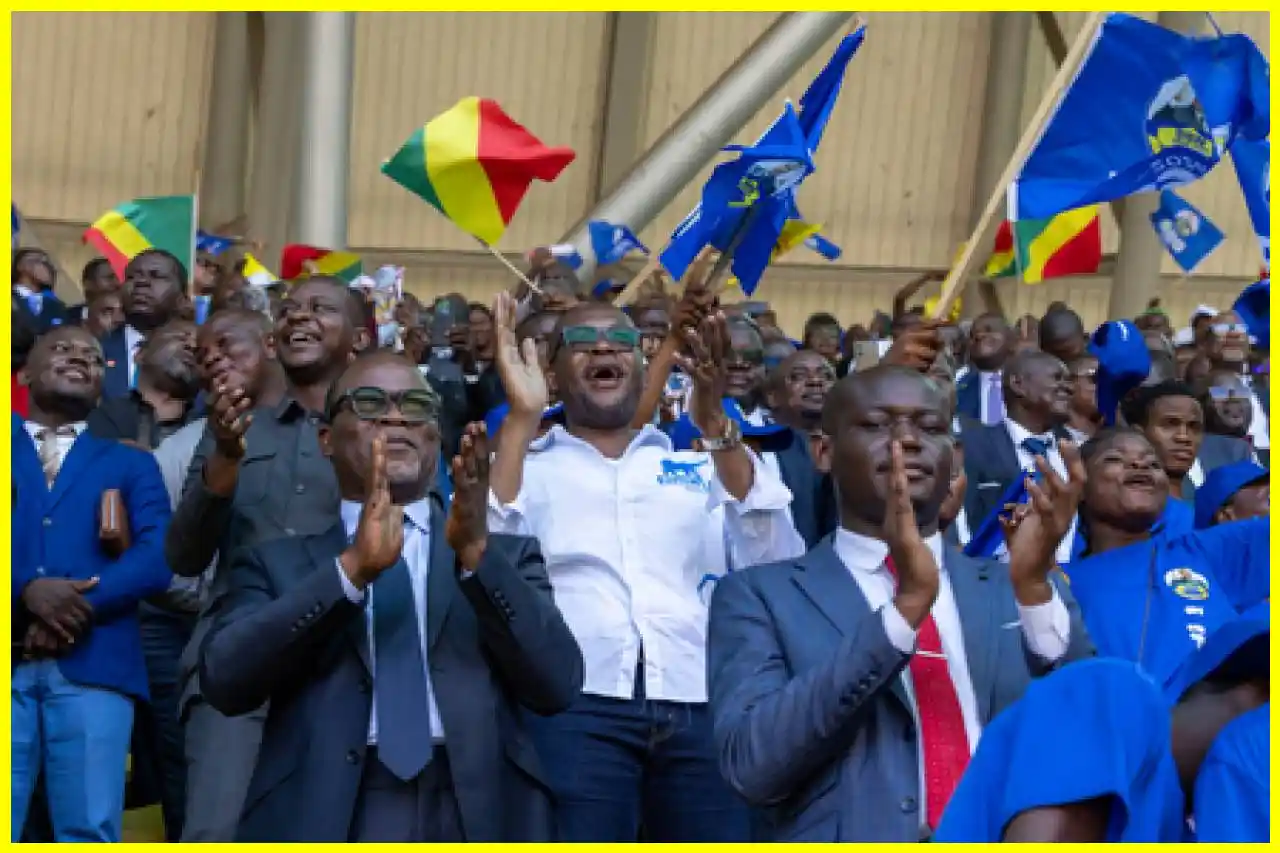

Brazzaville, April 25: The President of the Republic of Congo, Denis Sassou Nguesso, announced the formation of a new government on national television. Following the reappointment of Prime Minister Anatole Collinet Makoso, President Nguesso has established a new cabinet.
According to the statement, the new government includes a Deputy Prime Minister, three state ministers, and 37 ministers alongside Prime Minister Makoso. Previously, Prime Minister Makoso was reappointed by President Denis Sassou Nguesso.
As reported by the Xinhua News Agency, former state minister for regional planning and major projects, Jean-Jacques Bouya, has been appointed as the Deputy Prime Minister in charge of infrastructure development and territorial planning.
Former state minister for mines and geology, Pierre Oba, has been made state minister in charge of political affairs at the presidency. Claude Alphonse Nsila, the former state minister for trade, supply, and consumption, has been appointed as state minister for construction, urban planning, and housing. Additionally, Pierre Mabiala, the former state minister for land affairs and state property management, has been appointed as state minister for civil service, labor, and social dialogue.
The presidential election in Congo took place on March 15, where Denis Sassou Nguesso won re-election with 94.9% of the votes. According to the constitution, it is necessary for the President to appoint a new Prime Minister to form a government.
A total of 3,167,099 voters were registered, with a voter turnout of 84.65%. Seven candidates contested in the election.
Under the country’s electoral laws, the President is elected by direct voting, and if no candidate receives a clear majority in the first round, a two-round majority system is implemented.
Earlier, Prime Minister Makoso and his government resigned on April 17. On April 23, the President announced Makoso’s reappointment as Prime Minister and tasked him with forming a new government.
During the election, two major parties accused each other of electoral misconduct and boycotted the election. Among the protesters were two prominent opposition leaders, General Jean-Marie Michel Mokoko and André Okombi Salissa, who had spent nearly ten years in prison.
As is customary during presidential elections, internet access was cut off just before the elections, and traffic was restricted throughout the capital.

Bhupendra Singh Chundawat is a seasoned technology journalist with over 22 years of experience in the media industry. He specializes in covering the global technology landscape, with a deep focus on manufacturing trends and the geopolitical impact on tech companies. Currently serving as the Editor at Udaipur Kiran, his insights are shaped by decades of hands-on reporting and editorial leadership in the fast-evolving world of technology.