

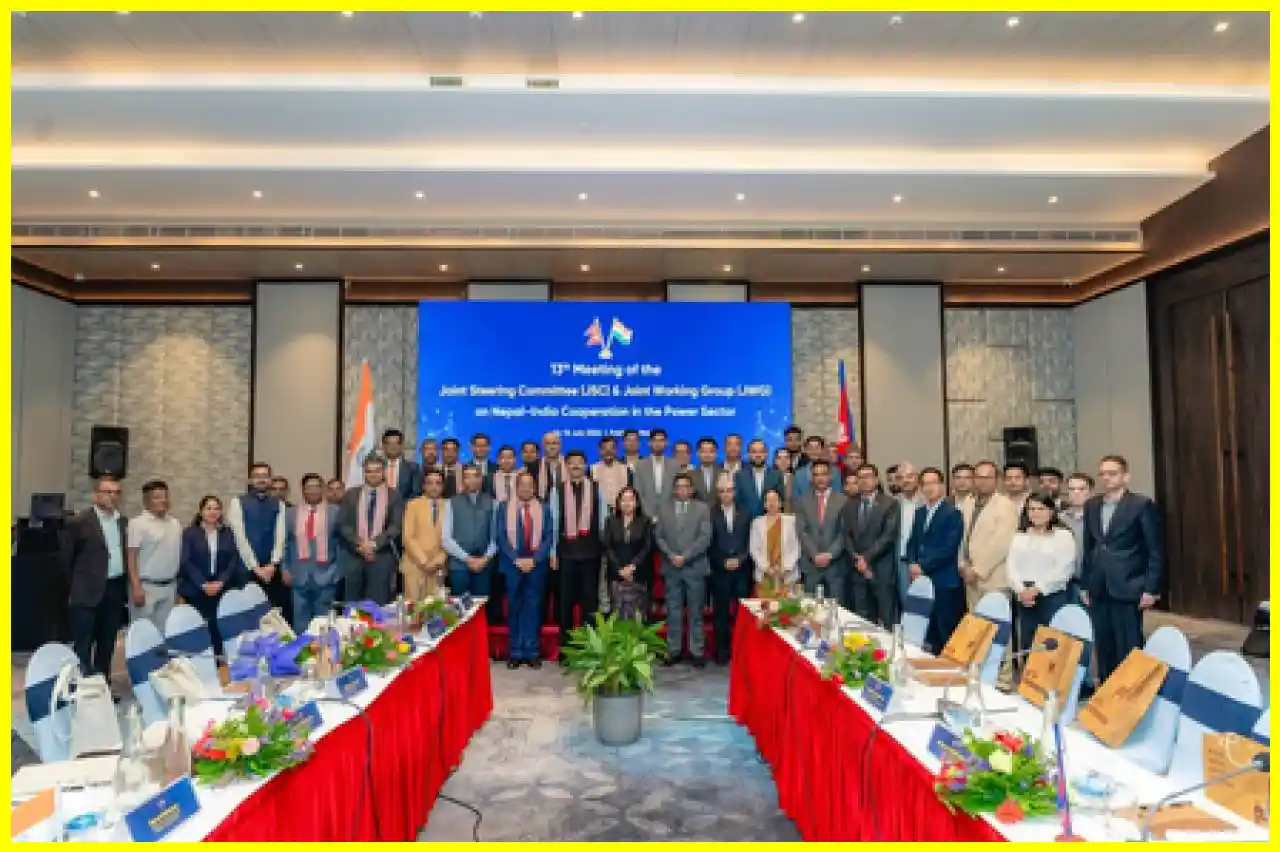

Kathmandu, July 16: India and Nepal have agreed to enhance the volume of electricity exchange between the two countries through two cross-border power transmission projects. This decision was made during the 13th meeting of the Nepal-India Joint Steering Committee (JSC) held in the western city of Pokhara. The meeting, which was at the level of energy secretaries, concluded that Nepal can now sell up to 1,650 megawatts of electricity to India via two 400 kV cross-border transmission lines, while also being able to import up to 1,400 megawatts from India.
The two transmission lines that will facilitate this electricity exchange are the Dhalkebar-Muzaffarpur 400 kV transmission line and the Dhalkebar-Sitamarhi 400 kV transmission line. According to Nepal’s Ministry of Energy, Water Resources, and Irrigation, the Dhalkebar-Muzaffarpur transmission line has been operational since 2016, while the Dhalkebar-Sitamarhi transmission line project is nearing completion.
The construction of the Dhalkebar-Sitamarhi transmission line is being undertaken by the SJVN Arun-3 Power Development Company, a subsidiary of India’s SJVN Limited, which is developing a 900 megawatt Arun-3 hydropower project in eastern Nepal. Previously, the Dhalkebar-Muzaffarpur transmission line allowed for the export of up to 1,100 megawatts of electricity from Nepal to India and the import of up to 1,000 megawatts from India.
With the larger capacity transmission line of Dhalkebar-Sitamarhi nearly ready, both countries have decided to expand the limits of electricity trade. The meeting was co-chaired by Sarita Dawadi, Secretary of Nepal’s Ministry of Energy, Water Resources, and Irrigation, and Pankaj Kumar, Secretary of India’s Ministry of Power.
Prior to the JSC meeting, a joint working group meeting at the level of joint secretaries was also held. Both nations agreed to expedite the work on several new high-capacity cross-border transmission projects.
As per a statement from Nepal’s Ministry of Energy, the detailed project report (DPR) for the Chameliya (Nepal)-Jauljibi (India) 220 kV double circuit transmission line was approved during the meeting, with a target to complete construction by December 2028.
The meeting also agreed to accelerate the formation of a joint venture company between the Nepal Electricity Authority (NEA) and India’s Power Grid Corporation of India Limited (PGCIL) to develop the Inaruwa-New Purnia and Dododhara (New Lamki)-Bareilly 400 kV cross-border transmission line projects. Both companies have already signed a shareholders agreement (SHA) and joint venture (JV) agreement for these projects.
Additionally, the DPR for the Motihari-Nijgadh 400 kV double circuit transmission line was approved, which is expected to help export additional electricity from Nepal to India by 2034-35. The proposal to enhance the capacity of the Muzaffarpur-Dhalkebar 400 kV transmission line was also approved, which will involve replacing existing wires with high-temperature low-sag conductors to increase electricity delivery capacity.
The ministry stated that further technical studies will be conducted before finalizing the proposed Lucknow-Kohlpur (Lamhi) 400 kV transmission line project. Agreement was also reached on the New Butwal-Gorakhpur 400 kV cross-border transmission line, with the Nepalese portion expected to be completed by August 2026 and the New Butwal 400 kV substation by December 2027. Until the substation is completed, this transmission line will temporarily operate at a capacity of 220 kV.
The construction of the Nepalese portion of this project is being funded by the U.S. government’s aid agency, Millennium Challenge Corporation (MCC). The Ministry of Energy of Nepal stated, “Under this interim arrangement, this transmission line will be capable of importing up to 130 megawatts of electricity from India and exporting up to 200 megawatts of electricity to Nepal.”

Deependra Singh Chundawat is a Senior Sub-Editor at Udaipur Kiran, specializing in a wide range of technology topics including mobile phones, applications, gaming, PCs, and wearables. Along with covering the latest tech news, he also creates engaging web stories. Passionate about emerging technologies, he stays up to date with the newest trends and enjoys reading and writing about the latest mobile launches and digital innovations.