

CERN Detects Evidence of Ultra-Rare Particle Decay
CERN scientists have found evidence of a rare particle decay, potentially advancing particle physics understanding.

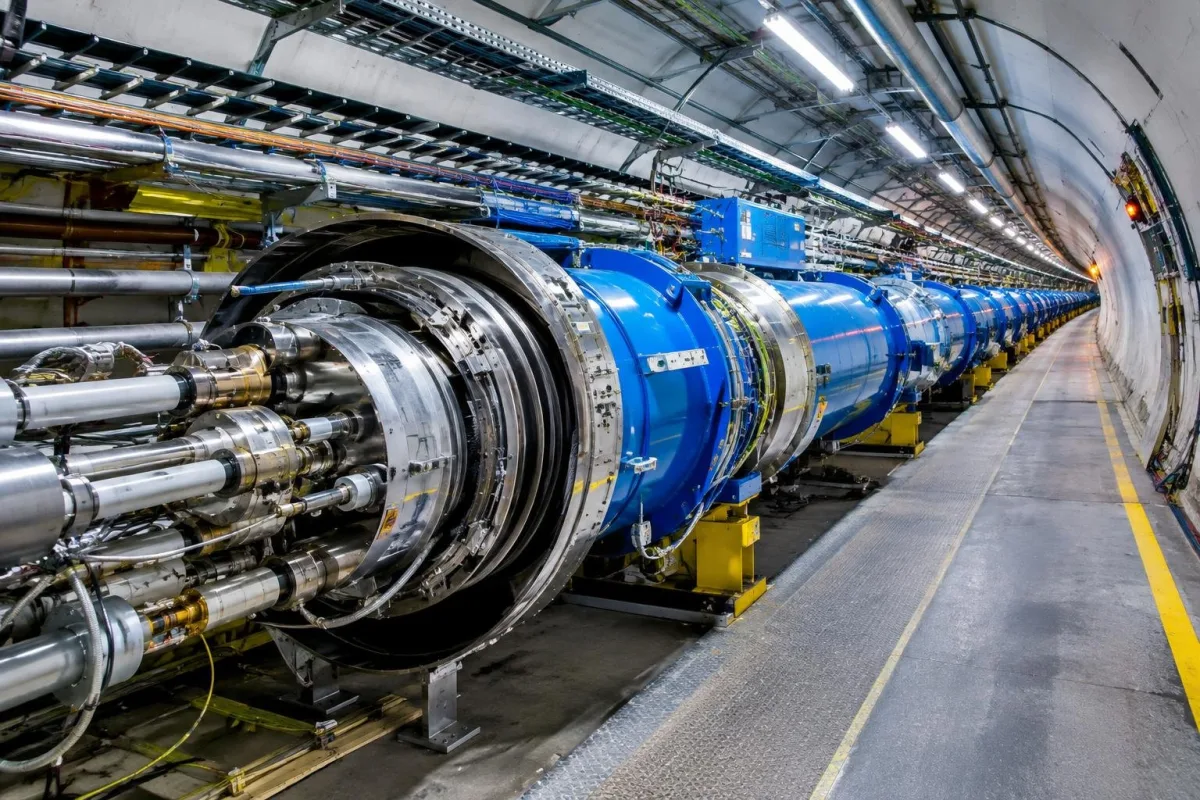
NEW DELHI, Nov 11: Scientists at CERN have reported finding evidence of a rare particle decay involving a beauty quark. This process, known as Bd → μ+μ-, was detected in data from the Large Hadron Collider (LHC) and is expected to occur only once in about 10 billion beauty particle decays.
This discovery is significant for researchers as it could help to probe phenomena associated with particles that are beyond the direct reach of current particle accelerators. The analysis, conducted by the LHCb experiment team, marks a milestone after more than 40 years of searching for such a decay.
Marco Santimaria, co-leader of the analysis team, said, “Physicists have been chasing this decay for more than forty years.” The researchers achieved a statistical significance of 3.2 standard deviations, which surpasses the standard threshold for declaring evidence of new phenomena.
The Bd decay falls under a category that physicists consider ‘golden channels’ for exploring physics beyond the Standard Model. This decay occurs when a beauty quark interacts with an antiquark, resulting in two muons, which are heavier cousins of electrons. Previous observations related to this process were made with a different particle, the Bs, which decays at a higher frequency.
The team utilized an upgraded detector that increased data collection efficiency and applied machine learning techniques to isolate the rare signals from other particle interactions. This combination of advancements allowed them to identify the decay despite challenges from background noise from numerous other events occurring simultaneously.
While the new findings represent a major step forward, the threshold for officially confirming this decay requires a significance of five standard deviations. Future upgrades to the LHC, set to enhance data collection capabilities even further, could facilitate the observation of these decays with greater precision and frequency.
In the words of Harry Cliff, LHCb’s Rare Decays Convener, “Seeing evidence of this rare decay is incredibly exciting, opening up new possibilities to probe beyond the direct reach of the LHC.” With these ongoing efforts, scientists aim to deepen their understanding of the universe’s fundamental particles.
Sources

Bhupendra Singh Chundawat is a seasoned technology journalist with over 22 years of experience in the media industry. He specializes in covering the global technology landscape, with a deep focus on manufacturing trends and the geopolitical impact on tech companies. Currently serving as the Editor at Udaipur Kiran, his insights are shaped by decades of hands-on reporting and editorial leadership in the fast-evolving world of technology.