

Hindustan Zinc and IIT Madras Achieve Major Breakthrough in Zinc-Air Battery Technology for Electric Mobility

Chennai / Udaipur, November 26, 2026 (Udaipur Kiran): Hindustan Zinc Limited, the world’s largest integrated zinc producer, has joined hands with IIT Madras to unveil an electric three-wheeler prototype equipped with an approximately 1 kW zinc-air battery as a range extender. The development marks an important step towards building indigenous and sustainable energy storage solutions for electric mobility.
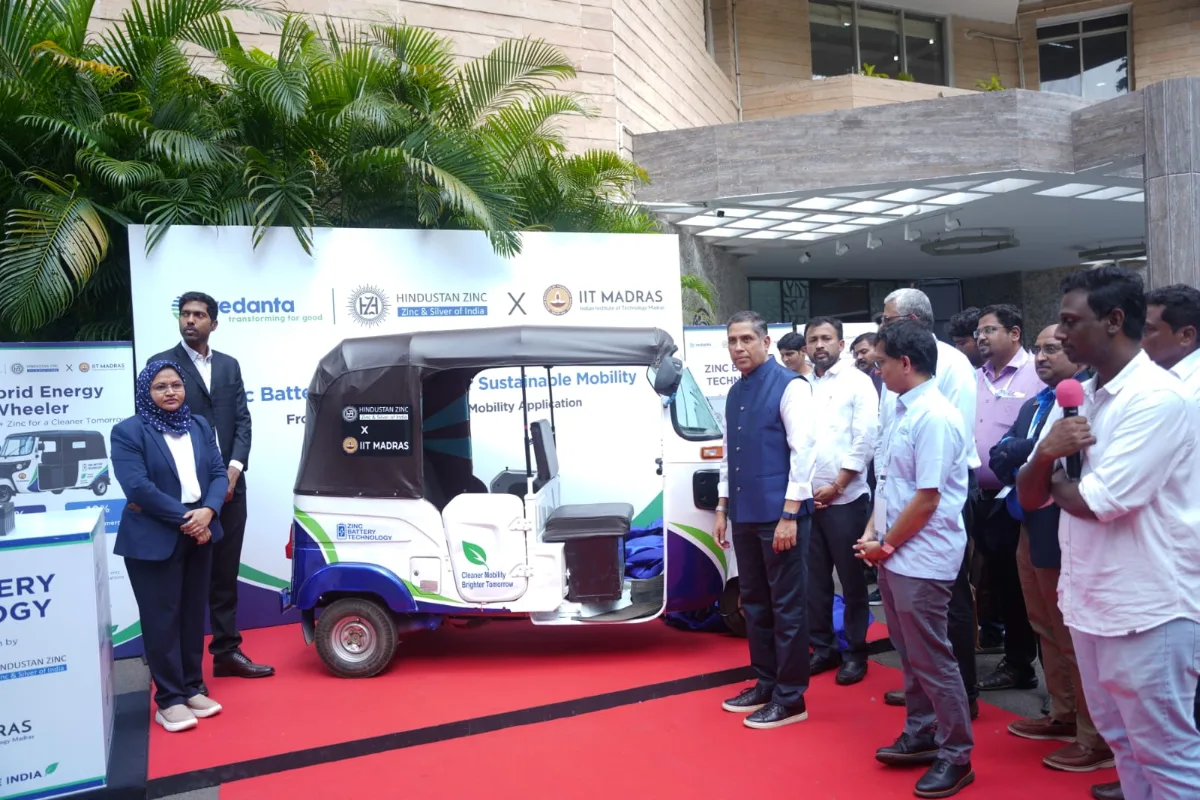
The prototype was unveiled at the recently held IIT Madras Energy Summit 2026. It is the result of ongoing research collaboration between Hindustan Zinc and IIT Madras and demonstrates progress towards the practical application of zinc-based battery technology.
The event was attended by Rajya Sabha MP Praveen Chakravarty, Hindustan Zinc CEO and Whole-time Director Amarendu Prakash, IIT Madras Dean (ICSR) Prof. Manu Santhanam, and Dr. Aravind Kumar Chandiran, who is leading the project, along with other dignitaries.
Zinc-Air Battery Provides Around 10% of Vehicle’s Energy
With demand for clean energy and electric vehicles increasing worldwide, the need for affordable, safe and sustainable energy storage solutions is also growing. Zinc is emerging as an important metal for next-generation battery technologies because of its abundant availability, recyclability and potential cost advantages.
The electric three-wheeler uses a dual-battery system. Its existing lithium-ion battery meets the vehicle’s power requirements for movement and higher energy demand, while the zinc-air battery continuously supplies additional energy during operation.
The zinc-air battery contributes approximately 10% of the vehicle’s total energy requirement and works as a range extender.
Hindustan Zinc Highlights India’s Opportunity in Energy Storage
Hindustan Zinc CEO and Whole-time Director Amarendu Prakash said the company is continuously exploring new applications of zinc to create greater value from the versatile metal.
He said India’s abundant zinc resources offer a major opportunity to develop indigenous energy storage solutions that can support the vision of a developed India.
He added that the collaboration with IIT Madras reflects the company’s commitment to converting scientific research into practical solutions, creating new demand areas for zinc and strengthening the metal’s role in the global clean energy transition.
Zinc-Air Battery Uses Oxygen from the Atmosphere
Zinc-air batteries generate electricity using zinc and oxygen available in the atmosphere. They use water-based and non-flammable electrolytes.
Zinc is also an easily available and recyclable metal. These characteristics give the technology the potential to become a suitable option in terms of safety, cost and environmental sustainability.
Research Collaboration Started in 2024
The collaboration between Hindustan Zinc and IIT Madras began in 2024. It has now moved beyond laboratory-level research to vehicle-level performance, marking an important milestone in the development of indigenous zinc-air battery technology.
IIT Madras Director Prof. V. Kamakoti congratulated the research team and said energy is one of the most important subjects globally, whether in artificial intelligence, agriculture or advanced manufacturing.
He highlighted the importance of developing new solutions for the generation, storage and distribution of energy from different sources, particularly renewable energy. He described the collaboration with Hindustan Zinc as an important effort in this direction.
Hindustan Zinc is actively exploring the potential of zinc-based battery technologies in areas such as renewable energy storage and electric mobility. Under its HZL 2.0 strategy, the company is committed to innovation, the development of value-added products and strengthening zinc’s role in the global energy transition.
FAQs
1. What has Hindustan Zinc achieved with IIT Madras?
Hindustan Zinc and IIT Madras have unveiled an electric three-wheeler prototype fitted with an approximately 1 kW zinc-air battery as a range extender.
2. Where was the electric three-wheeler prototype unveiled?
The prototype was unveiled at the IIT Madras Energy Summit 2026.
3. What is the role of the zinc-air battery in the vehicle?
It works as a range extender and continuously supplies additional energy during vehicle operation.
4. How much of the vehicle’s energy requirement does the zinc-air battery meet?
The zinc-air battery contributes approximately 10% of the vehicle’s total energy requirement.
5. Does the electric three-wheeler also use a lithium-ion battery?
Yes. The existing lithium-ion battery meets the vehicle’s movement and higher energy requirements, while the zinc-air battery provides additional energy.
6. How do zinc-air batteries generate electricity?
They generate electricity using zinc and oxygen from the atmosphere, with water-based and non-flammable electrolytes.
7. When did the collaboration between Hindustan Zinc and IIT Madras begin?
The research collaboration began in 2024 and has now progressed from laboratory research to vehicle-level performance.
8. Who led the zinc-air battery project at IIT Madras?
Dr. Aravind Kumar Chandiran led the project.