2026 Physics Nobel Prize Awarded to Francis Halzen for Work on High-Energy Neutrinos
Stockholm, October 6 (Udaipur Kiran): American scientist Francis Halzen has been awarded the 2026 Nobel Prize in Physics for his important contributions to the IceCube Neutrino Observatory and the discovery of extremely high-energy neutrinos reaching Earth from space.
Halzen was born in Denmark but spent a major part of his scientific career in the United States.
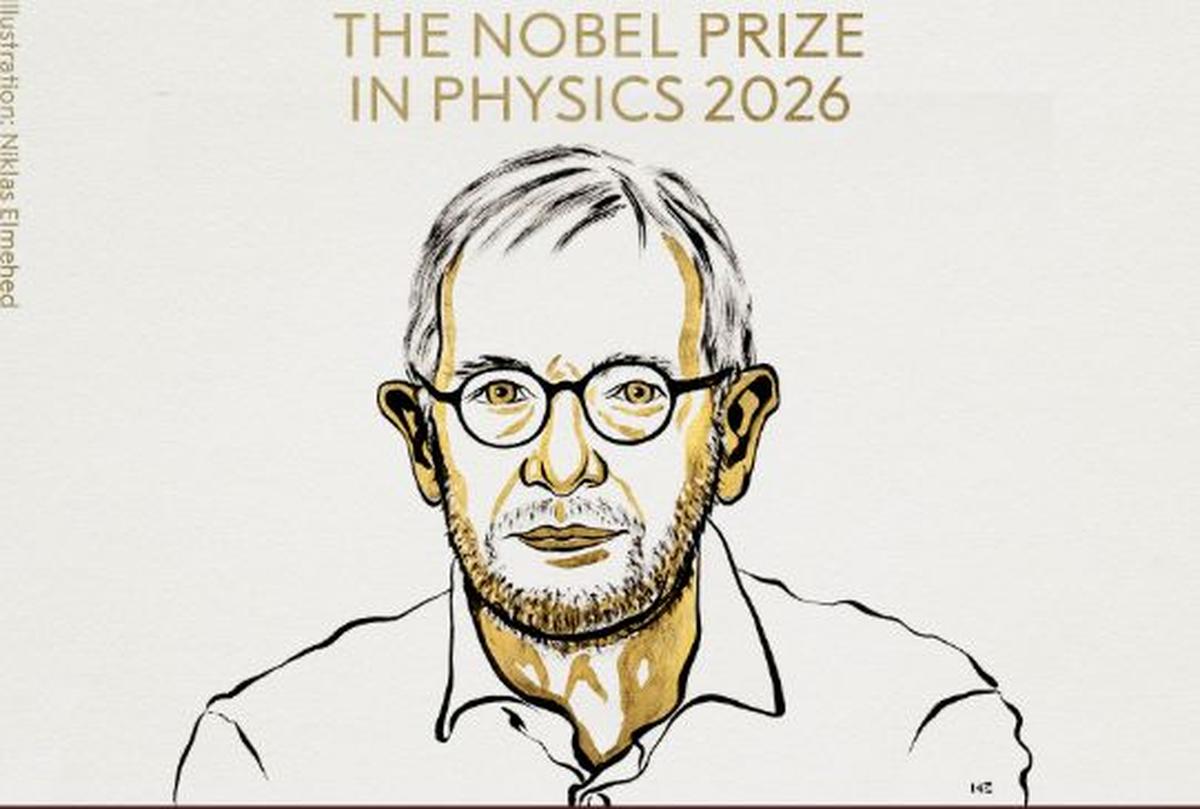

The Nobel laureates will be honoured in Stockholm, Sweden, in December. They will receive a medal, diploma and prize money. The Nobel Prize amount in 2026 is around ₹11.5 crore.
Using Ice to Detect Neutrinos from Space
Neutrinos are extremely small particles produced by the Sun, stars and highly powerful events in space. Billions of neutrinos pass through the human body and Earth every second without being detected.
A key feature of these particles is that they travel from space to Earth in almost a straight direction and undergo very little change along the way. If scientists can detect them, they can determine where they came from and what event produced them in the universe.
However, detecting neutrinos is difficult because they pass through most matter without interacting with it. To address this challenge, Francis Halzen proposed in 1988 using the ice at the South Pole for neutrino detection.
Under this approach, thousands of light-detecting sensors were installed in nearly one cubic kilometre of ice. When a neutrino collides with the nucleus of an atom in the ice, the interaction produces an extremely faint flash of light. Sensors placed in the ice detect this flash.
IceCube Neutrino Observatory Completed in 2011
The idea eventually led to the development of the IceCube Neutrino Observatory, whose construction was completed in 2011.
The high-energy neutrinos detected there gave scientists a new way to study sources located far beyond the Solar System and the events taking place there.
Earlier, scientists primarily studied the universe through visible light, X-rays and other forms of radiation. Neutrinos have provided another way to observe the universe. Scientists can now study not only where light is coming from in space but also where neutrinos are coming from and what powerful cosmic events may be behind them.
2025 Physics Nobel Recognised Quantum Discovery in Electric Circuits
The 2025 Nobel Prize in Physics was awarded to John Clarke, Michel H. Devoret and John M. Martinis. They were recognised for a discovery that demonstrated quantum effects in electric circuits.
The scientists showed that phenomena governed by quantum mechanics can be observed not only in extremely small systems but also in electric circuits. The discovery helped in understanding and advancing emerging technologies such as quantum computing.

Bhupendra Singh Chundawat is a seasoned technology journalist with over 22 years of experience in the media industry. He specializes in covering the global technology landscape, with a deep focus on manufacturing trends and the geopolitical impact on tech companies. Currently serving as the Editor at Udaipur Kiran, his insights are shaped by decades of hands-on reporting and editorial leadership in the fast-evolving world of technology.