

Unified Pension Scheme: 50% Last Salary Pension for Central Govt Employees

The Government of India has announced the Unified Pension Scheme (UPS), a landmark initiative aimed at providing central government employees with a guaranteed pension of 50% of their last salary. This scheme, introduced in early 2025, is set to come into effect from April 1, 2025, as an alternative to the National Pension Scheme (NPS). The UPS is designed to address the long-standing demand for the restoration of the Old Pension Scheme (OPS) and ensure financial security for government employees post-retirement.
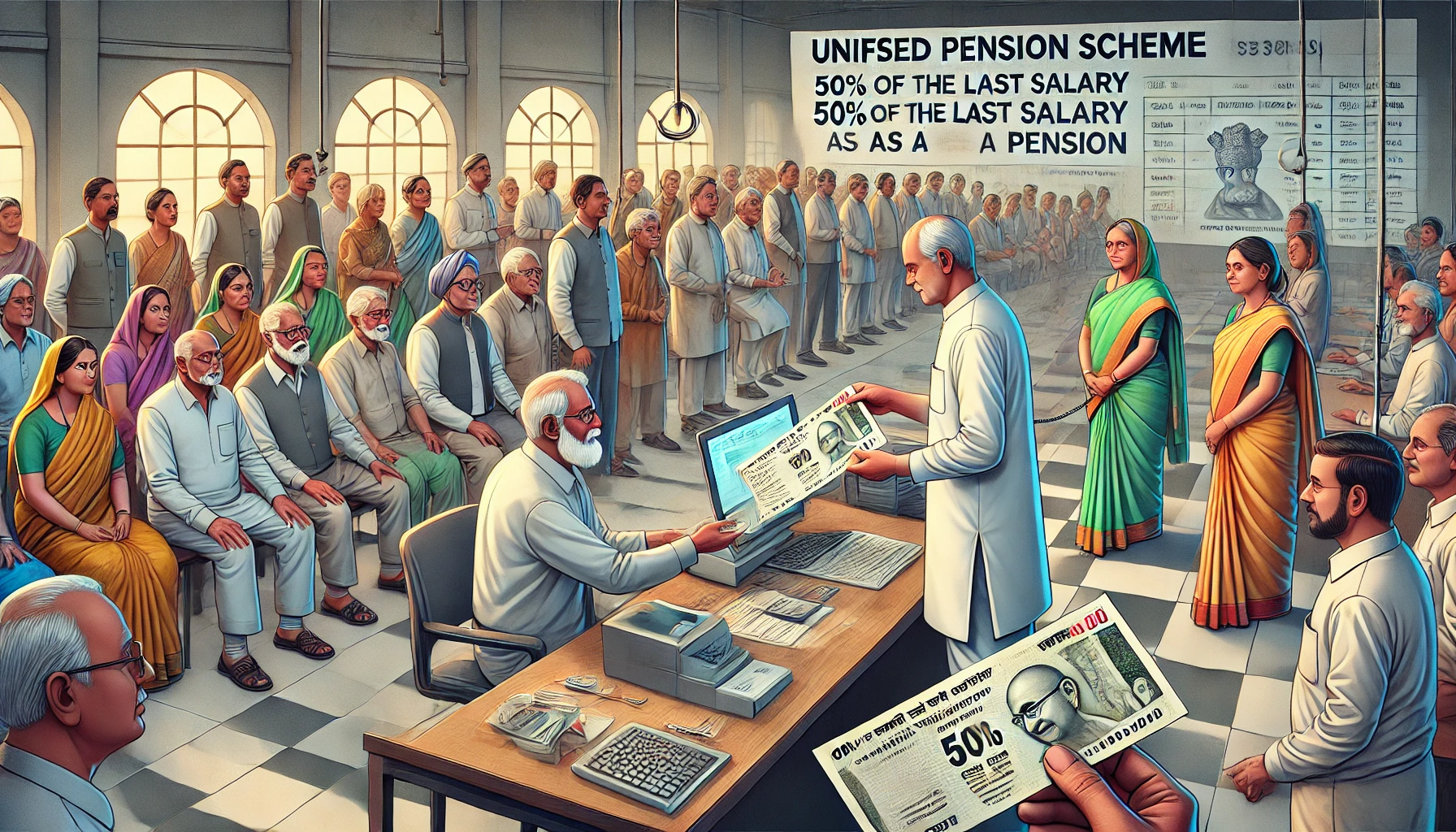
Why Was the Unified Pension Scheme Introduced?
For years, central government employees have been advocating for the return of the Old Pension Scheme (OPS), which provided a fixed pension equal to 50% of their last drawn salary. The introduction of NPS in 2004 replaced the OPS with a market-linked pension, leading to uncertainty regarding retirement benefits. UPS bridges this gap by reinstating a secure pension structure, ensuring financial stability for retirees while incorporating some revised contribution mechanisms.
Key Features of the Unified Pension Scheme (UPS)
The Unified Pension Scheme introduces a structured contribution model, benefiting both existing and future government employees. The key features include:
- 50% Last Salary Pension: Employees retiring under UPS will receive half of their last drawn salary as a pension, providing a stable post-retirement income.
- Balanced Contribution Structure: Employees will contribute 10% of their basic salary and dearness allowance (DA), while the government will contribute 18.5% towards the pension fund.
- Additional Government Support: A separate pool fund will be established, where the government will contribute an additional 8.5%, ensuring sufficient reserves for sustainable pension disbursements.
- Minimum Pension Guarantee: Employees who have served at least 10 years will be entitled to a minimum monthly pension of ₹10,000, ensuring financial security even for lower-income employees.
- Proportional Pension for Mid-Service Retirees: Employees with 10 to 25 years of service will receive proportional pension benefits, making retirement planning more flexible.
- Family Pension in Case of Death: In the unfortunate event of an employee’s death, 60% of the pension will be provided to their family, ensuring financial stability for dependents.
- Gratuity & Lump-Sum Benefits: Retirees will receive a gratuity payout along with a lump-sum retirement benefit, further enhancing financial security post-retirement.
Eligibility Criteria and Beneficiaries
The Unified Pension Scheme (UPS) will benefit:
- All Central Government Employees: The scheme is applicable to both existing and future employees of the central government.
- Employees with Over 10 Years of Service: Those who have completed a minimum of 10 years in government service will be eligible for pension benefits.
- Employees Retiring After 25 Years of Service: Such individuals will be entitled to full pension benefits upon reaching the official retirement age.
- Pre-UPS Retirees Also Eligible: Employees who retired before the implementation of UPS can also opt into the scheme. They will receive pension arrears calculated based on Public Provident Fund (PPF) interest rates, ensuring fairness in compensation.
How UPS Compares to NPS and OPS?
| Feature | Old Pension Scheme (OPS) | National Pension Scheme (NPS) | Unified Pension Scheme (UPS) |
|---|---|---|---|
| Pension Type | Fixed 50% of last salary | Market-linked returns | Fixed 50% of last salary |
| Employee Contribution | None | 10% of basic + DA | 10% of basic + DA |
| Government Contribution | Fully funded | 14% of basic + DA | 18.5% of basic + DA + 8.5% in pool fund |
| Minimum Pension | No minimum guarantee | Depends on market performance | ₹10,000 per month |
| Family Pension | 50% of pension | Dependent on corpus | 60% of pension |
| Arrears for Pre-Scheme Retirees | Not applicable | Not applicable | Yes, based on PPF interest rates |
Government’s Perspective on UPS Implementation
The government sees UPS as a balanced approach, addressing employees’ demands while ensuring long-term fiscal sustainability. Unlike the OPS, which was entirely government-funded, the UPS introduces a contribution-based system that secures employee benefits while reducing long-term financial burdens.
A senior government official stated:
“The Unified Pension Scheme is designed to provide financial security to our central government employees while ensuring the system remains sustainable. It incorporates the best elements of OPS and NPS, creating a fair and structured pension framework.”
Public Reaction and Employee Sentiment
The introduction of UPS has been welcomed by central government employees, especially those who were against NPS due to its dependency on market fluctuations. Trade unions and employee associations have largely expressed satisfaction with the restoration of a guaranteed pension, though some still demand a complete return to OPS.
A government employee from the education sector shared:
“This scheme gives us peace of mind. Knowing that 50% of our last salary is secured, we can retire without worrying about market performance.”
What’s Next? UPS Rollout and Future Developments
- The Unified Pension Scheme will be fully implemented from April 1, 2025.
- Employees can start contributing under the new structure in the upcoming financial year.
- Further clarifications on pension calculation, withdrawal policies, and additional benefits are expected to be released in the coming months.

Bhupendra Singh Chundawat is a seasoned technology journalist with over 22 years of experience in the media industry. He specializes in covering the global technology landscape, with a deep focus on manufacturing trends and the geopolitical impact on tech companies. Currently serving as the Editor at Udaipur Kiran, his insights are shaped by decades of hands-on reporting and editorial leadership in the fast-evolving world of technology.