

The Universe’s Brightest Lights Originate from Its Darkest Phenomena: A Deep Dive into Supermassive Black Holes and Blazars
Some of the brightest and most energetic light sources in the universe come from regions shrouded in darkness — namely, supermassive black holes. According to data from NASA’s Fermi Gamma-ray Space Telescope, these immense objects, despite being invisible themselves, create some of the most luminous events in the cosmos.

What Are Active Galactic Nuclei (AGN)?
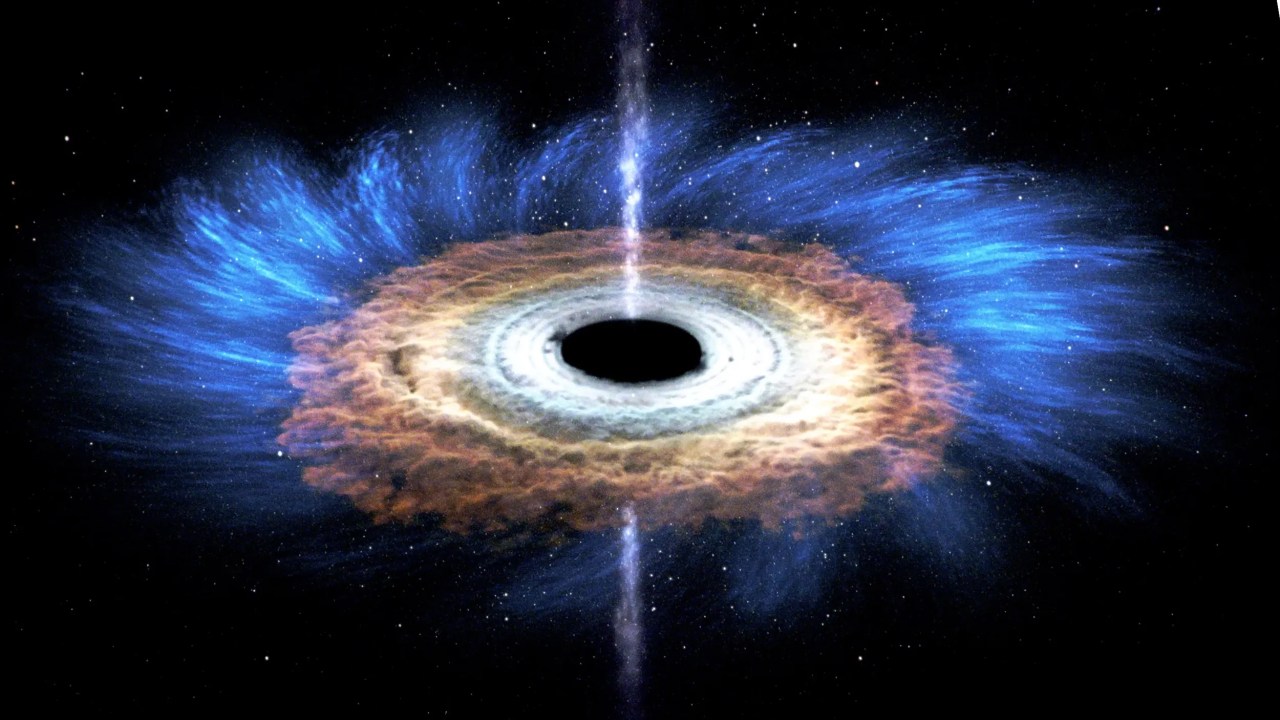
At the core of many galaxies lie active galactic nuclei (AGN) — regions where matter spirals into supermassive black holes at high speeds. As gas and dust get pulled into the accretion disks surrounding these black holes, they heat up due to friction and magnetic turbulence, emitting radiation across the entire electromagnetic spectrum, from radio waves to gamma rays.
About 10% of AGN also launch jets of particles that travel at relativistic speeds, close to the speed of light. These high-energy jets continue to puzzle astronomers, especially how such intense acceleration occurs so close to the event horizon, where not even light can escape.
Blazars: Cosmic Beacons of Gamma-Ray Light
A key revelation from Fermi’s ongoing sky surveys since 2008 is the role of blazars, a subtype of AGN. These are AGN whose particle jets are pointed nearly directly at Earth, making them appear far brighter in gamma-ray wavelengths. Remarkably, over half of the gamma-ray sources detected by Fermi are blazars.
In contrast, radio galaxies, another AGN class, have jets angled sideways relative to Earth, making them appear less intense from our vantage point. These differences in orientation help scientists better understand jet mechanics and AGN classification.
Why AGN Matter in Cosmic Evolution
AGN are not just dazzling anomalies; they are critical clues to understanding galaxy formation and evolution. Studies suggest that AGN were common in the early universe, influencing the development of galaxies by heating and expelling gas, thus regulating star formation.
By analyzing emissions from AGN and the environments around black holes, researchers aim to reconstruct a detailed timeline of cosmic evolution, particularly how galaxies matured over billions of years.
The Cosmic Paradox: Darkness That Illuminates
The most intriguing paradox is that black holes — famed for their ability to consume all light and matter — are also responsible for producing some of the brightest observable phenomena in the universe. Missions like Fermi are continually reshaping our understanding of this apparent contradiction.
These findings are a powerful reminder: the darkest objects in the universe often give rise to its most brilliant lights. In uncovering the secrets of AGN and blazars, scientists are unraveling not just the physics of black holes but also the broader history and fate of the universe itself.

Bhupendra Singh Chundawat is a seasoned technology journalist with over 22 years of experience in the media industry. He specializes in covering the global technology landscape, with a deep focus on manufacturing trends and the geopolitical impact on tech companies. Currently serving as the Editor at Udaipur Kiran, his insights are shaped by decades of hands-on reporting and editorial leadership in the fast-evolving world of technology.