

New Delhi, March 19 – A Proud Moment for India and the Space Community. The Indian Space Research Organisation (ISRO) has extended a warm welcome to Indian-origin astronaut Sunita Williams following her safe return to Earth. Williams, who has been associated with NASA, has once again demonstrated her resilience and dedication to space exploration.
Early this morning, ISRO took to X (formerly Twitter) to express its joy over Williams’ safe return. In a heartfelt message, the organization stated, “Welcome back, Sunita Williams!” The statement further highlighted her extended mission and the remarkable achievement of returning safely to Earth.
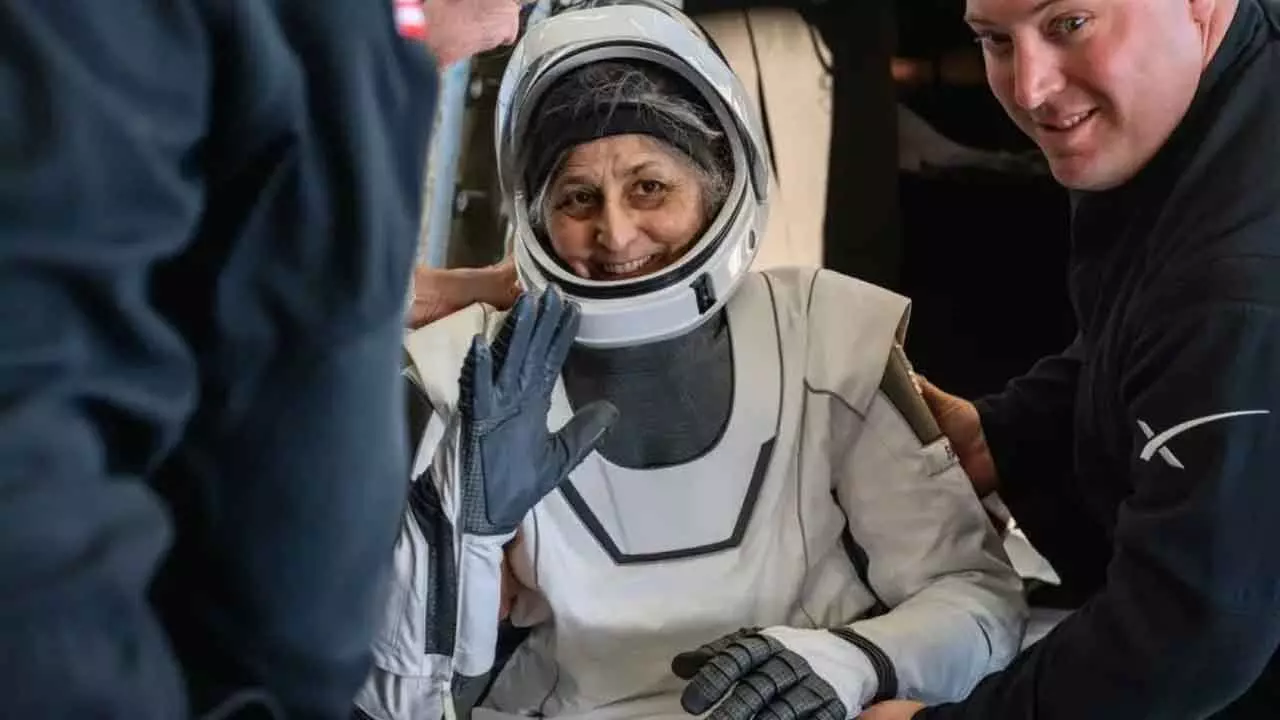

ISRO emphasized that her successful space journey stands as a testament to the commitment of NASA, SpaceX, and the United States toward advancements in space exploration. The organization also lauded her perseverance and dedication, emphasizing that her contributions continue to inspire space enthusiasts across the globe.
ISRO Chairman’s Congratulatory Message to Sunita Williams
Alongside its social media statement, ISRO also shared a message from its Chairman and Secretary of the Department of Space, expressing profound admiration for Williams’ achievements.
The chairman remarked, “On behalf of my colleagues and the entire space fraternity in India, I extend my heartfelt congratulations to you.”
Further, he acknowledged the role of Prime Minister Narendra Modi in driving India’s vision toward becoming a developed nation, particularly in space exploration. The statement indicated that India is eager to leverage Williams’ vast expertise in space missions, opening doors for future collaborations in advancing human spaceflight programs.
A Nation Celebrates: Minister Jitendra Singh’s Tribute to Sunita Williams
India’s Minister of State for Space and Science, Dr. Jitendra Singh, also took to X to celebrate the triumphant return of Sunita Williams. His statement resonated with national pride, as he expressed,
“This is a moment of honor, pride, and relief! The entire world has come together to celebrate the safe return of this remarkable daughter of India. She has carved her name in history with her unmatched courage, unwavering conviction, and remarkable stability in the face of space’s uncertainties.”
This recognition highlights the significant emotional and professional impact that Sunita Williams has on the global space community, particularly in India, where she is regarded as a symbol of perseverance and ambition.
Sunita Williams: A Trailblazer in Space Exploration
Sunita Williams’ name is synonymous with determination, resilience, and scientific brilliance. Having completed multiple spaceflights, she has spent a cumulative 321 days in space, ranking among the most experienced astronauts in human history.
Williams’ career in space exploration began when she was selected by NASA in 1998. Since then, she has become an inspiration for millions worldwide. Some of her remarkable achievements include:
- Holding a record for the most spacewalks by a female astronaut at the time of her mission.
- Being the second woman to command the International Space Station (ISS).
- Participating in critical space missions, including repairs and experiments that have significantly contributed to the understanding of human spaceflight.
Her latest mission underscores the advancements in commercial spaceflight, as it was conducted in collaboration with SpaceX, one of the pioneers in private space travel.
India’s Rising Aspirations in Space Technology
India, under the leadership of Prime Minister Narendra Modi, has made significant strides in space technology. The country has launched ambitious space programs, including Chandrayaan, Gaganyaan, and Aditya-L1, positioning itself among the world’s leading space powers.
With the upcoming Gaganyaan mission, which aims to send Indian astronauts to space, ISRO is keen on expanding its collaboration with experts like Sunita Williams. Her vast knowledge and experience in human spaceflight could prove instrumental in shaping India’s future space endeavors.
Furthermore, the nation’s commercial space sector is witnessing unprecedented growth, with private companies actively participating in launching satellites and space missions. Sunita Williams’ association with NASA and her involvement in international space projects could provide valuable insights into enhancing India’s own space missions.
The Future of Indo-American Space Collaboration
India and the United States have been long-time partners in space exploration, with NASA and ISRO working together on numerous projects. The collaboration includes:
- The NASA-ISRO Synthetic Aperture Radar (NISAR) mission, set to revolutionize Earth observation technology.
- Joint training programs for astronauts, paving the way for future crewed missions.
- Scientific research collaborations in planetary exploration and deep-space missions.
With Sunita Williams’ vast experience and Indian roots, her association with NASA could bridge further ties between the two space agencies, ensuring a future of stronger collaboration in deep-space exploration.
A Role Model for Women in STEM
Beyond her technical accomplishments, Sunita Williams serves as an inspiration for women worldwide, particularly those aspiring to enter STEM (Science, Technology, Engineering, and Mathematics) fields.
Her journey from being a naval officer to a celebrated astronaut highlights the importance of determination, education, and perseverance. As more women break barriers in aerospace and engineering, Williams remains a guiding light, encouraging young minds to dream beyond the skies.
Her impact extends to education and mentorship, with many students across the globe looking up to her as a role model. She has consistently advocated for diversity in space exploration, ensuring that future space missions benefit from a broad spectrum of talent and perspectives.

Bhupendra Singh Chundawat is a seasoned technology journalist with over 22 years of experience in the media industry. He specializes in covering the global technology landscape, with a deep focus on manufacturing trends and the geopolitical impact on tech companies. Currently serving as the Editor at Udaipur Kiran, his insights are shaped by decades of hands-on reporting and editorial leadership in the fast-evolving world of technology.