

It has been confirmed that the Redmi Turbo 3 will launch in China soon. Details about the phone, including renders that recently surfaced online, hint at key specs and design. The company recently confirmed the name of this phone and announced the release date. The design, color options and some key features of the upcoming model were also revealed. This smartphone is powered by the new 3rd generation Qualcomm Snapdragon 8s chipset.
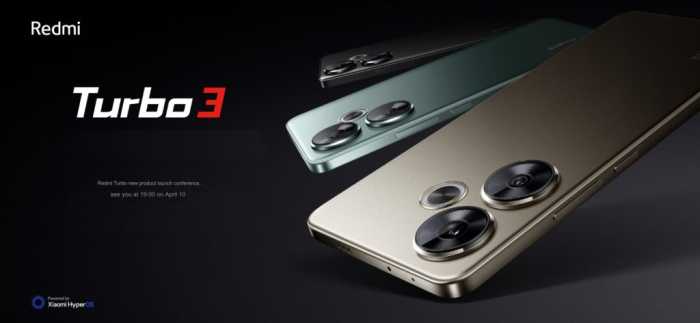

The landing page on Xiaomi China’s website confirms that the Redmi Turbo 3 will go on sale in China on April 10 at 7:00 p.m. local time. This phone has three colors: black, green and gold. On the back there are two camera sensors in addition to a ring-shaped flash unit. The power button and volume control button are located on the right edge of the phone.
Meanwhile, an official post on Weibo reveals that the Redmi Turbo 3 will feature a flat display with narrow bezels and a central cutout for the front camera. Several other official posts suggest that the upcoming phone will be 7.8mm thick and weigh 179g and the top-end model will come with 16GB of RAM and 1TB of internal storage. It should also be able to run Xiaomi’s HyperOS out of the box.
The company has confirmed that the Redmi Turbo 3 will launch alongside the Redmi Pad Pro. The tablet comes in three colors and features a 12.1-inch 2.5K display and a 10,000mAh battery. This tablet complements the Redmi Pad launched in 2022. It is also confirmed that the next model will be equipped with Xiaomi’s HyperOS. The Redmi Turbo 3 landing page also announces the launch of Xiaomi’s open headphones.
Previous leaks suggested that the Redmi Turbo 3 could feature a 6.78-inch 144Hz 1.5K OLED display and a 6,000mAh battery with support for 80W wired fast charging. It was also suggested to be launched outside China as Poco F6.

Bhupendra Singh Chundawat is a seasoned technology journalist with over 22 years of experience in the media industry. He specializes in covering the global technology landscape, with a deep focus on manufacturing trends and the geopolitical impact on tech companies. Currently serving as the Editor at Udaipur Kiran, his insights are shaped by decades of hands-on reporting and editorial leadership in the fast-evolving world of technology.