

Mumbai-Ahmedabad Bullet Train: Power Supply to Begin on Surat-Bilimora Section from November 20

November 18, 2026 (Udaipur Kiran): India’s ambitious Mumbai-Ahmedabad bullet train project is set to achieve another major milestone, with electricity supply scheduled to begin on the Surat-Bilimora section of the high-speed rail corridor from November 20.
The National High Speed Rail Corporation Limited (NHSRCL) shared the information on social media platform X on Wednesday, November 18. Electricity will be supplied through the Overhead Equipment (OHE) system.
The Surat-Bilimora section will be the first part of the 508-km Mumbai-Ahmedabad High-Speed Rail Corridor where the overhead power supply system will be activated. This marks an important step towards preparing the section for high-speed train operations.
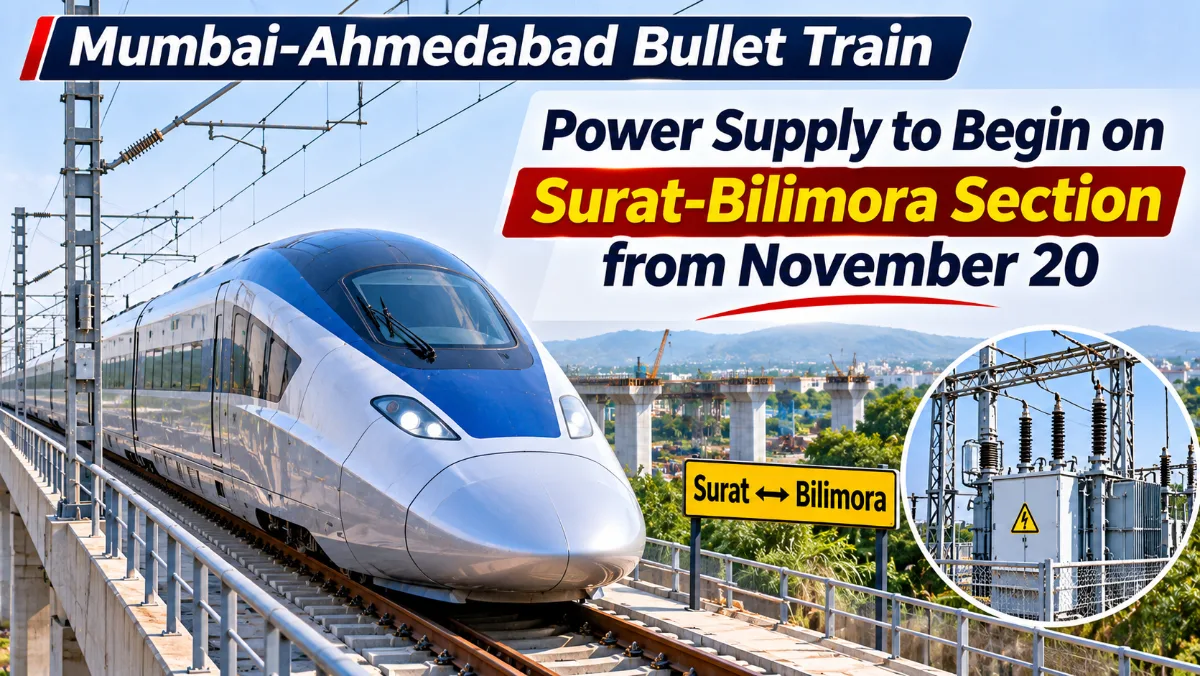
High-Voltage Power Lines to Be Activated from November 20
According to a safety advisory issued by the electrical department of NHSRCL, the 2 x 25,000-volt AC traction system on this section may be energised on or after November 20.
Once the power supply begins, the overhead wires must be treated as live at all times. The corporation has warned people against entering the section without authorisation.
Residents, passengers, construction workers and others have been advised to stay away from overhead electrical installations and avoid carrying out any unauthorised work near the wires. Contact with high-voltage lines can cause serious accidents.
How Will the Bullet Train Reach 320 Kmph?
The Mumbai-Ahmedabad bullet train corridor is being developed to support speeds of up to 320 kmph. An advanced overhead traction system is being installed to meet the electricity requirements of high-speed operations.
For the first time in India, this type of power supply arrangement is being introduced on a high-speed rail line. The bullet train will receive electricity from the national power grid through a dedicated network.
A total of 14 traction substations are being developed across the corridor, including nine in Gujarat and five in Maharashtra. These substations will receive electricity from the national grid and supply the power required for train operations.
31 Switching Posts to Support Uninterrupted Power Supply
The project will have 31 switching posts to manage the electricity network and isolate an affected section quickly in case of a fault. This arrangement is intended to improve the safety and reliability of the power supply system.
The corridor will also have 16 distribution substations. These will provide electricity to railway stations, signalling systems and maintenance facilities.
The electrical infrastructure will therefore support not only train operations but also other essential facilities across the high-speed rail network.
Around 22,000 Steel Masts to Be Installed
A large electrical infrastructure network is being developed along the corridor. Around 22,000 steel masts will be installed across a total network of 1,125 track kilometres, including the depot.
The steel masts will have heights ranging from 10.5 metres to 14.5 metres. They will support the overhead electrical system required for high-speed train operations.
Compound Catenary Technology to Be Used for the First Time in India
Another major feature of the project is the use of compound catenary technology. This system is being introduced for the first time on a high-speed rail corridor in India.
High-speed trains require a continuous and stable electricity supply. The technology is designed to support reliable power delivery even when trains operate at high speeds.
2 x 25 kV Traction System Across the Corridor
The entire 508-km Mumbai-Ahmedabad High-Speed Rail Corridor is being equipped with a modern 2 x 25 kV overhead traction system.
Under this arrangement, electricity will be supplied to trains through overhead wires. The 14 traction substations will receive power from the national grid and feed it into the overhead traction network.
A centralised control centre will monitor the electrical network to help maintain a safe and reliable power supply across the corridor.
Safety Advisory Issued for Residents and Workers
NHSRCL has issued a warning for people living near the corridor, passengers, construction workers and other individuals.
People have been advised not to approach or touch overhead electrical wires and not to carry out any unauthorised activity near the installations. Once the system is energised, the overhead wires will remain live and could cause serious accidents if approached.
Frequently Asked Questions
1. When will electricity supply begin on the Surat-Bilimora bullet train section?
Electricity supply is scheduled to begin from November 20, 2026.
2. Which organisation announced the power supply milestone?
The National High Speed Rail Corporation Limited (NHSRCL) announced the development.
3. Which section will receive power first?
The Surat-Bilimora section will be the first part of the Mumbai-Ahmedabad High-Speed Rail Corridor to have its overhead power supply activated.
4. What voltage system will be used for the bullet train?
The corridor is being equipped with a 2 x 25,000-volt AC overhead traction system.
5. What will be the maximum speed of the Mumbai-Ahmedabad bullet train?
The corridor is being developed to support train speeds of up to 320 kmph.
6. How many traction substations are planned for the project?
A total of 14 traction substations are planned, including nine in Gujarat and five in Maharashtra.
7. How many steel masts will be installed along the corridor?
Around 22,000 steel masts will be installed across 1,125 track kilometres, including the depot.
8. Why have people been advised to stay away from overhead wires?
The overhead wires will carry high-voltage electricity after energisation and can cause serious accidents if people approach or touch them.