

Mumbai–Ahmedabad Bullet Train to Pass Through 21-Km Tunnel, Including 7-Km Undersea Section

Mumbai, October 28, 2026 (Udaipur Kiran): India’s first bullet train project is set to showcase advanced engineering with a 21-km tunnel section in Maharashtra, including a 7-km railway tunnel beneath Thane Creek. The undersea section will connect Mumbai’s Bandra-Kurla Complex (BKC) station with the Shilphata area in Thane as part of the 508-km Mumbai–Ahmedabad High-Speed Rail Corridor.
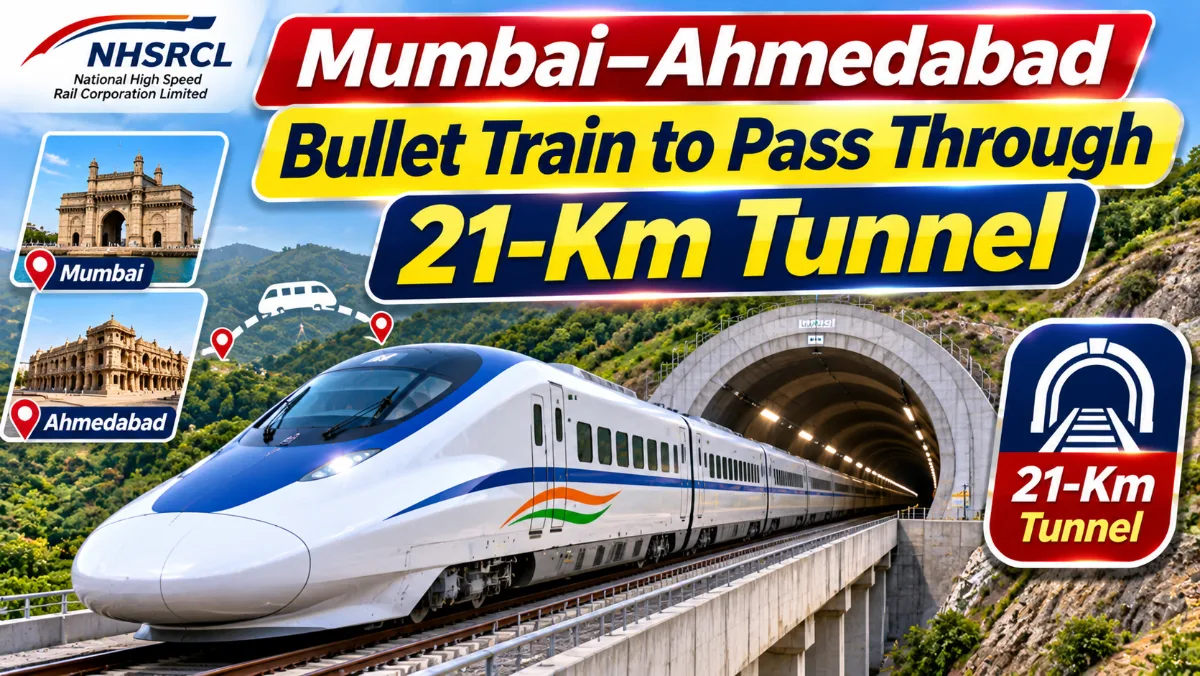
The tunnel is being constructed using advanced tunnelling technologies, including tunnel boring machines (TBMs) and the Austrian tunnelling method. The project is being developed by the National High Speed Rail Corporation Limited (NHSRCL) using Japan’s Shinkansen technology.
The first bullet train service on the corridor is expected to operate between Surat and Bilimora by August 15, 2027, while speed trials are expected to begin in May or June 2027, according to the supplied report.
Mumbai–Ahmedabad Bullet Train: First Undersea Railway Tunnel
The 21-km tunnel will run between BKC in Mumbai and Shilphata in Thane. It includes a 7-km section beneath Thane Creek, described in the report as India’s first undersea railway tunnel.
Of the total tunnel length, excavation for around 16 km is being carried out using tunnel boring machines. The remaining sections involve tunnelling through difficult geological terrain using the Austrian tunnelling method.
Two large tunnel boring machines are working on different sections. Excavation has begun from Vikhroli towards BKC, covering approximately 6 km. Another section is being excavated from Savli near Ghansoli towards Vikhroli, including the challenging stretch beneath Thane Creek.
Two Parallel Tracks Inside a Single Tunnel
The tunnel is being constructed as a large tube containing two parallel tracks for trains travelling in opposite directions. According to the report, it will pass approximately 25 to 55 metres below the ground and sea surface.
A major construction milestone has also been achieved between Ghansoli and Shilphata, where a breakthrough has been completed in a 4.8-km tunnel section.
The Mumbai–Ahmedabad corridor will have 12 stations: Mumbai BKC, Thane, Virar, Boisar, Vapi, Bilimora, Surat, Bharuch, Vadodara, Anand, Ahmedabad and Sabarmati.
Mumbai–Ahmedabad Bullet Train Project: Key Updates
The bullet train project is designed for a maximum operating speed of 320 kmph. The journey between Mumbai and Ahmedabad is expected to take approximately two hours and seven minutes once the relevant service is operational, according to the project details cited in the report.
Key figures include:
- Total corridor length: 508 km
- Tunnel section in Maharashtra: 21 km
- Undersea tunnel beneath Thane Creek: 7 km
- Designed maximum speed: 320 kmph
- Number of stations: 12
- Expected initial service: Surat–Bilimora section by August 15, 2027
- Expected speed trials: May or June 2027
Construction Progress Across Gujarat and Maharashtra
The report states that land acquisition for the project has been completed. Of the total 508-km corridor, civil construction work covering 459.90 km has been completed, while pillars have been erected along approximately 455 km of the route.
More than 366 km of elevated viaduct has also been constructed across Gujarat and Maharashtra.
In Gujarat, bridges have been completed over 18 of the state’s 21 rivers. Of the 28 steel bridges planned for the corridor, 16 have been completed, according to the report.
A 100-metre-long steel bridge weighing 1,405 tonnes has been constructed over National Highway 3 in Bhiwandi, Thane district.
At Vadodara, all 14 portal beams required to carry the bullet train viaduct over the busy Delhi–Mumbai railway line have been installed.
When Will Bullet Train Speed Trials Begin?
Union Railway Minister Ashwini Vaishnaw has said that speed trials for the first indigenously manufactured bullet train are expected to begin in May or June 2027, according to the report.
Special trainsets are also expected to be imported from Japan. The first service is projected to begin on the approximately 50-km Surat–Bilimora section by August 15, 2027.
The entire 508-km Mumbai–Ahmedabad corridor could become fully operational by December 2030.
Special Tunnel Technology to Control Pressure Waves
The project is using specialised engineering techniques for high-speed rail tunnels. Tunnel hoods are being introduced in India for the first time in a mountain tunnel as part of efforts to control pressure waves generated when high-speed trains pass through tunnels.
The technology is intended to reduce the sudden explosive sound that can occur when a train exits a tunnel at high speed.
These engineering measures are designed to support safe and efficient operations as trains travel at speeds of up to 320 kmph.
Indigenous B28 Trainsets Planned for the Corridor
Delays in the delivery of Japan’s Shinkansen E10 trainsets have led to a decision to use indigenously manufactured B28 trainsets, according to the report.
BEML has been awarded a rolling-stock supply contract worth ₹5,400 crore to support the development and supply of the trainsets.
The move is expected to support domestic manufacturing for India’s high-speed rail programme.
Bullet Train Stations to Feature Different Themes
Each of the 12 stations on the Mumbai–Ahmedabad corridor is being designed around a distinct theme reflecting the region it serves.
The Surat station draws inspiration from the city’s diamond-cutting industry and follows a diamond theme. Anand station reflects the region’s dairy heritage and the milk revolution associated with Amul.
Sabarmati station is planned as a multimodal transport hub, connecting the bullet train with other modes of transport.
The corridor passes through Maharashtra, Gujarat and the Union Territory of Dadra and Nagar Haveli, linking major cities and industrial centres along the route.
FAQ Section
1. How long is the tunnel on the Mumbai–Ahmedabad bullet train route in Maharashtra?
The tunnel section in Maharashtra is approximately 21 km long.
2. How long will the undersea railway tunnel be?
The tunnel beneath Thane Creek will be approximately 7 km long.
3. Which areas will the tunnel connect?
The tunnel will connect Mumbai’s Bandra-Kurla Complex station with the Shilphata area in Thane.
4. How many stations will the Mumbai–Ahmedabad bullet train corridor have?
The corridor is planned to have 12 stations, from Mumbai BKC to Sabarmati.
5. What will be the bullet train’s maximum speed?
The train is designed to operate at speeds of up to 320 kmph.
6. When are bullet train speed trials expected to begin?
Speed trials are expected to begin in May or June 2027, according to the report.
7. When could the first bullet train service begin?
The Surat–Bilimora section could begin operations by August 15, 2027, subject to project readiness.
8. When is the entire Mumbai–Ahmedabad bullet train corridor expected to become operational?
The full 508-km corridor could become operational by December 2030, according to the report.

Bhupendra Singh Chundawat is a seasoned technology journalist with over 22 years of experience in the media industry. He specializes in covering the global technology landscape, with a deep focus on manufacturing trends and the geopolitical impact on tech companies. Currently serving as the Editor at Udaipur Kiran, his insights are shaped by decades of hands-on reporting and editorial leadership in the fast-evolving world of technology.